
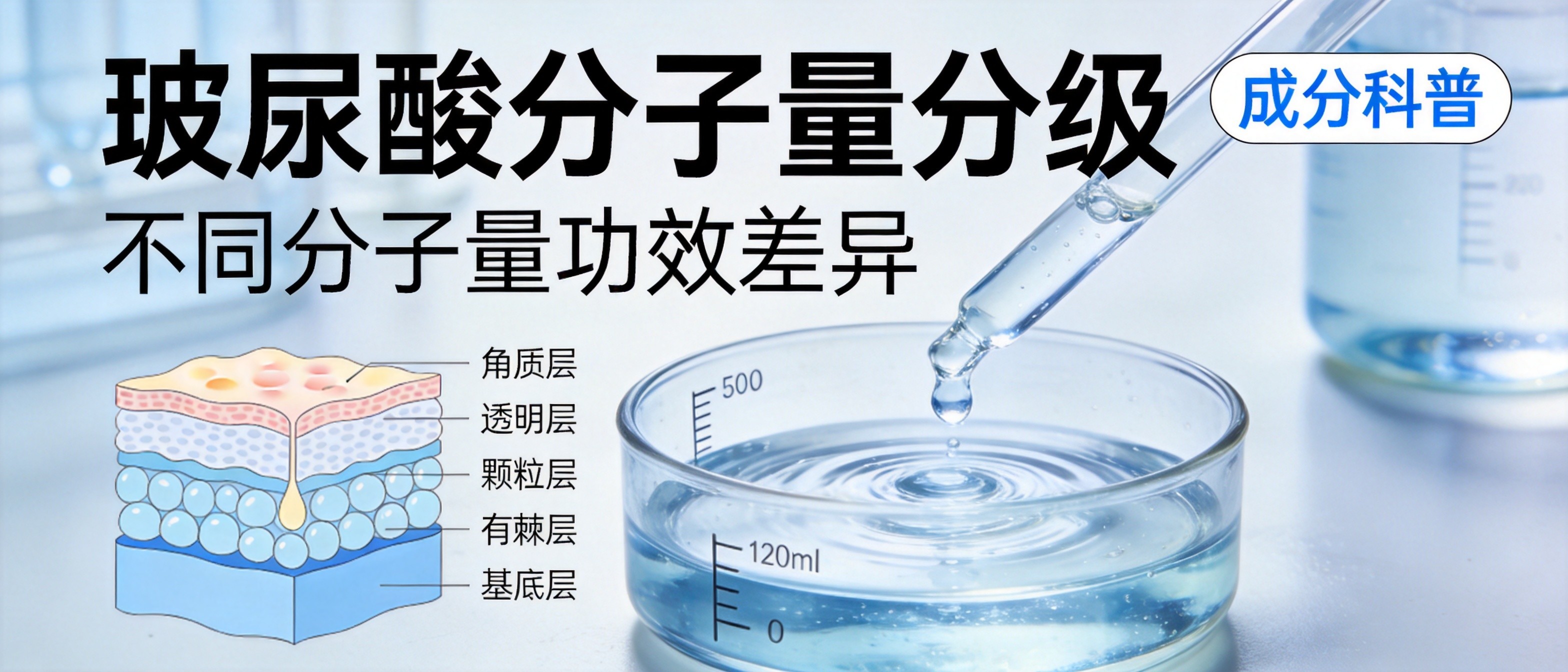
Hyaluronic Acid Molecular Weight Classification and Efficacy Differences: Practical Breakdown of Full-Scenario Applications from Injection to Facial Masks
Recently, while chatting with a few newly connected brand partners, I discovered a very typical cognitive blind spot: when "hyaluronic acid" is mentioned, many people's first reaction is "it's for hydration."
To be honest, that's both right and wrong. Hyaluronic acid (Sodium Hyaluronate) does hydrate, but its efficacy differences across molecular weights and application scenarios are so significant that they can determine whether a product actually works. The same hyaluronic acid: high-molecular-weight forms a film on the skin surface to lock in moisture, medium-molecular-weight penetrates the stratum corneum to hydrate, low-molecular-weight can reach the dermis, and oligomeric/ultra-low-molecular-weight can even repair the extracellular matrix.
This article thoroughly explains the molecular weight classification of hyaluronic acid, combining the inclusion of Sodium Hyaluronate in the 2026 version of the "Safety and Technical Standards for Cosmetics" and the "Catalog of Used Cosmetic Raw Materials (2021 Edition)," as well as several real formulations that Weptide has used in Class II medical device dressings and cosmetic registrations, to clearly tell brand partners "how to choose."
id="_4">VI. Final ThoughtsHyaluronic acid is an "old ingredient", but "old" does not mean "simple." Molecular weight classification, application scenarios, and formula combinations each have their nuances.
Weptide has mature hyaluronic acid application solutions across three product categories: Class II medical device dressings, cosmetic registrations, and lyophilized powder, with full-chain services from raw material selection, formula design, registration and declaration to mass production. If a brand partner has contract manufacturing needs for hyaluronic acid products, they can directly contact Weptide's business team for a solution assessment.
The next article will continue with ceramides—the "core lipids" for skin barrier repair, which are much more complex than hyaluronic acid.
References: - "Catalog of Used Cosmetic Raw Materials (2021 Edition)" - "Safety and Technical Standards for Cosmetics" (2022 Edition) - "Medical Device Classification Catalog" 2017 Edition (including 2023/2024 revisions) - YY/T 0606.9-2014 "Tissue-Engineered Medical Device Products: Sodium Hyaluronate" - National Medical Products Administration Cosmetics Regulatory APP filing data (January-June 2026)