
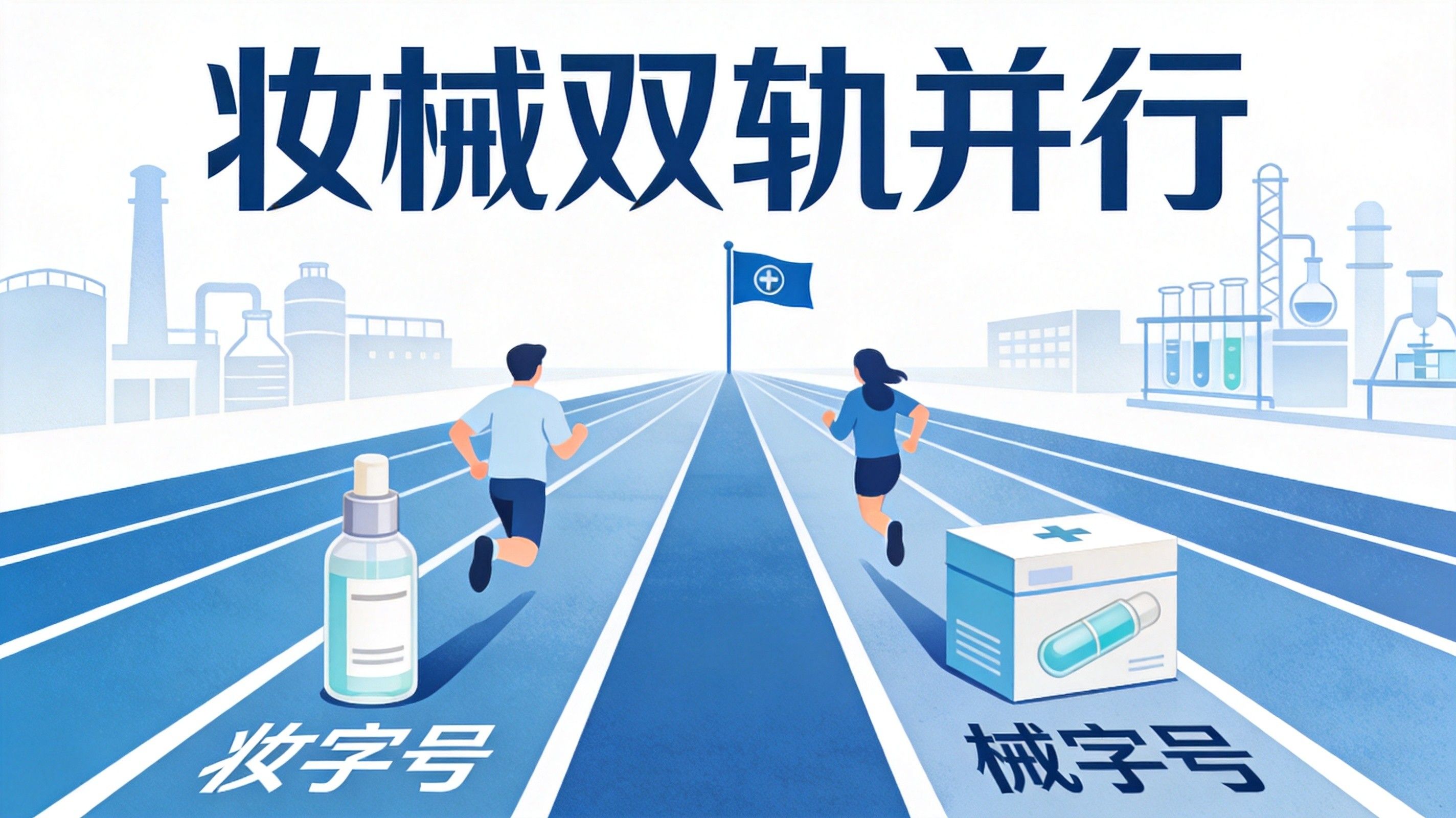
"Medical Device + Cosmetics" Dual-Track: 4 New Opportunity Points Brands Must Master in H2 2026
Recently, I've been chatting with several brand owners, and they're all asking the same question —
"We're currently doing cosmetics registration, should we add a medical device registration?"
"Is medical device registration 'more premium' than cosmetics registration?**"
"How do we handle dual qualifications, what's the cost, how much more can we sell?**"
In this article, I'll explain it thoroughly — based on the latest regulatory environment in 2026, NMPA approval data, and our Weptide practical case studies from H1.
1. Let's Clarify the Concepts First
Cosmetics registration — Cosmetic product filing. The regulatory basis is the "Regulations on the Supervision and Administration of Cosmetics" (implemented January 1, 2021). Regular skincare, masks, serums, and cleansers are basically all cosmetics registration.
Medical device registration — Medical device registration/filing. The regulatory basis is the "Regulations on the Supervision and Administration of Medical Devices" (implemented June 1, 2021). Medical dressings, repair patches, medical cold compresses, and Class II devices are all medical device registration.
Key differences between the two (the points brand owners most commonly confuse):
| Dimension | Cosmetics Registration | Medical Device Registration (Class II) |
|---|---|---|
| Regulatory Body | NMPA Cosmetics Supervision Department | NMPA Medical Device Supervision Department |
| Application Cycle | 3-6 months | 12-24 months |
| Application Cost | 0.5-20K RMB | 50-150K RMB |
| Testing Cost | 3-8K RMB | 10-30K RMB |
| Post-Market Surveillance | Post-filing surveillance | Continuous post-registration surveillance + re-registration (every 5 years) |
| Indication Claims | Cannot claim effects beyond "repair" or "soothing" | Can state "for post-operative wound care for XX" or "adjunctive care for XX symptoms" |
| Sales Channels | E-commerce, CS, KA, private domain | Pharmacies, medical aesthetics clinics, hospitals, some e-commerce (medical device sections) |
| Label Marking | National drug approval number / none | National medical device approval / imported medical device approval / provincial medical device approval |
Important reminder — Medical device registration is divided into Class I, Class II, and Class III. Class II is the most common type for medical device skincare products (medical dressings, repair patches, medical cold compresses), requiring provincial NMPA approval. Class III covers implantable products (injectable hyaluronic acid, injectable fillers, etc.), requiring national NMPA approval — these high-risk injectable products are outside the scope of today's discussion.
2. What's New in the Dual-Qualification Environment in 2026
1. Regulatory Level
- "Medical Device Classification Catalog" 2026 Edition (published by NMPA in December 2025, implemented in 2026) — simplified application materials for some Class II medical device registrations, some categories reclassified
- 78 new regulations published from January to June 2026 (Source: NMPA announcement compilation) — at least 6 directly impact medical device product applications
- Faster review times — average review cycle for Class II devices compressed from 14 months in 2024 to 10-12 months in 2026
2. Market Level
- NMPA approved 323 Class II medical device products in June 2026 (Source: NMPA June 2026 announcement) — a record high for a single month
- Of these, 41 related to recombinant collagen, 87 medical dressing products, 56 repair products — 184 in total across these three categories, accounting for 57% of all new Class II approvals that month
- Beauty salon channel rebounded 5%-8% in H1 — medical device + cosmetics combination products are the core driver
3. Consumer Perception Changes
- Consumers increasingly recognize the "medical device registration" concept — especially in repair, post-procedure, and sensitive skin scenarios
- Douyin/Xiaohongshu medical device registration buzz is up +47% year-over-year (Source: Qiangua Data June 2026 report)
- Average order value for medical device products is 30%-80% higher than cosmetics registration products — in the same category, products with medical device registration can be sold at higher prices
3. 4 New Opportunity Points
Opportunity 1: Cosmetics + Medical Device Combination Products ("Cosmetic-Medical CP")
Best suited for: Established brands with an existing cosmetics registration foundation
How to do it:
- Main product line (cosmetics registration) goes through e-commerce/retail channels
- Complementary medical device products (medical dressings/repair patches) go through medical aesthetics/pharmacy channels
- Both products share core ingredients, share brand story, share user recognition
Our OEM case of Shiwei Landai masks + Yian Biological recombinant collagen dressings is a typical example —
- Shiwei Landai Collagen Mask (cosmetics registration, Guangdong Cosmetics Filing No. 2025XXXXXX) sells on Tmall/Douyin
- Recombinant Collagen Repair Dressing (medical device registration, Hunan Medical Device Approval No. 20232140861) sells through beauty salon chains/pharmacies
- Both products share the "recombinant collagen" core ingredient and brand story
- Selling them together, promoting them as a set — customer repurchase rate increased by 25%
Key point: Cosmetics and medical device registrations must come from different entities (cosmetics registration under Guangzhou Weptide, medical device registration under Hunan Yian) — this is a hard regulatory requirement.
Opportunity 2: Upgrading from a Cosmetics-Only Brand to a "Dual-Qualification Brand"
Best suited for: Mid-sized brands with annual revenue of 50-200 million RMB
How to do it:
- Initial stage (0-6 months): Select 1-2 core products (repair, soothing, post-procedure) for medical device registration upgrade
- Growth stage (6-12 months): Launch medical device products, distribute through medical aesthetics channels
- Mature stage (12-24 months): Increase medical device product share to 20%-30%, increase average order value by 30%+
Cost breakdown:
- Single product medical device application: 50-150K RMB (including testing fees)
- Full qualification infrastructure (including factory qualifications, testing capabilities): 0.5-2 million RMB
- Time cost: 12-18 months
Opportunity 3: Medical Device Registration as a Brand's "Trust Endorsement"
Best suited for: Emerging brands, startup brands
How to do it:
- Don't get medical device registration for the entire product line (too costly)
- Only get medical device registration for 1-2 core SKUs (e.g., an "emergency repair patch")
- Use it as the brand's "trust anchor" — tell consumers "our factory has medical device production capabilities"
- Display the medical device registration certificate on e-commerce product pages to build trust
A case we've seen:
- An emerging brand primarily promoted a cosmetics-registered mask (99 RMB/box)
- Paired with a medical device-registered "emergency repair patch" (128 RMB/box)
- At the top of the product page, they wrote "Factory holds Class II medical device production qualification" and displayed Yian Biological's registration certificate number
- Conversion rate increased from 1.8% to 3.2% — the power of medical device registration endorsement
Opportunity 4: Medical Device Registration + Medical Aesthetics Clinic Collaboration Model
Best suited for: Brands with medical aesthetics channel resources
How to do it:
- Customize medical device products (formula, specifications, packaging) for medical aesthetics clinics
- Medical aesthetics clinics act as "channel partners", brand acts as "supplier"
- Products carry the clinic's brand or dual branding — depends on the specific collaboration model
Profit margins:
- Ex-factory price of medical device dressings: 5-15 RMB/piece
- Medical aesthetics clinic retail price: 50-150 RMB/piece
- Brand gross margin: 30%-50%
- Clinic gross margin: 50%-70%
Both parties profit, and consumers find the pricing reasonable ("clinic-grade" products in medical aesthetics settings have premium pricing power).
4. 3 Most Common Pitfalls to Avoid
Pitfall 1: Thinking Medical Device Registration Can "Cure Everything"
The truth: Medical device registration is not a "more premium version of cosmetics registration". The "indications" for medical device products are clearly defined — you cannot claim medical aesthetics-level effects, you cannot claim XX effects, you can only say "for XX wound care". Overstating claims constitutes false advertising — at minimum you'll face fines, at worst your registration certificate will be revoked.
Pitfall 2: Thinking Any OEM Factory Can Produce Medical Device Products
The truth: Medical device registration requires high factory standards — you must have a medical device production license, you must have a Class 100,000+ cleanroom, you must have a dedicated production line. Cosmetics factories trying to convert to medical device production will fail 90% of the time.
Pitfall 3: Thinking Medical Device Approval Is Fast
The truth: Average review cycle for Class II devices is 10-12 months, Class III is 24-36 months. This is not something you can accomplish in 3-6 months. Brands must start planning 1-2 years in advance.
5. What We Can Offer
Weptide Group — 14 years of efficacy skincare OEM experience, dual qualifications in both cosmetics and medical device registration:
- Guangzhou Weptide Bio — Cosmetics registration and production (Guangdong Cosmetics 20160001)
- Hunan Yian Bio — Class II medical device production (Hunan Medical Device Production License No. 20230013)
- CMA/CNAS Dual-Certified Testing Center — self-testing and self-control, hassle-free applications
- 8 Class II medical device registration certificates obtained from 2024-2026 — including recombinant collagen, mussel adhesive protein, medical dressings, and more
Brand owners interested in learning how to implement the "dual-track" approach — you can schedule a visit to our Hunan Yian factory for an on-site inspection. Located in Changsha Huanghua District, 4,000 sqm of Class 100,000 cleanroom space, 4 medical device production lines — seeing is believing.