
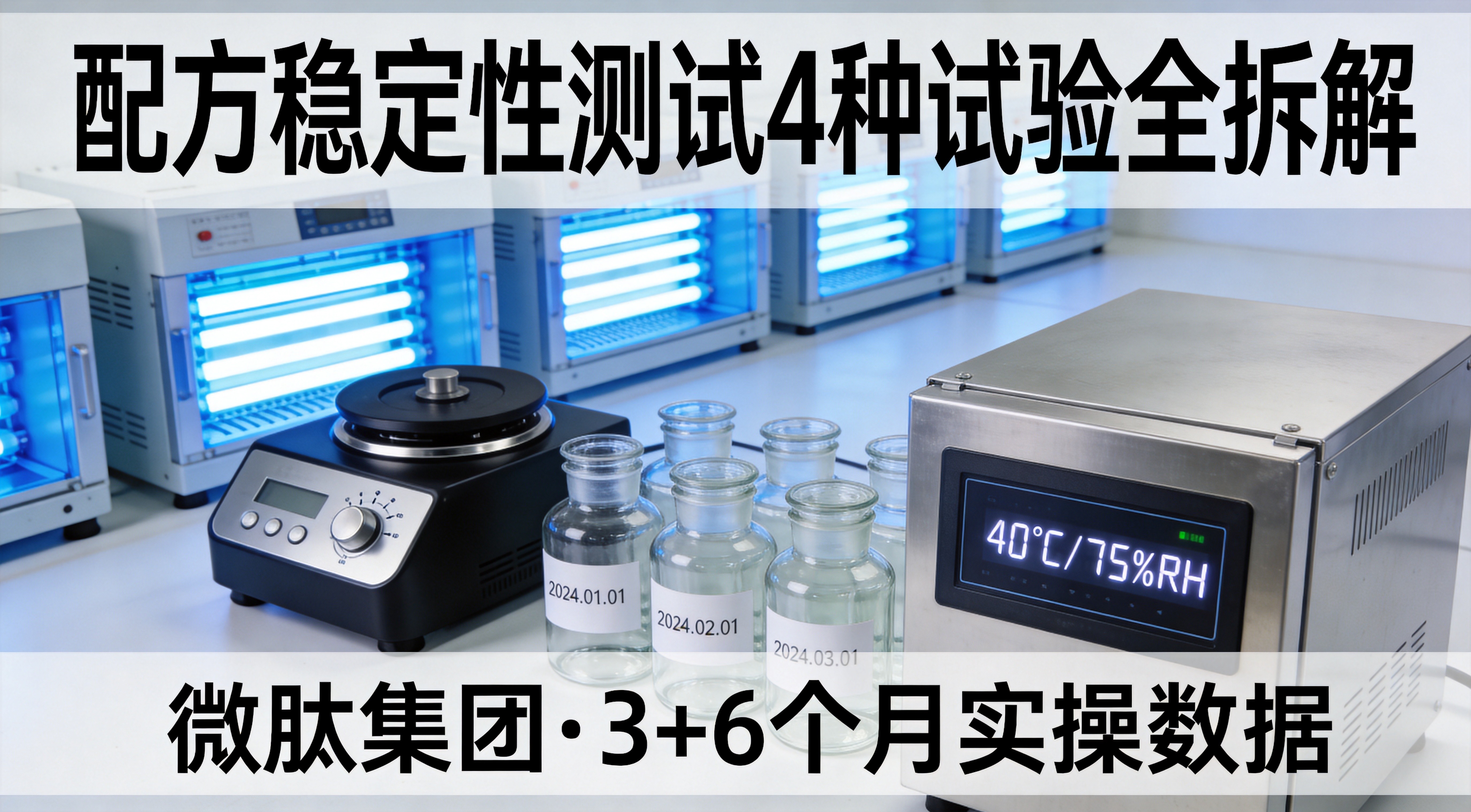
How to Test Skincare/Medical Dressing Formula Stability? Practical Design of 3-Month Accelerated + 6-Month Room Temperature Testing: Full Breakdown of 4 Tests Including Temperature/Light/Centrifugation/Freeze-Thaw Cycles
When discussing formula stability testing with several brand owners who have just started OEM manufacturing, I found that everyone tends to get stuck on the four questions of "what to test, how to test, how long to test, and where the pass line is." After asking around, I found two extremes: either "just leave it for three months, and if it hasn't changed, ship it" (testing without really testing anything), or blindly copying the SOPs of large manufacturers without understanding the meaning behind each test (testing without knowing what was actually tested).
This article breaks down the practical logic of formula stability testing for skincare/medical dressings. After reading it, you should be able to answer three things: which items need to be tested for formula stability, where the "pass line" is for each test, and why cosmetics OEM manufacturers need to test these.
1. What Exactly Does Stability Testing "Test"?
The essence of formula stability testing is to answer one question: "Can the product be used within its shelf life?"
Shelf life is generally calculated as 2-3 years. Cosmetics registration requires at least 3 months of accelerated stability data (for submission), while medical dressings registered as Class II medical devices require 6 months of accelerated + 12 months of long-term retention samples. The internal standard for OEM factories is 3 months accelerated + 6 months long-term retention samples — this is the "industry default threshold" verified through practical operation.
The 4 core questions that stability testing must answer: 1. Will the appearance change? (color, transparency, precipitation, separation) 2. Will the pH drift? (acid-base stability of the formula system) 3. Will the activity drop? (changes in the content of core active ingredients) 4. Will microorganisms grow? (is the preservative system truly effective)
2. The "4 Tests" in 3-Month Accelerated Stability Testing
Accelerated stability testing places the product in an environment "more severe than room temperature" and uses 3 months of data to project 2-3 years of shelf life performance. The 4 commonly used tests are:
Test 1: High-Temperature Test (40℃ / 75%RH 30 Days)
What it tests: The stability of the formula in a "Southeast Asian summer warehouse" environment How long: 30 days (some brands extend to 90 days) How many batches: At least 1 batch, 3 batches recommended Test items: Appearance, pH, content, microorganisms
Practical key points: - Temperature: 40℃±2℃ - Humidity: 75%RH±5% - Testing time points: Day 0, Day 15, Day 30 - Pass line: Activity retention ≥90% after 30 days, pH drift ≤±0.5, no change in appearance
Experience value: The 40℃ test is the minimum threshold for "whether the formula can survive summer." For formulas that cannot achieve ≥90% activity retention after 30 days at 40℃, it is recommended to directly redo the preservative system or adjust the pH.
Test 2: Light Exposure Test (4500Lux±500Lux 30 Days)
What it tests: The light stability of the formula in a "transparent packaging + window display" environment How long: 30 days How many batches: 1 batch is sufficient Test items: Appearance (focus on color changes), pH, content
Practical key points: - Light source: Cool white fluorescent lamp or equivalent light source - Illuminance: 4500Lux±500Lux - Testing time points: Day 0, Day 7, Day 15, Day 30 - Pass line: No visible color change after 30 days, activity retention ≥90%
Experience value: Light-sensitive active ingredients (such as retinol, vitamin C, kojic acid) must have light exposure data. Products with light-sensitive ingredients that haven't undergone light exposure testing will likely fail during their shelf life.
Test 3: Centrifugation Test (3000rpm 30 Minutes)
What it tests: The physical stability of the formula (whether emulsions will separate, whether suspension systems will precipitate) How long: 30 minutes How many batches: 1 batch Test items: Appearance (check for separation/precipitation)
Practical key points: - Speed: 3000rpm (or 4000rpm for stricter version) - Time: 30 minutes - Pass line: No visible separation, precipitation, or flocculation
Experience value: The centrifugation test is a quick test for "physical stability of the formula." 3000rpm for 30 minutes ≈ natural settling pressure of 12-18 months of shelf life. Emulsion formulas, powder-containing formulas, and formulas with plant extracts must undergo this test.
Test 4: Freeze-Thaw Cycle Test (-10℃/25℃ 5 Cycles)
What it tests: The stability of the formula under repeated switching between "cold chain transport/winter outdoor" and "indoor room temperature" How long: 5 cycles (24 hours per cycle) How many batches: 1 batch Test items: Appearance, pH, content
Practical key points: - Temperature switching: -10℃ (24h) → 25℃ (24h) counts as one cycle - Number of cycles: At least 3 cycles, 5 cycles recommended - Pass line: No crystallization, no separation after 5 cycles, pH drift ≤±0.5, activity retention ≥90%
Experience value: The freeze-thaw cycle test is a mandatory item for "water-based/essence formulas". Repeated freeze-thaw cycles in water-based formulas can produce ice crystals that destroy the system; formulas that cannot pass 5 cycles need to be re-adjusted.
3. 6-Month Room Temperature Retention Sampling: "Long-Term Observation"
What it tests: The long-term stability of the formula in a "real usage environment" How long: 6 months How many batches: 1 batch Test items: Appearance, pH, content, microorganisms
Practical key points: - Temperature: 25℃±2℃ - Humidity: 60%RH±10% (simulating shelf environment) - Testing time points: Day 0, Month 1, Month 2, Month 3, Month 6 - Pass line: Activity retention ≥90% after 6 months, pH drift ≤±0.5, no change in appearance, microorganisms compliant
Experience value: 6-month room temperature retention sampling is the "true passing line for the formula." There are plenty of formulas that pass 3-month accelerated testing but fail 6-month room temperature testing — accelerated testing always has deviations when projecting shelf life; room temperature data is the "real data".
4. Special Points in Stability Testing for Medical Dressings (Class II Medical Devices)
Medical dressings classified as Class II medical devices require 3 additional types of tests compared to cosmetics:
Special 1: Accelerated Aging Test
- Basis: YY/T 0681.1 Sterile Medical Device Packaging Testing
- Conditions: 55℃ for 7 days ≈ 1 year of shelf life (ASTM F1980 accelerated aging model)
- Test items: Packaging integrity, sealability, sterility
- Pass line: Sealability passes dye penetration test + sterility passes culture test
Experience value: The accelerated aging test is the key test for "whether the packaging can survive the shelf life." Products with substandard packaging may experience bag breakage or leakage after 2-3 years, leading to sterility failure.
Special 2: Low-Temperature Transport Test
- Basis: GB/T 4857 Packaging Transport Testing
- Conditions: -40℃ for 24h simulating extreme cold chain transport conditions
- Test items: Packaging integrity, product appearance
- Pass line: No bag breakage, no deformation, no leakage
Experience value: Medical dressings may encounter extreme low temperatures during transport, and -40℃ for 24h is a hard indicator of "whether it can survive northern winters".
Special 3: Compatibility Test
- Basis: GB/T 16886 Biological Evaluation of Medical Devices
- Conditions: Long-term contact between product + packaging materials (37℃ for 90 days)
- Test items: Dissolved substances from packaging materials, migrated substances, product changes
- Pass line: Dissolved substances meet standards, product shows no abnormalities
Experience value: Plasticizers and antioxidants in packaging materials may migrate into the product during long-term storage. The compatibility test answers "whether packaging + product can coexist long-term."
5. The "5 Common Pitfalls" in Stability Testing
Pitfall 1: Only Testing 3-Month Accelerated, Not 6-Month Room Temperature
Accelerated testing is about "projecting" shelf life, and projections have errors. Formulas that pass 3-month accelerated testing may fail at 6-month room temperature. If the budget allows, 6-month room temperature data is the "real data".
Pitfall 2: Incomplete Test Items
Many brands only test "appearance" and "content," but not pH and microorganisms. pH drift and microbial overgrowth are the two biggest killers of shelf life, and stability reports without pH and microbial data are "incomplete".
Pitfall 3: Using Only One Batch for Testing
Stability testing requires "at least 3 batches" — different batches, different raw material sources, different operators. Data from 1 batch cannot represent the true stability of the formula.
Pitfall 4: Ignoring "Extreme Conditions"
Using only 25℃ for room temperature retention sampling is incomplete. Real shelves may experience 40℃ summer warehouses, -10℃ winter transport, and window display lighting. If extreme conditions can't be passed, the product will likely fail after launch.
Pitfall 5: Unscientific Testing Time Points
Testing at Day 0, Day 30, Day 60 vs testing at Day 0, Day 15, Day 30 — the amount of information seen is completely different. Denser testing at key time points (Day 15/Day 30/Day 90) can identify stability issues earlier.
6. Final Thoughts
Formula stability testing is "the most easily overlooked yet most critical link in cosmetics/medical dressing OEM manufacturing." It seems like a matter of "just leaving it and testing it," but there are many nuances in actual operation.
To judge the stability testing level of an OEM factory, just look at three details: 1. Whether the test items are complete (4 items for cosmetics + 7 items for medical dressings) 2. Whether the testing time points are scientific (denser testing at key time points) 3. Whether the data covers 3 or more batches (single-batch data doesn't count)
If all three criteria are met, it shows that the OEM factory's stability data can withstand scrutiny. OEM factories that fail to meet these three criteria are most likely cutting corners on stability testing.
Weptide implements dual standards for cosmetics + medical dressings in formula stability testing, and core formulas have complete 3+6 month data archives. When brand owners are just starting OEM cooperation, it is recommended to require the OEM factory to provide the "full version" of stability data — 3-month accelerated with 4 tests + 6-month room temperature retention sampling + 3 batches of data.