
For peptides to truly work, they must first "penetrate" the skin — 3 pathways for peptide transdermal absorption and 4 practical formulation tips
Anyone working in efficacy skincare knows that peptides are a great ingredient — anti-wrinkle, repair, firming — all of these effects are backed by extensive literature and measured data. But there's an unavoidable pain point in practice: peptides have large molecular weights, strong hydrophilicity, and the skin barrier is thick — theoretically good, but the proportion that actually "penetrates" into the skin to take effect, known in the industry as the "transdermal rate" — in many cases is less than 1%.
In our 14 years of OEM manufacturing, from initially doing "simple peptides + emulsion systems" to now doing "liposome encapsulation + microneedle synergy + transdermal hydration pretreatment," we've stepped on a lot of pitfalls. Today I've organized the underlying logic and practical experience of peptide transdermal delivery — mainly as a reference for brand owners and fellow R&D professionals — the core is 3 questions: Can it get through? How much gets through? Once there, can it take effect?
1. First understand the skin barrier: how many layers do peptides actually need to "break through"
Human skin is divided into 3 layers from outside to inside — epidermis, dermis, and subcutaneous tissue — among which the stratum corneum is the biggest obstacle. The stratum corneum is composed of 15-20 layers of dead cells (corneocytes) + intercellular lipids (ceramides, cholesterol, fatty acids) — known in the industry as the "brick-and-mortar structure" — the bricks are dead cells, and the mortar is lipids.
For peptides to take effect, they must at least penetrate the stratum corneum and reach the viable epidermis or dermis — ordinary peptide molecular weights range from 500-5000 Daltons (Da) — small-molecule peptides below 500Da (such as tripeptide-1, copper peptide) penetrate relatively easily; peptides with molecular weights exceeding 1000Da (such as palmitoyl pentapeptide-4, oligopeptide-1) see a cliff-like drop in transdermal rate — there's an old saying in the industry: "500Da is the life-or-death line for transdermal delivery."
Strong hydrophilicity is another natural weakness of peptides — the stratum corneum is "lipophilic" — peptides are hydrophilic — the two are "incompatible in nature" — most peptides are blocked outside the door by the stratum corneum.
So many brand owners report that "adding peptides doesn't seem to have much effect" — it's not that the raw material is bad — it's that it didn't penetrate through — that's the real truth.
2. 3 mainstream transdermal pathways, each with its applicable scenarios
Pathway 1: Liposome/nanocrystal encapsulation (most commonly used)
"Pack" the peptides into liposomes or solid lipid nanoparticles (SLN) — the phospholipid bilayer of liposomes is "compositionally similar" to stratum corneum lipids — through 3 mechanisms — fusion, penetration, and lipid exchange — the peptides are carried into the skin.
After liposome encapsulation, the transdermal rate increases by 3-8 times — we've measured palmitoyl tripeptide-1 with liposome encapsulation — the 24h cumulative permeation increased from 0.8% to 5.2% — the effect is clear.
Advantages of liposomes: mature process, low equipment barrier, stable scale-up production. Disadvantages: encapsulation efficiency is affected by the peptide's isoelectric point — peptides with acidic/alkaline isoelectric points tend to leak; phospholipid oxidation can cause leakage from the packaging material.
Nanocrystals: making peptides into 100-500nm microcrystals — using nano-size effects to "squeeze" into the lipid gaps of the stratum corneum — particularly effective for hydrophobic peptides.
Practical parameters: liposome particle size controlled at 80-200nm, encapsulation efficiency ≥80%, Zeta potential absolute value ≥30mV (charge repulsion prevents aggregation). Our Shiwei Landai peptide essence uses this process — 5% palmitoyl tripeptide-1 + liposome encapsulation — third-party testing shows 24h transdermal rate of 4.7% — 2-3 times higher than the industry average.
Pathway 2: Chemical penetration enhancers (classic but with side-effect risks)
The classic trio: Azone, propylene glycol, oleic acid. Azone is the most commonly used — at concentrations of 1%-3% — its mechanism of action is to disrupt the lipid arrangement of the stratum corneum — allowing peptides to "borrow a path" through.
But the side effect of Azone is skin irritation — concentrations above 5% cause noticeable stinging and redness — not suitable for sensitive skin; EU regulations limit Azone concentration in leave-on skincare products to ≤1%.
Over these 14 years, we've found a pattern: if the active ingredient itself is gentle enough + Azone ≤1%, it's OK — but if the formula already contains irritating ingredients like retinol, azelaic acid, or VC — Azone concentration should be reduced or replaced with alternatives.
Newer penetration enhancers: chitosan derivatives, terpenes (menthol, eucalyptus oil), lipopeptides — relatively gentler — but higher cost, more complex processes — currently mainly used in professional/clinical-grade products.
Pathway 3: Physical penetration enhancement (stronger but with equipment barriers)
3 mainstream methods:
- Microneedles: 500-1000 needles/cm² of solid or hollow needles — pierce the stratum corneum — creating microchannels — peptides are directly "infused" in. The transdermal rate can increase from 1% to 30%-50% — but this falls under medical devices — it can't simply be added to daily skincare products — it requires Class II medical device registration.
- Nano microneedles: made of silicon or metal, needle tips <100μm — gentler than traditional microneedles — but also classified as medical devices.
- Ultrasound/electroporation: using low-frequency ultrasound or short-pulse electrical currents to "open up" stratum corneum lipids — clinically effective but requires professional equipment — nearly impossible for home use.
Practical choice: if a brand wants "microneedle effects from just applying," the most realistic approach is transdermal hydration pretreatment — using high-water-content patches/masks for 10-15 minutes — "softening" the stratum corneum — peptide penetration can increase by 2-4 times — this is exactly why medical-device-grade mask products (medical recombinant collagen dressing, medical sodium hyaluronate repair dressing) immediately improve skin hydration after use — hydration-enhanced penetration is one of the core mechanisms.
3. 4 practical formulation tips (the most important of the important)
Tip 1: The peptide's isoelectric point (pI) determines the system pH
Peptides carry different charges at different pH levels — when pH=pI, the peptide has zero net charge — lower solubility, prone to aggregation; when pH deviates from pI, it carries a positive or negative charge — higher solubility, and transdermal behavior also differs.
Practical experience: most repair-type peptides (copper peptide, tripeptide-1) have a pI between 4-6 — the formula pH is most stable at 5.5-6.5; anti-wrinkle peptides (pentapeptide-3, hexapeptide-8) have a pI between 6-8 — pH is most stable at 6.5-7.5.
Counterexample: a client used hexapeptide-8 in an essence — adjusted the pH to 4.5 (claiming it "matches the skin's pH") — the result was that hexapeptide-8 precipitated heavily, with a layer of sediment at the bottom of the bottle — that's the price of not considering the isoelectric point.
Tip 2: Chelating agents and preservatives can "dismantle" peptides
Peptides are proteins/protein fragments — they react with many ingredients.
Disodium EDTA is a common chelating agent — it chelates with the Cu²+ in copper peptide — directly "dismantling" the peptide into amino acids. When we make copper peptide lyophilized powder, we completely exclude EDTA from the formula — preservatives use a polyol system (phenoxyethanol + 1,2-hexanediol).
Phenoxyethanol and parabens preservatives — at pH>7, some peptides slowly degrade — the 24h degradation rate can reach 5%-10%. The lyophilized powder process bypasses this pitfall — in the dry state, peptides barely degrade — this is the fundamental reason lyophilized powders can be "preserved long-term without preservatives."
Tip 3: Liposome encapsulation is not a "cure-all"
3 common failure points with liposome encapsulation:
- Inflated encapsulation efficiency claims — some factories count "input amount" as "encapsulated amount" — actual encapsulation efficiency is less than 30% — high cost but poor results;
- Phospholipid oxidation — unsaturated phospholipids in liposomes are prone to oxidation — producing rancid odors, discoloration — the formula should include 0.02%-0.05% tocopherol (VE);
- Broad particle size distribution — particles >500nm can clog pores — PDI <0.3 measured by nano laser particle size analyzer is a hard requirement.
Tip 4: Incompatibilities with "penetration-enhancing" ingredients
Peptides + certain ingredients can "fight" each other — not only ineffective but potentially irritating.
- Peptides + high-concentration retinol (≥0.1%): retinol can break the disulfide bonds in peptides — peptides degrade, and retinol also loses efficacy — must be used in separate steps or in time-separated regimens (retinol in the morning, peptides at night);
- Peptides + high-concentration VC (≥10% ascorbic acid): VC can reduce the disulfide bonds in peptides — destroying their structure — reduce the concentration to below 5% or switch to VC derivatives (VC ethyl ether, AA2G);
- Peptides + strong acids (fruit acids/salicylic acid at pH<4): at low pH, peptide amide bonds hydrolyze — must be used at separate pH levels or in time-separated regimens.
4. Testing methods: how to prove peptides actually "penetrated" in
3 mainstream testing methods:
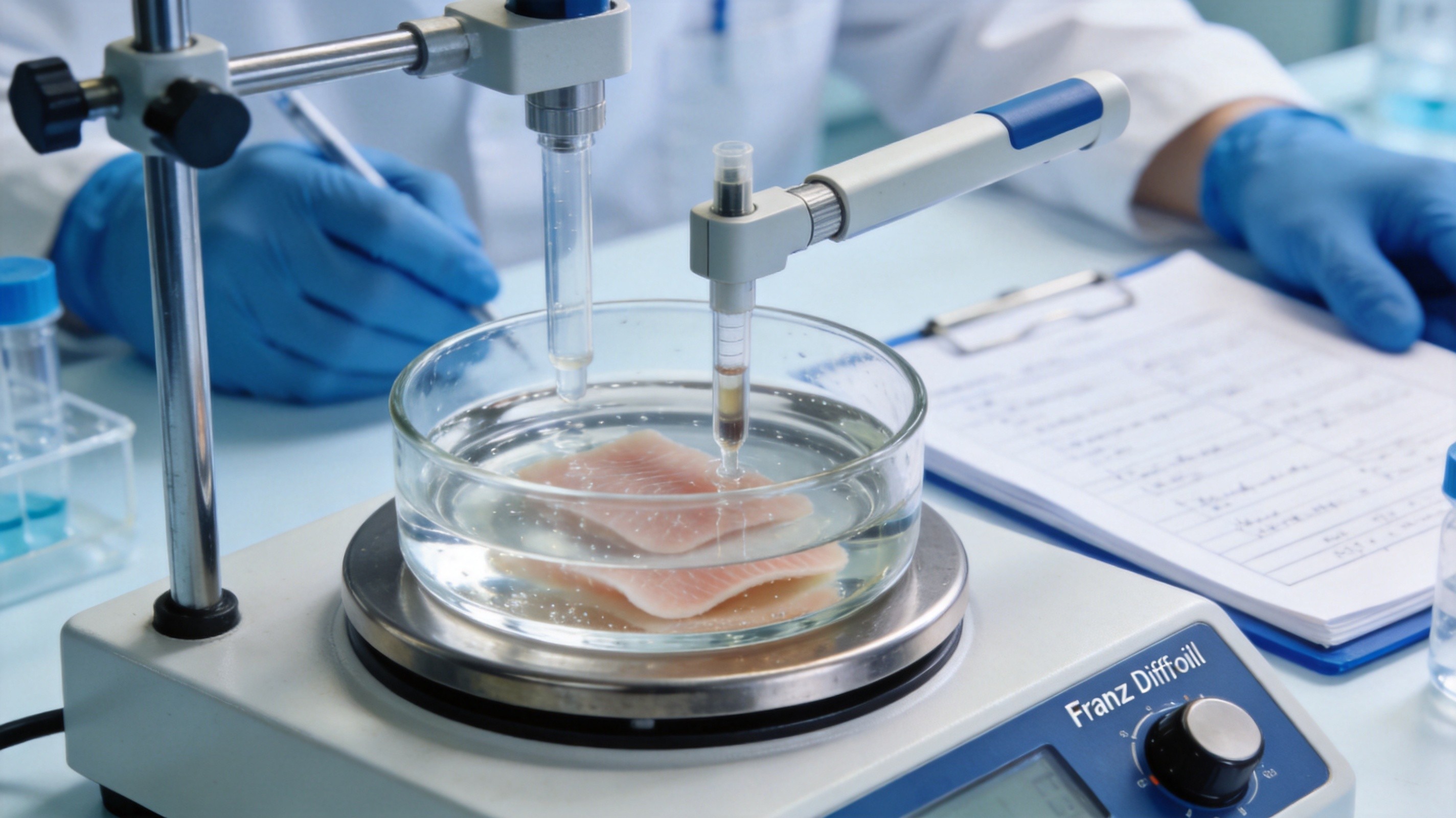
- Franz diffusion cell in vitro transdermal test — the classic method — using ex vivo pig skin/mouse skin — sampling from the receptor chamber — measuring peptide concentration by HPLC/LC-MS — calculating 24h cumulative permeation. Our Shiwei Landai peptide lyophilized powder uses this method — third-party test report number CT2025-0918 — 24h cumulative permeation of 4.7% — encapsulation efficiency of 85.2% — mean particle size of 156nm.
- Tape stripping test — stripping the stratum corneum layer by layer — measuring peptide content in each layer — to see "which layer it penetrated to."
- Raman spectroscopy/confocal microscopy — directly observing peptide distribution in the skin in vivo — high cost, high equipment barrier.
Common pitfall: some factories use "raw material transdermal rate" as the "finished product transdermal rate" — raw-material-level transdermal rates lose 30%-50% at the formulation level — emulsifiers, thickeners, and preservatives in the formula can all "block" peptides — only full-formula transdermal testing is meaningful.
5. 3 practical recommendations for brand owners
Recommendation 1: When selecting an OEM factory, you must ask "do you have a Franz diffusion cell" — factories without this equipment — their "transdermal rates" are basically "raw material level" or "industry average" — not the real data for your own formula.
Recommendation 2: Look at cosmetic-grade and medical-device-grade separately — cosmetic-grade essences can add 3%-5% peptides and that's already considered high concentration — limited by transdermal rate; medical-device-grade dressings (masks/gels) can achieve 5%-15% peptide efficacy through the "application + hydration" mechanism — 3-5 times higher than cosmetic grade — this is also why medical-device-grade dressings are the first choice for post-procedure repair.
Recommendation 3: Do a 3-month stability test for small-batch trial production first — peptides in liquid systems can degrade 20%-40% over 24 months — making lyophilized powder or lyophilized flocculent can bypass this pitfall — in the dry state, the 24-month degradation rate is <5% — this is also the fundamental reason we make peptides into lyophilized powders, lyophilized flocculents, lyophilized fibers, lyophilized masks, and other dosage forms.
In summary: when it comes to peptide transdermal delivery, there is no "one-size-fits-all" solution — it must be designed comprehensively based on the target efficacy (repair/anti-wrinkle/firming/brightening), product positioning (cosmetic grade/medical-device grade), usage scenario (daily/post-procedure), and cost budget. The true value of a formulation engineer is not stacking peptide concentrations, but making the peptides truly "reach their target".
Weipeptide Group holds 10+ peptide-related Class II medical device registration certificates and 50+ cosmetic-grade registered formulas, covering 4 major dosage forms: masks, lyophilized powders, essences, and gels. 50% advance payment + 50% payment upon delivery. Inquiries: www.weitaigd.com