
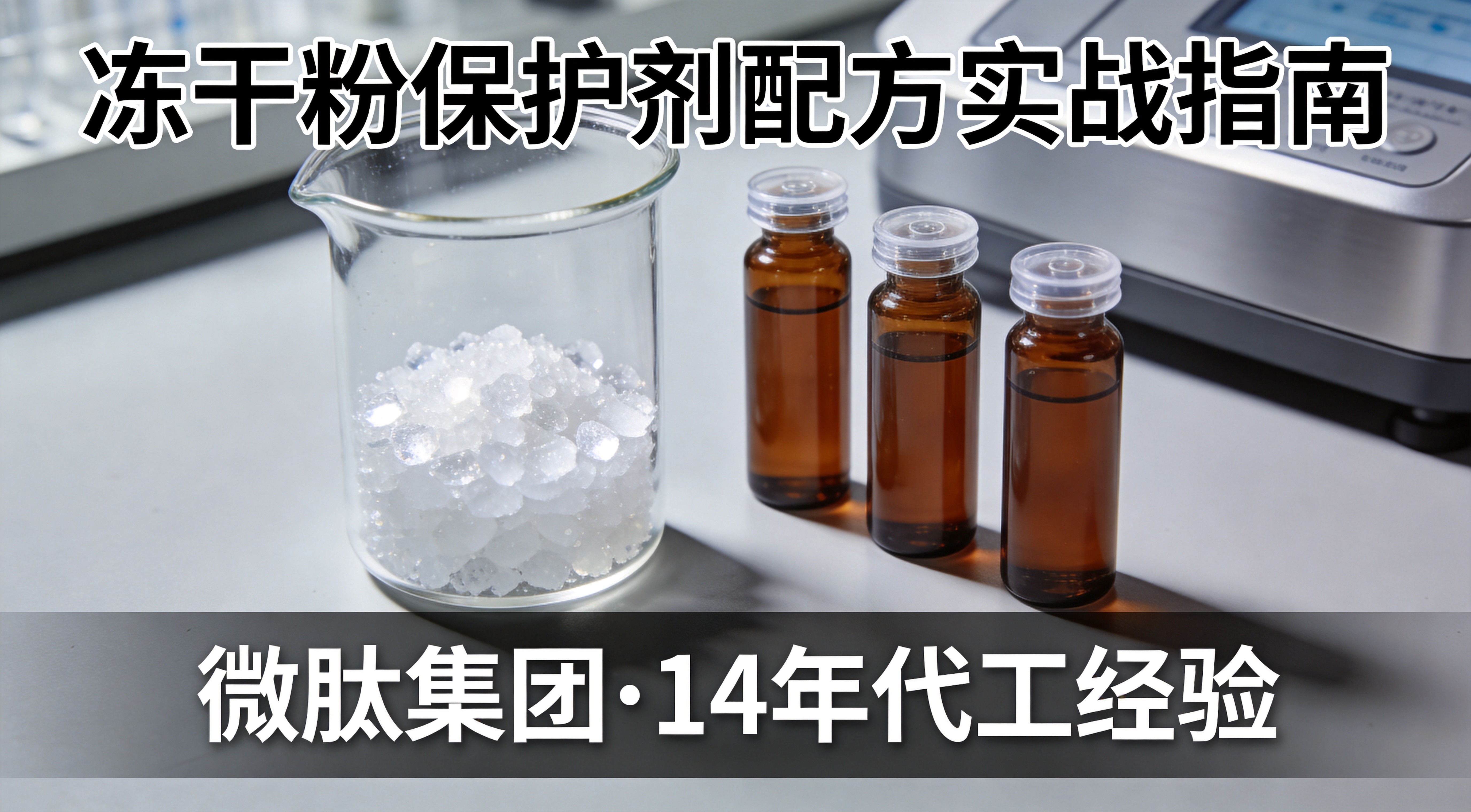
How to Formulate Lyophilized Powder Protectants? Practical Logic of 5 Common Protectants: Trehalose/Mannitol/Sucrose/Dextran/PVP
Recently, I talked with several brand owners who are just starting out with lyophilized powder OEM manufacturing. I found that the place where everyone gets "stuck" most easily is not lyophilizer selection, not aseptic filling, not registration filing—it's how to formulate the protectant.
After asking around, I found that the protectants used in lyophilized powder formulations in the industry are just a few: trehalose, mannitol, sucrose, dextran, and PVP (polyvinylpyrrolidone). But with the same raw materials, the product stability produced by different OEM factories varies enormously. Some lyophilized powders reconstitute in 3 seconds with over 90% activity retention; others take 1 minute to reconstitute with activity dropping to 60%. Where exactly is the difference? In plain terms, it's the expertise in protectant combination and dosage.
This article breaks down the practical logic of lyophilized powder protectants clearly. After reading it, you should be able to answer three things: how many types of protectants there are, what each one does, and how brand owners can judge whether an OEM factory's protectant formulation is truly "stable."
I. What Exactly Are Lyophilized Powder Protectants "Protecting"
Lyophilized powder is made by first freezing the liquid formulation into ice, then sublimating the ice directly into water vapor under vacuum conditions.During this process, the active ingredients (proteins/peptides/collagen/PDRN) must pass through three hurdles: "freezing-dehydration-reconstitution". Each hurdle "harms" the active ingredients:
- Freezing hurdle: When water freezes, it expands in volume, which can "squeeze and deform" the protein molecular structure, destroying the active conformation
- Dehydration hurdle: After ice sublimation, active ingredients are directly exposed to air, and the hydrogen bond network originally maintained by water molecules breaks
- Reconstitution hurdle: Dried active ingredients are added back to water and must "quickly, uniformly, and completely" restore their original conformation
The role of protectants is to replace water molecules during the freezing and dehydration process to "hold onto" the structure of active ingredients, keeping them stable in the dried state. When reconstituted, water molecules "seamlessly connect" back, and activity is preserved.
II. The "Division of Labor" of 5 Common Protectants
1. Trehalose—"The All-Rounder"
Trehalose is a non-reducing disaccharide formed by two glucose molecules linked via an α,α-1,1 glycosidic bond. Its special feature is that it can form a "glassy state" layer wrapping around protein molecules in the dried state, like putting a transparent protective suit on the active ingredient.
Practical points: - Common concentration: 2%-5% - Advantages: High glass transition temperature (Tg) (>100°C), good drying stability; non-reducing, does not participate in Maillard reactions - Disadvantages: High unit price (5-10 times that of ordinary sugars)
Experience value: Trehalose is the "foundation grade" protectant for lyophilized powders—almost all lyophilized powder formulations contain it. If the budget allows, trehalose is the recommended option.
2. Mannitol—"The Skeleton Builder"
Mannitol is a six-carbon sugar alcohol with good water solubility. During lyophilization, it forms a rigid "skeleton" that supports the cake structure.
Practical points: - Common concentration: 1%-4% - Advantages: Supports cake formation, the cake does not collapse or shrink after lyophilization; low unit price - Disadvantages: Limited protective capability for activity when used alone; mainly serves a "skeleton" role
Experience value: Mannitol doesn't "protect activity"—it "props up the cake." Combining it with trehalose gives more stable results—trehalose protects activity, mannitol holds the shape.
3. Sucrose—"The Classic"
Sucrose is a reducing disaccharide and is also considered a "veteran" in lyophilized powders. It has a high glass transition temperature (Tg around 65-70°C) and is cheaper than trehalose.
Practical points: - Common concentration: 1%-3% - Advantages: High Tg, good activity protection capability; cheaper than trehalose - Disadvantages: It is a reducing sugar that participates in Maillard reactions, which accelerates browning and degradation of protein/peptide active ingredients
Experience value: Sucrose can replace part of the trehalose to reduce costs, but formulations containing proteins/peptides/collagen should be used with caution—Maillard reactions will "consume" activity, and over time the product turns yellow and activity declines.
4. Dextran—"The Polymer"
Dextran is a high-molecular-weight polysaccharide with molecular weights ranging from 10,000 to 200,000 Da. In lyophilized powders, it mainly serves "dispersion" and "water retention" functions.
Practical points: - Common concentration: 0.5%-2% - Advantages: Large molecular weight, prevents protein molecules from aggregating during freezing; forms a "skeleton" during reconstitution that accelerates dissolution - Disadvantages: Molecular weight selection requires care—too high increases solution viscosity and affects filtration; too low reduces protective effectiveness
Experience value: Dextran's "special trick" is improving the reconstitution speed of the cake. If a lyophilized powder reconstitutes slowly, it's most likely because dextran is missing from the formulation.
5. PVP—"The Quick-Dissolve Specialist"
PVP (polyvinylpyrrolidone) is a synthetic polymer with molecular weights ranging from a few thousand to several hundred thousand Da. In lyophilized powders, low-molecular-weight PVP K15 and K30 are used as "solubility enhancers".
Practical points: - Common concentration: 0.5%-2% - Advantages: Extremely fast reconstitution speed, solves the problem of "lyophilized powder won't dissolve no matter how long you shake it" - Disadvantages: Excessive dosage makes the lyophilized powder "too hard"—the cake becomes dense, and reconstitution actually takes longer as it slowly dissolves
Experience value: PVP is the "first-aid remedy" for lyophilized powder reconstitution. When reconstitution speed doesn't meet the standard, adding 0.5%-1% PVP K15 basically solves it.
III. The "Golden Combinations" of Protectant Formulation
In practice, protectants are never used "one at a time"—they are basically compounded in 2-3 combinations. Here are several combinations commonly used by OEM factories:
| Combination | Applicable Scenario | Reference Ratio |
|---|---|---|
| Trehalose + Mannitol | Most lyophilized powders (collagen, peptides, PDRN universal) | Trehalose 3% + Mannitol 2% |
| Trehalose + Mannitol + Dextran | Formulations with high protein content (recombinant collagen lyophilization) | Trehalose 2% + Mannitol 2% + Dextran 1% |
| Sucrose + Mannitol + PVP | Cosmetic-grade lyophilized powders (without active proteins) | Sucrose 2% + Mannitol 2% + PVP 1% |
| Trehalose + PVP K15 | Lyophilized powders emphasizing "3-second instant dissolution" | Trehalose 3% + PVP 0.5% |
Key principles: 1. Use at least 2 protectants in combination—a single protectant can hardly withstand the lyophilization process 2. Total concentration should be controlled at 3%-8%—too low means insufficient protection; too high makes lyophilization difficult and reconstitution slow 3. Avoid sucrose in formulations containing active proteins (Maillard reactions) 4. Add PVP for instant dissolution emphasis; add trehalose + dextran for stability emphasis
IV. 3 Pitfalls Brand Owners Easily Fall Into
Pitfall 1: Higher Protectant Concentration Is Always Better
Wrong. Total protectant concentration exceeding 8% slows down the lyophilization process (slower water sublimation), makes the cake too dense (slow reconstitution), and drives up costs.
Practical experience: Total concentration controlled at 3%-6% is the most economical and stable.
Pitfall 2: Copying "Celebrity Formulations"
Many brand owners see a best-selling lyophilized powder go viral and directly copy its protectant formulation. But different active ingredients have different optimal protectant combinations—the "four major families" of recombinant collagen, peptides, PDRN, and hyaluronic acid each have different optimal formulations.
Experience value: Protectant formulations must be "tailored to the specific case"—determined based on the active ingredient's molecular weight, isoelectric point, and stability data.
Pitfall 3: Ignoring the "Reconstitution Speed" Indicator
Many OEM factories only test "activity retention rate" and don't test "reconstitution speed." Reconstitution speed directly determines the consumer's user experience—shaking for 30 seconds versus shaking for 3 minutes makes a huge difference.
Practical standard: Lyophilized powder reconstitution speed ≤30 seconds to completely clear and transparent is acceptable; ≤10 seconds is excellent.
V. Final Thoughts
Lyophilized powder protectant formulation is a "small formulation, big knowledge" matter. On the surface, it looks like just a combination of a few sugars and sugar alcohols, but the combination ratios, raw material sources, and process details all affect the final product's stability and reconstitution speed.
To judge an OEM factory's lyophilized powder formulation capability, just look at three indicators: 1. Accelerated stability: activity retention ≥90% at 3 months 2. Reconstitution speed ≤30 seconds 3. Cake appearance: dense, flat, uniform color, no collapse
If all three pass, the protectant formulation is solid. OEM factories that can't meet these three criteria are most likely cutting corners on the protectant.
Weptide has been in lyophilized powder OEM manufacturing for 14 years. Our protectant formulations cover the four major directions of recombinant collagen/peptides/PDRN/hyaluronic acid, and core formulations have all passed 3+6 months of accelerated stability verification. When brand owners first approach lyophilized powder OEM manufacturing, we recommend starting trial production with mature protectant combinations, and then making custom adjustments after the process is running smoothly.