
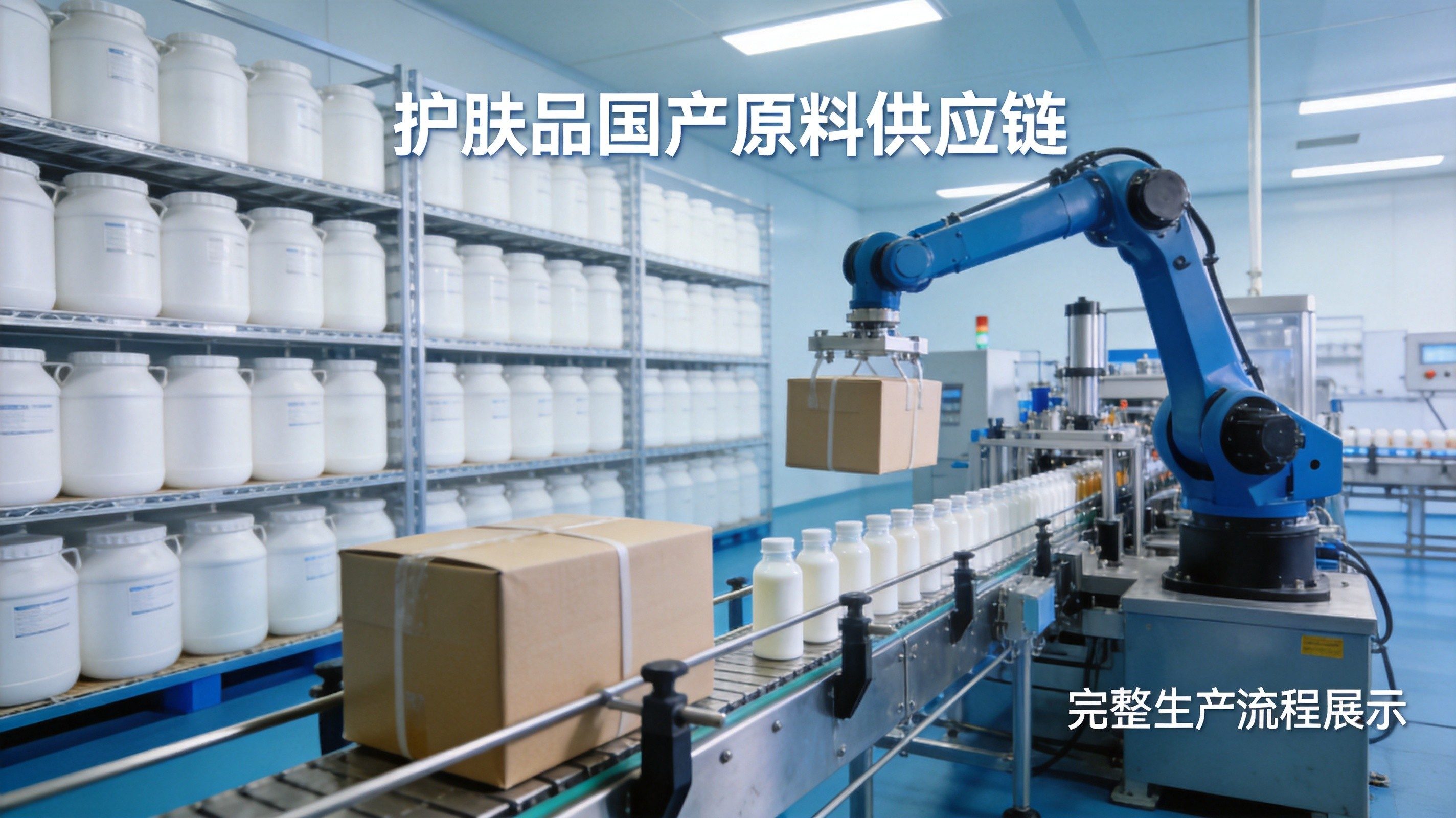
2026 Efficacy Skincare Supply Chain Domestic Substitution Enters Second Half: From Ingredients to Equipment, 5 New Opportunities for OEMs
Recently, while chatting with several brand owners, I found everyone asking the same question: "For efficacy skincare now, should we bet on imported or domestic ingredients?" Behind this question lies the most obvious trend in the entire efficacy skincare industry chain in 2026—domestic substitution moving from concept to implementation.
Here's a number to get a sense: according to data from the Industry Research Center of the China Fragrance and Cosmetics Association, imported high-end cosmetic ingredients account for over 70% domestically, with self-sufficiency of some core ingredients below 20%. But in Q1 2026, the National Medical Products Administration (NMPA) filed 50 new cosmetic ingredients, a year-on-year increase of 66.67%; in June alone, 23 new ingredients were filed, with domestic ones accounting for 78.3%. Put these two sets of data together, and you see the real rhythm of domestic substitution—import dependence hasn't changed, but the local supply side is catching up fast.
Today, let's break this down from the industry chain perspective and see what opportunities OEMs, brand owners, and ingredient suppliers each face.
I. Why 2026 Became the "Year of Accelerated Domestic Substitution"
This didn't happen suddenly; three variables are at play simultaneously in 2026:
Variable 1: Policy "hard evidence". On March 31, 2026, the State Council officially signed the "State Council Regulations on the Security of Industrial Chains and Supply Chains," incorporating the core supply chain issues of the beauty and health industry into national top-level design. This is the first time at the level of State Council administrative regulations that rules have been set for the autonomy and controllability of local ingredients.
Variable 2: Giant entrants. Previously, many cosmetic ingredient makers were small workshops unable to compete head-on with overseas giants. In 2026, this situation is broken—Wanhua Chemical directly invested in a 10,000-ton bio-based 1,3-butanediol plant, forcefully "taking back" this core moisturizing ingredient monopolized by foreigners, forcing overseas suppliers to cut prices.
Variable 3: Standard discourse power. On June 4, 2026, two ISO international standards for biomaterials (for recombinant collagen and silk fibroin) led by Chinese experts were officially approved. This means Chinese ingredients have upgraded from "product going global" to "standards going global."
With these three variables叠加, domestic substitution is no longer "empty slogans," but real substitution with policy, production capacity, and standards.
II. Three Questions Brand Owners Care Most About
On domestic substitution, brand owners actually have three unavoidable hurdles:
Question 1: Can domestic ingredients "beat" imported ones?
This depends on the category.
- Basic moisturizing/oils (e.g., glycerin, 1,3-butanediol, basic oils): Domestic products have fully substituted, 30-50% cheaper, with quality basically aligned
- Recombinant collagen/peptides: Domestic "triple helix structure" and "activity retention rate" have reached the global leading tier; ingredients from top companies like Giant Biogene, Jinbo Bio, and Juyuan Bio are reverse-procured by international brands
- Special actives/precision fermentation products: There's still a gap, but it's narrowing. At this stage, a hybrid formulation strategy is most stable—use imported for core actives, domestic for basic ingredients.
Question 2: Can domestic ingredient filing data be checked?
Yes. The NMPA's cosmetic new ingredient filing information platform publicly discloses all filing data (starting with "国妆原备字"), and each ingredient's filer, source, use, and safety monitoring period can be checked. As of the end of June 2026, a total of 119 new ingredients have been filed domestically, nearly double the same period in 2025.
Question 3: If domestic ingredients are used, can the product still "sell at a high price"?
This needs to be looked at separately. If the product positioning is "cost-effective"—domestic ingredients are actually an advantage (costs come down, profit margin remains). If the product positioning is "high-end"—the source of ingredients is not the deciding factor; the key is the "formula story" and "clinical evidence". Blockbuster products like Comfy and Winona—aren't they all made with domestic ingredients + domestic formulas + domestic factories? Whether it sells at a high price depends on brand power and efficacy evidence, not the word "imported".
III. 5 New Opportunities for OEMs
In the wave of domestic substitution, OEMs are actually underestimated players. Whoever can integrate "domestic ingredients + domestic processes + domestic registration certificates" can capture this wave of dividends. Specifically, there are 5 new opportunities:
Opportunity 1: "Domestic reshuffling" of the ingredient library
The core asset of an OEM is not equipment, but the formula library. In 2026, the OEM's formula library must shift from "mainly imported ingredients" to "domestic + imported hybrid."
Practical path:
- Review existing formulas, mark each ingredient's source, filing number, and supplier
- Find domestic substitutes one by one (focus on basic moisturizing/oils/recombinant collagen/peptides)
- Conduct stability testing (accelerated stability for 3 months + long-term retention observation for 6 months)
- Form a "domestic substitution list" for brand owners
Weitai's current formula library has already completed domestic substitution of basic ingredients; core actives like recombinant collagen, hyaluronic acid, ceramides, and mussel adhesive protein all have dual backups from domestic and imported suppliers. If a brand wants to create a "pride of domestic products" concept, we can provide a full-chain domestic solution.
Opportunity 2: "Collaborative application" for registration certificates
A more prominent advantage of domestic ingredients is high cooperativeness. Imported ingredient suppliers and brand owners are separated by national borders, with high communication costs and slow responses; domestic ingredient suppliers can collaborate with OEMs on joint R&D + joint registration.
Practical path:
- Ingredient supplier provides technical documents
- OEM provides formula and production process
- Brand owner provides product positioning and efficacy claims
- All three parties work together on product filing/registration to shorten the cycle
Opportunity 3: "Domestic upgrade" of medical device registration
In June 2026, the NMPA approved 323 medical device products in a single month, with domestic Class II certificates accounting for over 85%. This means the domestic substitution of medical device registration has been proven.
Opportunities for OEMs:
- Advance layout for medical device applications of core domestic ingredients (recombinant collagen, mussel adhesive protein, silk fibroin—these three major categories)
- Build full-chain capabilities from "ingredient-process-registration", handling everything from ingredient supply to obtaining certification and launching
- Serve brand owners with a dual domestic substitution solution of "medical device registration + domestic ingredients"
Opportunity 4: Small-batch "domestic trial production"
Domestic ingredients generally have lower minimum order quantities than imported ones (some start at 1-5 kg), especially suitable for small-batch trial production. OEMs can launch a "domestic ingredient small-batch exclusive production line"—accepting orders from 500-2,000 units, using domestic ingredients to lower per-unit costs.
Opportunity 5: Going global with "domestic standards"
This is a new opportunity that only emerged in 2026. As the ISO biomaterial standards led by China enter the substantive stage, the next 2-3 years will see a "standard dividend" for domestic ingredients/products going global.
What OEMs can do now:
- Follow international standard progress (focus on recombinant collagen and silk fibroin)
- Advance layout for registration pathways in Southeast Asia/Middle East/EU (find local agents/partners)
- Build dual-track capabilities of "Chinese standards + overseas registration"
IV. 3 "Pitfall" Warnings for OEMs
Now that opportunities are covered, let's talk about a few easy pitfalls:
Pitfall 1: Don't blindly go "all-domestic". Core actives (such as certain special peptides, precision fermentation products) still lag behind imports; forced substitution will affect product efficacy. A reasonable strategy is "domestic for basic ingredients + retain imports for core actives."
Pitfall 2: Don't just look at price. Domestic ingredients are generally 30-50% cheaper than imported ones, but cheap doesn't equal cost-effective. Some domestic ingredients, despite low prices, have inferior stability and batch consistency compared to imports, which in the long run actually raises overall costs.
Pitfall 3: Don't ignore the "safety monitoring period". Domestic new ingredients have a 3-year safety monitoring period, during which efficacy claims cannot be made in products. Using new ingredients still under monitoring for products—if problems are detected during monitoring, the entire product line may be recalled. When choosing domestic ingredients, prioritize mature ingredients that have passed the safety monitoring period.
V. Final Thoughts
Domestic substitution is not a passing trend; it is the main theme of the efficacy skincare industry chain for the next 5-10 years. In this transformation, OEMs are not supporting players but key midfield organizers—integrating ingredients, formulas, registration, and production to provide brand owners with an overall solution of "Chinese ingredients + Chinese processes + Chinese registration certificates."
Weitai has already laid out its strategy for domestic substitution in advance—the formula library has dual backups of domestic + imported for recombinant collagen, hyaluronic acid, ceramides, and mussel adhesive protein, over 110 Class II medical device registrations and filings are all based on domestic ingredients, and long-term cooperation has been established with top domestic ingredient suppliers like Giant Biogene, Juyuan Bio, and Freda.
The second half of domestic substitution is not about "who replaces whom," but "who can integrate well." OEMs with integration capabilities are the partners brand owners truly need.