

Collagen and ECM: Why Recombinant Collagen Has Become a Hot Trend
One-sentence direct answer: Collagen accounts for about 30% of total mammalian protein and is the most abundant structural protein in the ECM (extracellular matrix). Over the past two to three years, "recombinant collagen" has jumped from a skincare ingredient to a star raw material for Class III injectable devices. The core drivers are sequence homology reaching 99.7%, greatly reduced immunogenicity, a proven regulatory pathway (18 Class III certificates), and China's recombinant collagen market growing at a CAGR of about 44.93% from RMB 19.24 billion in 2022 toward RMB 219.38 billion in 2030. (Sources: MarketDataForecast, Frost & Sullivan/Jinbo Bio financial reports, 21st Century Business Herald)
1. The Role of Collagen in the ECM: More Than Just "Holding Things Up"
1.1 Collagen Is Not One Thing—At Least Distinguish Types I, III, and IV
There are 28 confirmed collagen types in vertebrates (I–XXVIII), assembled from 46 different α chains. In skincare and aesthetic injections, three types are most commonly encountered:
| Type | Where It Is Abundant | Function Keywords |
|---|---|---|
| Type I | Dermis, bone, tendon | Tensile resistance, volume support (80–85% of the dermis) |
| Type III | Fetal skin, blood vessels, internal organs | Related to wound repair; deposited in large amounts early in wounds |
| Type IV | Basement membrane | Forms a reticular scaffold, separating epithelium from dermis |
The most common confusion in skincare writing: simply equating "Type I = anti-wrinkle, Type III = repair." In reality, both coexist in the dermis. Type III increases in proportion early in wound healing, while Type I becomes dominant again in adulthood—so rather than saying "which is better," it is more accurate to say "different scenarios."
1.2 Structural Functions of Collagen in the ECM Network
The four major functions of the ECM—structural scaffold, cell signaling, tissue repair, and aging-related—all depend on collagen. Taking skin as an example:
- Structural scaffold: Type I collagen fiber bundles provide tensile strength, while Type III collagen forms a finer reticular structure; both interweave with elastin.
- Cell signaling: Fibroblasts "grip" collagen fibers through integrin receptors, sensing tension and regulating their own secretory behavior; collagen degradation products themselves can also serve as chemotactic signals to attract immune cells.
- Tissue repair: After a wound appears, Type III collagen is first rapidly deposited to form a "temporary scaffold," which is then gradually replaced by Type I collagen—this is the microscopic logic of scar maturation.
- Aging-related: UV-induced MMP-1 enzymes cleave Type I collagen. The cleaved fragments lose mechanical support capacity while releasing signals that stimulate more MMP-1—forming a vicious cycle of "photoaging → collagen degradation → more degradation."
2. Recombinant Collagen vs Animal-Derived Collagen: Why the Industry Is Switching
2.1 Three Hard Problems with Animal-Derived Collagen
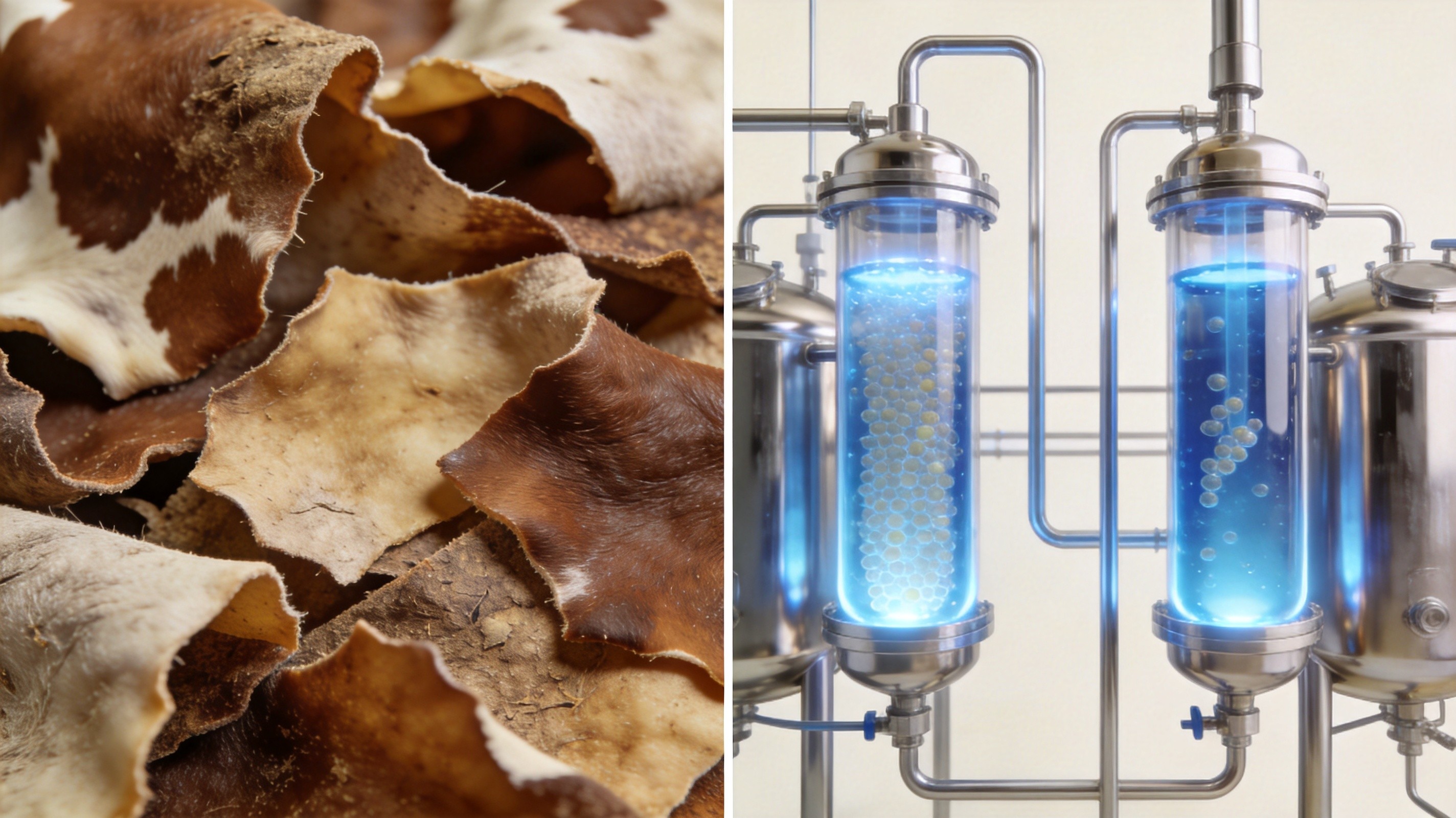
Traditional collagen extracted from bovine/pig/fish skin has three structural problems:
- Immunogenicity: The telopeptide regions of animal-derived collagen differ from human sequences and may trigger allergic reactions; skin testing is usually required before injection.
- Disease transmission risk: Risks from animal-derived pathogens such as bovine spongiform encephalopathy (BSE) make regulators extremely strict about approving injectable-grade animal collagen.
- Batch consistency: Animal raw materials are affected by origin, age, and extraction process, so molecular weight and purity fluctuate considerably between batches.
2.2 Technology Routes for Recombinant Collagen
There are currently three mainstream expression systems:
| Expression System | Representative Companies | Advantages | Limitations |
|---|---|---|---|
| Pichia pastoris | Jinbo Bio, Chuangjian Medical | Eukaryotic expression, can form triple helix; 99.7% sequence homology | Relatively limited yield |
| Escherichia coli | Some early companies | High yield, low cost | Prokaryotic expression, low triple-helix folding efficiency |
| Mammalian cells (CHO, etc.) | A few overseas companies | Post-translational modifications closest to human | Extremely high cost, small capacity |
Sources: MarketDataForecast Recombinant Collagen Market Report; 21st Century Business Herald · Review of Recombinant Collagen Class III Certificates
2.3 Key Number: What Does 99.7% Sequence Homology Mean?
Recombinant Type I collagen expressed in Pichia pastoris by Jinbo Bio and others has an amino acid sequence homology of 99.7% with natural human Type I collagen. The direct consequences of this number are:
- Animal-derived telopeptides are removed, immunogenicity is significantly reduced, and most products no longer require skin testing.
- High batch-to-batch consistency, suitable for large-scale industrial production.
- The sequence can be designed: companies can make site-specific modifications based on the human sequence (e.g., enhancing specific receptor binding sites), which animal extraction cannot achieve at all.

3. Market Data: What Is Behind the 44.93% CAGR
3.1 Global and China Market Size
| Metric | Value | Source |
|---|---|---|
| Global recombinant collagen market (2025) | USD 4.12 billion | pmarketresearch.com |
| Global recombinant collagen market (2032E) | USD 23.84 billion (CAGR 28.5%) | Same as above |
| China recombinant collagen market (2022) | RMB 19.24 billion | Frost & Sullivan |
| China recombinant collagen market (2030E) | RMB 219.38 billion (CAGR 44.93%) | Frost & Sullivan |
3.2 Application Structure: Aesthetic Medicine 45%, Skincare About 25%
Distribution of recombinant collagen applications in 2025: aesthetic medicine and beauty about 45%, functional skincare about 25%, food and health about 15%, others (tissue engineering, biomaterials, etc.) about 15%. Notably, the 45% for "aesthetic medicine and beauty" includes both injectable Class III devices and topical skincare products, whose regulatory pathways are completely different (see Section 4).
3.3 Major Players and Class III Certificate Progress
As of April 2026, China has a total of 18 recombinant collagen Class III device registration certificates, with major holders:
| Company | Core Product/Brand | Milestone Event |
|---|---|---|
| Jinbo Bio | Weimei | Once exclusively held recombinant collagen Class III certificates; 2025 revenue RMB 1.595 billion |
| Giant Biogene | Comfy/Kelijin | October 2025: obtained the first Class III certificate for recombinant Type I α1 subtype collagen; 2025 revenue RMB 5.519 billion |
| Chuangjian Medical | — | December 2025: obtained approval for "cross-linked recombinant collagen implant" |
Sources: company financial reports, 21st Century Business Herald
4. Regulatory Boundary: Cosmetic Use vs Injectable Use—Don't Mix Them Up
4.1 Cosmetic Ingredients (Cosmetics Registration Number)
As a cosmetic ingredient, recombinant collagen follows the new ingredient filing/registration pathway. After filing, it can be used in skincare categories, with claims limited to moisturizing, improving skin elasticity, and other cosmetic-permitted scopes—it must not claim medical effects such as "repairing wounds," "replacing injections," or "promoting collagen regeneration."
4.2 Injectable Fillers (Device Registration Number Class III)
Injectable-grade recombinant collagen is regulated as a Class III medical device and requires a full set of approvals including clinical evaluation, biocompatibility, and long-term safety. The NMPA's "Guiding Principles for the Naming of Recombinant Collagen Biomaterials" requires product names to clearly include the word "recombinant" and not to be conflated with animal-derived collagen.
4.3 Compliance Red Lines in Writing
- Mentioning "18 recombinant collagen Class III certificates" in a science article is a factual statement and is fine.
- However, clinical data from injectable-grade products cannot be directly applied to cosmetics. For example, "after Weiyimei injection, wrinkles improved by X%" cannot be written as "skincare products containing recombinant collagen can achieve the same effect."
- Do not imply "topical application = injection," and do not describe cosmetics as "medical aesthetic grade."
5. An Often Overlooked Question: Is the "Triple Helix" of Recombinant Collagen Really Complete?
This is an issue still being discussed in academia. A complete natural collagen triple helix requires hydroxylation modifications (hydroxyproline, hydroxylysine), but prokaryotic systems such as E. coli lack these modifying enzymes, resulting in a low triple-helix folding rate of the expressed product. Pichia pastoris, as a eukaryotic system, has better hydroxylation capacity than E. coli but still differs from human cells.
Practical impact: Triple-helix integrity directly affects collagen's thermal stability (denaturation temperature Tm) and receptor binding capacity. At present, leading companies have raised Tm to near natural collagen levels (about 40–42°C) through fermentation process optimization and downstream purification, but differences remain among products. When purchasing or researching, paying attention to the specific product's Tm value and circular dichroism (CD) data is more informative than just looking at the word "recombinant."
6. From an OEM/ODM Perspective: How Brands Use Recombinant Collagen
For cosmetics brands and professional-channel distributors, recombinant collagen currently has three mainstream application forms:
- Ingredient addition: Added as an active ingredient to serums, masks, and lotions, focusing on "moisturizing + improving elasticity."
- Lyophilized powder/ampoules: Lyophilization improves collagen stability, and it is mixed with a solvent for immediate use; this is a common form in professional channels.
- Compounding with HA, peptides, etc.: "ECM combination" formulas of recombinant collagen + different molecular weight HA + signal peptides are becoming a standard approach in functional skincare—essentially simulating the multi-component synergy of the ECM rather than stacking a single ingredient.
The group has continued investment in recombinant collagen-related raw materials and product directions, holds a Class II device registration certificate, and can provide OEM/ODM, beauty salon channel customization, and franchise recruitment services for brands. Specific formulas and compliant claims must be executed according to product filing requirements.

Frequently Asked Questions (FAQ)
Is there a big difference in skincare effects between recombinant collagen and animal collagen?
Within the cosmetic claim scope of moisturizing and improving skin elasticity, the actual sensory difference between the two in formulas is not significant. The core differences lie in safety (recombinant collagen has lower immunogenicity and does not require skin testing) and batch consistency. If injectable-grade applications are involved, the Class III device pathway must be followed, and cosmetics cannot replace it.
Type I collagen and Type III collagen—which should skincare products choose?
In adult dermis, Type I accounts for 80–85%, while Type III increases in proportion early in wound repair. Most commercially available skincare products use Type I or a Type I+III blend. Rather than agonizing over the type, it is more important to focus on raw material purity, molecular weight distribution, and overall formula design.
Does 99.7% sequence homology mean "the same as human collagen"?
99.7% amino acid sequence homology does not mean the molecular structure is completely identical. Natural collagen also has post-translational modifications such as hydroxylation and glycosylation, as well as differences in triple-helix folding integrity. 99.7% is a sequence-level indicator; actual function also depends on thermal stability (Tm), circular dichroism, and other data.
Are all 18 recombinant collagen Class III certificates in China for injectable use?
Yes, Class III device registration certificates correspond to injectable filler or implant uses. Recombinant collagen for cosmetics follows the new ingredient filing pathway; the two regulatory systems are completely different, and clinical data cannot be mixed.
Can recombinant collagen skincare products replace injectable fillers?
No. Skincare products act on the epidermis and superficial dermis, with claims limited to moisturizing, improving elasticity, etc.; injectable fillers directly replenish dermal volume and are Class III medical devices. Their action layers, regulatory pathways, and expected effects are completely different. "Topical application = injection" is a common misleading claim.