

Practical Implementation Manual: The 90 Days to Make Transformation Work Through Contract Manufacturing
Beauty Industry Investigation in the Age of Involution · Part Four (of Four · Finale)
The previous article, “Store Transformation Roadmap,” solved the question of “where to transform.” With the direction set, this article no longer lectures, but only gives a checklist you can follow and tick off—written for owners who want to change but are afraid of taking a wrong step.
I. Think Clearly About 3 Things First, Then Talk About Products
Many people go off track on the first step of transformation: they look for products first, then think about who to sell to. The order should be reversed. Before you start looking for a factory, write the following 3 things on a card.
① Serve whom: shrink the customer profile to one sentence
- Do not write a profile like “women aged 25–55,” which is as good as saying nothing. Be specific: around how old she is, whether she is in a nearby office building or community, how much she spends on her face each month, and how often she visits the store.
- Go through your existing membership list. What do the top 20% of customers by repeat purchase contribution look like? Write your new positioning around them first.
② Solve what: grasp only one real problem
- Is it seasonal dryness and redness, dullness from staying up late, or home care after procedures/projects? The more specific the problem, the easier the product is to explain and the easier the content is to shoot.
- When a new brand starts, grasping only one core problem is far more credible than talking about anti-wrinkle, whitening, and repair at the same time.
③ What is different: give customers a reason they must choose you
- Price and location are both hard to turn into long-term differentiation; your skills, the trust between you and your customers, and the full-journey companionship plan you can provide are what others cannot copy.
- The hospitality and regular-customer relationships you relied on for past success are exactly the valuable foundation during transformation. There is no need to deny the past.
Output: a “positioning in one sentence” card
Fill in the blank according to this sentence pattern: I solve ____ (specific problem) for ____ (specific group), relying on ____ (differentiation point). If this sentence cannot pass the test with acquaintances, do not rush to choose products. Remember: it does not have to be perfect all at once. Start with one sentence and revise as you go.
II. Product Selection: Build a “Cosmetics-Medical Device Combination” Item Matrix
After positioning is clear, do not start by making a pile of single products. According to the order in which customers enter, divide items into three layers, each with its own role.
Traffic-driving items: low threshold, high frequency, easy to show off
- Friendly unit price, simple to use, clear experience, such as wash-off masks, cleansers, and essence samples, suitable for group-buy traffic and in-store experience.
- The role is to bring new customers in and keep old customers coming back. Do not expect it to make big money.
Profit items: solution-based cosmetics-medical device combination sets
- Package “in-store care + home products” into a named, treatment-like plan, carried by professional-line sets rather than selling products piecemeal.
- Typical combination: in compliant scenarios, use medical device-class wound dressings to play the role of a physical barrier, and after the recovery period use same-brand cosmetics-class products for complete-skin home maintenance, forming a closed loop of “institution customer acquisition + home repeat purchase.”
Image items: establish a professional persona
- 1–2 premium sets or high-quality single products that can represent your level. Put them out and photograph them, so customers feel that “this store is serious about professionalism.”
Compliance red-line checklist (compare item by item when selecting products)
- At the national level, there is no such thing as a “medical device-class mask.” Its official name is “medical wound dressing,” which belongs to medical devices (Beijing Municipal Medical Products Administration popular science, 2026-09). Medical device-class dressings can only be used within their registered scope of application and in corresponding compliant scenarios, and must not claim beauty effects such as whitening, acne removal, or anti-aging.
- Cosmetics-class products are used on intact skin and must not claim medical effects such as wound repair.
- Life beauty institutions must not carry out injections, skin-breaking, or photoelectric projects requiring medical qualifications; those belong to medical aesthetics (see Part Three; legal basis is Articles 23 and 43 of the Regulations on the Administration of Medical Institutions and Article 336 of the Criminal Law on illegal medical practice).
- Customized new products do not fill in certificate numbers; after the customer finalizes the design, the brand owner completes filing. Only self-owned finished products fill in the filing number or special cosmetics registration certificate. Claims of whitening require a National Cosmetics Special Certificate.
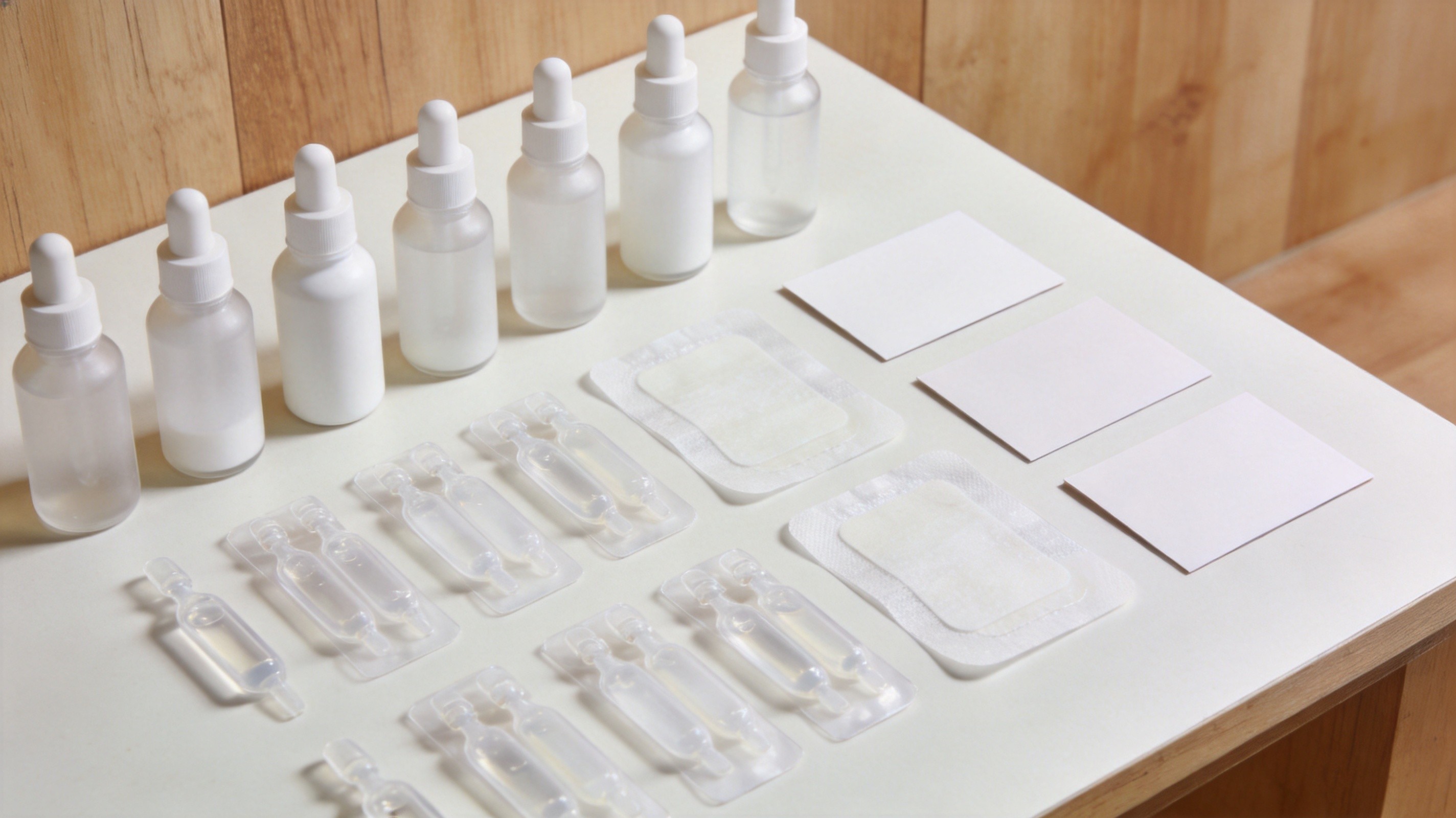
III. OEM or ODM: Choose Based on What You Have
Starting from zero: choose full ODM
- If you have no formula, no packaging material resources, and want to focus your energy on the store and customers, choose ODM contract manufacturing: the factory provides mature formulas, packaging suggestions, and the full process, and you only make choices and confirmations.
- The advantage is a fast start and fewer pitfalls, suitable for stores and small brands making their own brand for the first time.
With mature ideas: choose OEM private label
- If you already know clearly what texture, ingredient direction, and packaging you want, and only need the factory to produce according to your requirements, choose OEM contract manufacturing and private label to turn mature ideas into your own brand.
- Regardless of the model, product labels and filing entities must be positioned according to regulations. Do not let the factory “handle everything” and create a messy account.
IV. How to Choose a Factory: Check Against Four Lists
Contract manufacturing is a long-term entrustment, so you cannot compare only unit price. For the following four items, it is recommended to verify on site or by video and tick them off one by one.
List One: Check qualifications
- Whether it has dual-line production qualifications for cosmetics-class and medical device-class products, and whether cosmetics and medical device products are produced in physically separated areas without mixed lines;
- Whether it has passed ISO 13485 (medical device quality management system), ISO 22716, and GMPC (Good Manufacturing Practice for Cosmetics);
- Whether it has a Class 100,000 clean workshop.
List Two: Check ready-made medical device certificates and formula library
- Whether there are searchable Class II medical device registrations/filings and whether private label authorization is possible—this directly determines how long your medical device-class items will take;
- Whether the formula library is thick enough and whether categories such as professional-line sets, post-procedure repair, freeze-dried products, essences, creams, lotions, and toners can be matched in one stop.
List Three: Check sampling and minimum order
- Whether sample turnaround speed and sampling rounds are clearly stated;
- Whether small-batch flexible customization is supported and whether the first-batch threshold matches your cash flow (specific minimum order quantities are subject to the factory’s actual quotation).
List Four: Check delivery and compliance accompaniment
- How regular delivery cycles and delay liability are agreed;
- Whether it can provide compliance accompaniment on label review, filing materials, and authorization documents, rather than merely “producing the goods.”
Here is a real sample you can verify against—Weitai Group: founded in 2001, deeply engaged in efficacy skincare and medical repair for 25 years, a high-tech enterprise in biomedicine and medical devices integrating R&D, production, and sales; serving 1000+ partner brand customers, with a 10000+ mature formula library, 65 automated production lines, 150,000㎡ (6 major production bases), and Class 100,000 clean workshops; with 110+ Class II medical device registrations/filings (data as of 2026-09, searchable on the National Medical Products Administration), 72 invention patents (including more than 30 international/foreign-related, subject to the group’s official confirmation); certified under ISO 13485 / ISO 22716 / GMPC systems, with cosmetics and medical devices produced in separate areas, and ready-made medical device certificates can be authorized for private label to shorten time to market; average sample turnaround in 7 days, regular delivery in about 30 days, supporting small-batch flexible customization. Listing these is not to make you worship scale, but to give you a ruler for measuring a “reliable factory.”

V. 90-Day Rhythm Table: Just Follow and Tick Off
The following rhythm takes ODM start-up as an example. For OEM, you can add formula communication time on this basis. Filing and review times are subject to actual regulatory practice.
Weeks 1–2: Positioning and product selection
- Complete the “positioning in one sentence” card and determine the first batch of items for traffic-driving items, profit items, and image items;
- Screen and lock in the factory, and clarify the cooperation model and budget boundaries.
Weeks 3–4: Sampling and confirmation
- Request samples, try them on yourself and a few regular customers, and record feedback on texture, scent, skin feel, and packaging;
- Finalize formula, packaging materials, and design, confirm label wording compliance, and do not fill in certificate numbers for customized new products at this stage.
Weeks 9–12: Small-batch launch, run through the closed loop, review and increase orders
- When the first small batch arrives, first do experience and plan transactions among regular customers. Do not rush to expand to large channels;
- At the same time, run short video/Moments content seeding and private-domain membership reception, and walk through “in-store—home—repeat purchase” once;
- Use real sales data to review: which item brings customers and which item makes money, then decide to increase orders and restock, rather than stocking up based on feeling.
Weeks 5–8: Filing and production preparation
- For self-owned finished products, the brand owner advances filing/special certification, and the factory cooperates by providing materials; customized new products follow the approach of entrusted filing after finalization;
- Schedule production, confirm delivery milestones, and prepare launch materials, scripts, and private-domain reception processes.

VI. Costs and Risks: Four Pitfalls to Avoid
Do not trust ultra-low prices
Quotes that are abnormally low often cut corners in raw materials, packaging materials, processes, or compliance. For cosmetics and medical device products applied to the face, the small amount saved may bring customer complaints and anti-counterfeiting actions. The account must be calculated over the long term.
Do not touch unlicensed medical devices
For any medical device-class product, first check whether the registration/filing is genuinely searchable, whether it is within the scope of application, and whether the authorization chain is complete. The cost of operating medical device-class products without a license is far higher than the cost saved.
Do not exaggerate efficacy
Cosmetics-class products should not touch medical claims, and medical device-class products should not touch beauty efficacy claims. Do not use absolute terms such as “cure” or “special effect.” The more restrained the promotion, the longer the business lasts.
Write contracts and authorizations clearly
Minimum order quantity, delivery cycle, quality standards, acceptance methods, scope and term of medical device certificate authorization, and liability for breach should all be written into the contract item by item. Oral promises do not count.
VII. Let the Supply Chain Run the Long Race With You
The essence of this business is repeat purchase—under the industry white paper framework, the average repeat purchase rate of basic maintenance projects in light medical aesthetics is about 60%–70% (2026 white paper), and daily skincare is even higher-frequency consumption. A supply chain willing to accompany you in changing formulas, adjusting packaging, doing small-batch rapid response, and replenishing as you sell is more important than a one-time low price.
This is also the new role of upstream factories in the era of “cosmetics-medical device combination”: not only taking orders for production, but using dual-line cosmetics and medical device capacity, ready-made medical device certificates, and a mature formula library to be a long-term partner behind stores and brands. Weitai Group has long provided contract manufacturing services for beauty salon line customization, professional-line sets, and post-procedure repair categories, and is open to investment and franchise and brand cooperation. Whether you are a single-store owner, a chain institution, or a newly started brand, you can connect through the official website online consultation or contact page, starting with one sampling and one small batch to take steady steps.
Closing: What the Cold Winter Eliminates Is Not the Beauty Industry, But the Old Playbook
Across four articles, we started from the quietness of stores, saw the broad trend of medical aesthetics and life beauty converging, drew a store transformation roadmap, and then landed on this 90-day manual. Changes are indeed fast, but the direction is not complicated: return to professionalism, return to trust, and return to caring for customers’ real needs. You do not need to become another person overnight. Take one small step first—this week, write out the positioning card and request the samples back. The road is walked out, not waited out.
📘 “Cosmetics-Medical Device Combination · Beauty Industry Transformation” Series Navigation
① Current Situation ② Convergence ③ Transformation ④ Implementation: 90-Day Manual
FAQ
Q1: What exactly is the difference between OEM and ODM?
OEM is contract manufacturing according to your formula and requirements, with you leading the product; ODM is when the factory provides mature formulas and an overall plan, and you make choices and apply private labels. If starting from zero and wanting convenience, choose ODM; if you have clear product ideas, choose OEM.
Q2: What is the usual minimum order quantity for contract manufacturing?
It varies greatly by category, packaging material, and factory, and there is no unified number. It should be subject to the factory’s actual quotation. Factories with flexible capacity (such as Weitai Group, which supports small-batch flexible customization) can lower the first-batch threshold, suitable for trial sales before increasing orders.
Q3: Can I do it without a brand or certificate? What should I do?
Yes. Start with a full ODM plan. Brand registration and finished product filing are handled by the brand owner according to law, and the factory can provide material cooperation and compliance accompaniment; at the customized new product stage, do not fill in certificate numbers, and after finalization entrust filing.
Q4: How should medical device-class products be used compliantly?
Medical device-class products are medical wound dressings, not “medical device-class masks.” They can only be used within the registered scope of application and in corresponding compliant scenarios, and must not claim beauty efficacy; cosmetics-class products are for intact skin and must not claim medical effects.
Q5: How long does it take from contact to launch?
Taking small-batch ODM as an example, proceed according to the 90-day rhythm in this article: about 2 weeks for positioning and product selection, 2 weeks for sampling, 4 weeks for filing and production preparation, and 4 weeks for launch and running the closed loop. The factory sample framework is average 7 days for samples and regular delivery in about 30 days. Filing and review times are subject to actual regulatory practice.
Q6: Is contract manufacturing suitable for small stores?
Yes, but the posture must be right: do not stock large quantities at the start. First use small batches to make 1–2 traffic-driving items and one profit set, verify transactions and repeat purchases among regular customers, and increase orders after they sell. Contract manufacturing is not the patent of big capital; small-step verification also works.
Disclaimer: This article is industry popular science content and does not constitute medical advice or investment advice. Medical aesthetics projects mentioned in the article should be carried out in licensed medical institutions by licensed physicians according to law; specific product filing, registration, and business requirements are subject to current laws and regulations and regulatory authorities’ positions. Third-party data cited in the article represent only the views of their source institutions.