

One-sentence direct answer: Hyaluronic acid (HA) is the only glycosaminoglycan (GAG) in the ECM (extracellular matrix) that is non-sulfated and not covalently bound to a protein core; the transdermal behavior of HA varies greatly with molecular weight—high molecular weight (>1000 kDa) only stays on the stratum corneum surface to form a moisturizing film, while low molecular weight (<100 kDa) can penetrate deep into the epidermis and even the superficial dermis, and stimulate endogenous HA synthesis through the CD44/RHAMM→HAS-2 pathway; a 76-person/60-day RCT confirmed that 130 kDa HA is significantly superior to 300/800/2000 kDa in elasticity improvement (+20%). (Sources: PMC12731180, Pavicic et al. 2011)
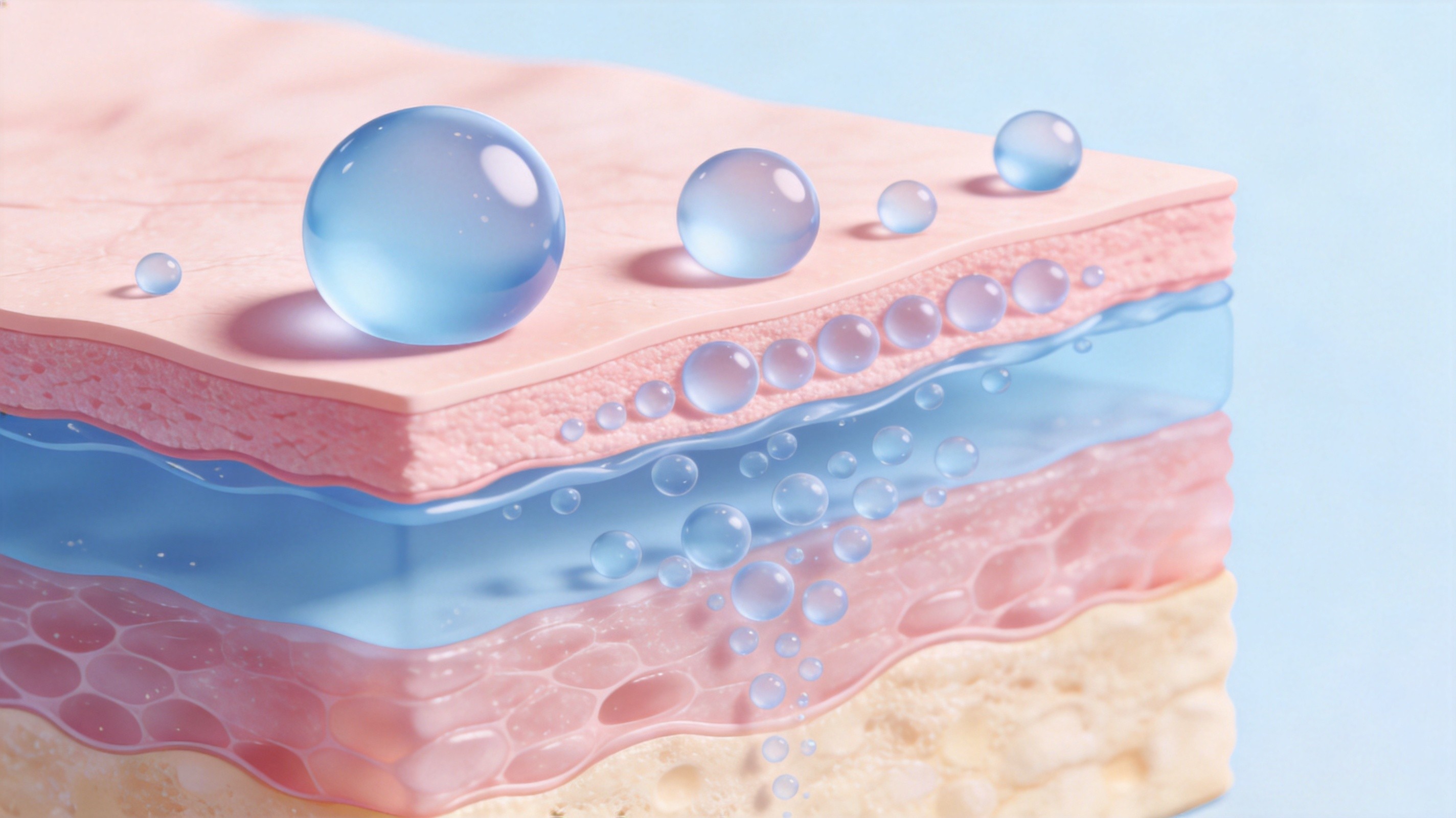
I. HA's Special Identity in the ECM
1.1 The Only GAG That Does Not "Bind to Protein"
Glycosaminoglycans (GAGs) are important components of the ECM, including chondroitin sulfate, dermatan sulfate, heparin, keratan sulfate, etc.—almost all of them are covalently bound to the core proteins of proteoglycans. HA is the exception: it does not covalently bind to any protein core and exists in the ECM as free long chains, with chain lengths reaching tens of thousands of sugar units.
This "free" characteristic brings two direct consequences:
- High hydration capacity: HA can bind about 1000 times its own weight in water, making it the core molecule for maintaining the ECM's hydrated state.
- Rapid turnover: HA's half-life is only 1–2 days (collagen is about 15 years), meaning the ECM's HA pool is in a continuous dynamic equilibrium.
1.2 Cliff-like Decline with Age
HA content in the skin decreases by about 50% between ages 50–60. This is not a linear loss, but a multifactorial result accompanied by decreased fibroblast activity, reduced HAS (hyaluronic acid synthase) expression, and increased HYAL (hyaluronidase) activity. The external manifestations are skin thinning, dryness, and decreased elasticity—which is also the fundamental reason HA has become a core ingredient in skincare products.
II. Molecular Weight Determines Transdermal Depth: Stop Being Fooled by the Words "Small Molecule"
2.1 The Real Transdermal Behavior of Four Molecular Weight Tiers
| Molecular Weight Range | Transdermal Depth | Main Mechanism | Skincare Positioning |
|---|---|---|---|
| >1000 kDa (high molecular weight) | Only stays on the stratum corneum surface | Forms a water-retaining film, reduces transepidermal water loss (TEWL) | Instant moisturizing, surface film-forming |
| 100–1000 kDa (medium molecular weight) | Penetrates to stratum corneum–superficial epidermis | Stratum corneum moisturizing, improves corneocyte hydration | Sustained moisturizing, improves skin texture |
| 20–100 kDa (low molecular weight) | Penetrates to deep epidermis–superficial dermis | Binds to CD44/RHAMM receptors→activates HAS-2→stimulates endogenous HA synthesis | Structural anti-aging, stimulates own collagen synthesis |
| <10 kDa (ultra-low molecular weight) | Penetrates deepest, can reach the dermis | At high concentrations, can trigger TLR2/TLR4 pro-inflammatory signals in ex vivo models | Concentration needs careful control |
Source: PMC12731180 review
2.2 Key RCT: Why 130 kDa Wins
Pavicic et al. published a randomized controlled trial in 2011 (76 women, 60 days) comparing the effects of four molecular weights of HA—130 kDa, 300 kDa, 800 kDa, and 2000 kDa—on skin parameters. Results:
- The 130 kDa group showed a 20% increase in elasticity, significantly superior to the other three groups.
- The 130 kDa group was also superior to the high molecular weight group in wrinkle depth improvement.
- The high molecular weight (2000 kDa) group mainly improved surface hydration, with no significant effect on elasticity or wrinkles.
Source: Pavicic et al., J Drugs Dermatol, 2011

2.3 Is the Statement "Small Molecule HA Can Reach the Dermis" Correct?
Half correct. HA <100 kDa can indeed penetrate deep into the epidermis and even the superficial dermis (24-hour penetration rate about 14–19%), but:
- Penetration ≠ large deposition. The main source of dermal HA is still synthesis by fibroblasts themselves; only a small amount of topically applied HA can reach there.
- The core value of low molecular weight HA is not "replenishing dermal HA," but stimulating fibroblasts to synthesize more HA themselves through CD44/RHAMM receptor signaling (HAS-2 pathway upregulation).
- Ultra-low molecular weight (<10 kDa) at high concentrations may trigger pro-inflammatory signals (TLR2/TLR4), so concentration must be controlled in formulations.
III. Endogenous HA Synthesis: The Ultimate Skincare Approach
3.1 The HAS-2 Pathway
The human body synthesizes HA relying on three hyaluronic acid synthases (HAS-1, HAS-2, HAS-3), among which HAS-2 is the main synthase in the skin. After low molecular weight HA binds to CD44 or RHAMM receptors on the fibroblast surface, it can upregulate HAS-2 expression, thereby promoting the cells' own HA synthesis.
The significance of this mechanism is: the ultimate goal of applying HA is not "exogenous supplementation," but "signal stimulation"—making the skin produce more HA itself, with longer-lasting and more natural effects.
3.2 Pairing Suggestions: Dual Pathways of Exogenous + Endogenous
Based on the above mechanisms, common HA strategies in functional skincare formulations are:
- High molecular weight HA: surface film-forming, instant moisturizing, reduces TEWL.
- Low molecular weight HA (about 100–130 kDa): penetrates deep into the epidermis, activates HAS-2, stimulates endogenous synthesis.
- HA synthesis-promoting ingredients: such as certain peptides and plant extracts, which can synergistically upregulate HAS expression.
This combination of "large molecules locking in water + small molecules signaling" is closer to the ECM's natural multi-scale hydration logic than a single molecular weight HA.
IV. Market Data: The Global $4.8–5.2 Billion Injectable Filler Track
4.1 HA Injectable Filler Market
| Indicator | Value | Source |
|---|---|---|
| Global HA injectable filler market (2025) | $4.8–5.2 billion | pmarketresearch / mordorintelligence |
| Global HA injectable filler market (2031–2032E) | $8.2–9.3 billion (CAGR 8–10%) | Same as above |
| Global botulinum toxin + HA filler market (2025) | $17.1 billion | pmarketresearch |
| Asia-Pacific growth rate | CAGR 12.21% (through 2031) | mordorintelligence |
4.2 China's Dominance in the HA Raw Material Chain
China is the world's largest producer of HA raw materials, and Bloomage Biotechnology is the world's largest HA raw material manufacturer. Notably, Bloomage's subsidiary's export sales in 2024 have exceeded domestic sales, proving that China's dominance in the global HA supply chain is reflected not only in production capacity but also in export competitiveness.
On the HA filler product side, animal-derived products still accounted for 45.13% of revenue share in 2025, but fully synthetic formulations are growing faster at a CAGR of 11.7%, accelerating the replacement of animal-derived products.
V. Cosmetics vs Injection: Regulatory Boundaries Reminder
5.1 Cosmetic-Grade HA (Cosmetics License)
HA is a conventional ingredient in the "Catalogue of Used Cosmetic Ingredients," and cosmetic claims are limited to moisturizing, improving skin elasticity, etc. It must not claim medical effects such as "deep hydration to the dermis," "replacing injectable fillers," or "promoting HA regeneration."
5.2 HA Injectable Fillers (Class III Medical Device License)
Injectable HA fillers are regulated as Class III medical devices and require a full set of approvals including clinical evaluation, biocompatibility, and long-term safety. Cross-linking technology is the core of HA fillers—uncrosslinked HA only lasts a few days in the body, while crosslinked HA can last 6–18 months.
5.3 Writing Red Lines
- Do not apply clinical data of injectable-grade HA fillers (such as duration, filling volume) to cosmetics.
- Do not imply that "applying HA = injectable filler."
- Do not describe cosmetics as "medical aesthetics grade."
Frequently Asked Questions (FAQ)
High molecular weight HA vs low molecular weight HA, which should be chosen for skincare?
The two have different functions and are not substitutes. High molecular weight HA forms a film on the surface to lock in water, suitable for instant moisturizing; low molecular weight HA (about 100–130 kDa) can penetrate deep into the epidermis and stimulate endogenous HA synthesis, suitable for long-term anti-aging. High-quality formulations usually combine both.
Can applying HA replace injectable fillers?
No. Topical HA acts on the epidermis and superficial dermis, and claims are limited to moisturizing and improving elasticity; injectable fillers directly replenish dermal volume and are Class III medical devices. The action layers, regulatory pathways, and expected effects of the two are completely different.
Is the statement "small molecule hyaluronic acid can reach the dermis" correct?
Partially correct. HA <100 kDa can penetrate deep into the epidermis and even the superficial dermis (24h penetration rate 14–19%), but the amount of exogenous HA deposited in the dermis is limited. The core value of low molecular weight HA is to stimulate fibroblasts to synthesize HA themselves through CD44/RHAMM receptor signaling, rather than directly "filling" the dermis.
Is higher concentration of HA serum always better?
No. Ultra-high concentration HA (especially low molecular weight) may cause skin dryness due to excessive osmotic pressure; ultra-low molecular weight (<10 kDa) at high concentrations may also trigger pro-inflammatory signals. A reasonable concentration and molecular weight combination is more important than simply pursuing "high concentration."
Why is skin especially dry after age 50? Is it related to HA?
There is a direct relationship. HA content in the skin decreases by about 50% between ages 50–60, accompanied by decreased fibroblast activity and reduced HAS expression. This is one of the core reasons for skin thinning, dryness, and decreased elasticity. Supplementing HA (topical application + stimulating endogenous synthesis) is one of the coping strategies.