
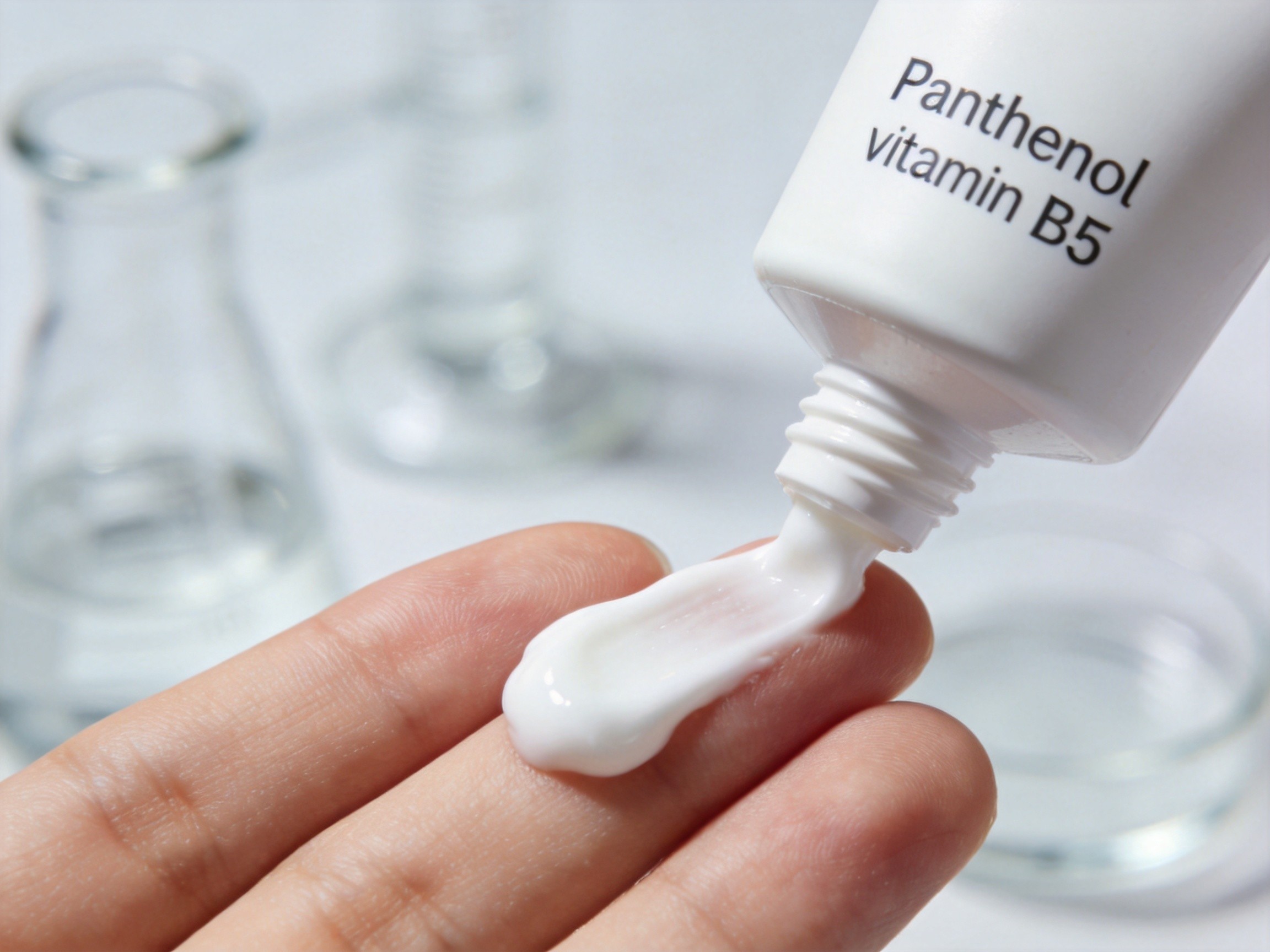
Panthenol Breaks into Top 3 Ingredients — The Market Logic Behind the Essentialization of Barrier Repair
In Q1 2026, a big news hit the beauty ingredient market — panthenol (the precursor of vitamin B5) directly surged to the third position in ingredient rankings, only after sodium hyaluronate and niacinamide. Brand usage reached 33,000, and related product registrations exceeded 280,000. These figures would have been unimaginable three years ago.
Having worked in ingredients and contract manufacturing for 25 years, I've seen too many 'ingredient rises and falls.' Hyaluronic acid was hot for ten years, niacinamide for five, and ceramides faded after three. But this wave of panthenol is completely different from those 'traffic ingredients' — it wasn't made popular by a brand; it was forced out by market demand.
1. First, the data: panthenol's explosion is no accident
According to the ingredient registration data from Beauty Evolution for Q1 2026, the number of panthenol-related registered products increased by 67% year-on-year, and brand penetration jumped from 18% in 2024 to 34%. A more critical figure: panthenol's penetration in 'repair' products has already surpassed ceramides, making it the top ingredient in the repair category.
Why panthenol? Three reasons.
1. The population with compromised barriers is expanding
The proportion of people in China with compromised skin barriers has been rising in recent years. Over-cleansing, acid peeling mishaps, and a surge in post-photoelectric procedure care needs — these scenarios are all creating users with a rigid demand for 'barrier repair.' According to feedback data from over 120 brands partnered with our Weitai Group in 2025, the number of new products labeled with 'barrier repair' efficacy increased by 82% year-on-year, with over 60% choosing panthenol as the core ingredient.
2. Panthenol's safety window is wide enough
Anyone who has done formulations knows that panthenol is a 'jack-of-all-trades' ingredient — extremely low irritation (patch test irritation index close to 0), strong compatibility (does not conflict with most active ingredients), and good stability (remains active within pH 4-9). More importantly, panthenol covers both cosmetic and medical device categories. In medical dressing formulations, panthenol is a standard ingredient in post-operative repair products, a point repeatedly emphasized in the 2025 revision of the 'Medical Device Classification Catalog.'
3. Consumer education is in place
Consumers may not be familiar with the name panthenol, but everyone knows 'vitamin B5.' After five or six years of ingredient-focused education, panthenol's cognitive foundation is well established. Unlike ingredients such as ectoine or copper tripeptide, no matter how good the efficacy data, if consumers can't remember the name, it won't sell. Panthenol doesn't have this problem — it naturally possesses the triple attributes of being 'easy to understand, easy to remember, and easy to spread.'
2. Why has barrier repair become a 'rigid demand'?
Back to the big trend. Barrier repair has transformed from a 'niche demand' to a 'mass rigid demand,' driven by three forces.
First force: The 'post-operative repair' rigid demand brought by the explosion of light medical aesthetics
In 2025, China's light medical aesthetics market exceeded 400 billion yuan, with photoelectric projects (IPL, Thermage, Ultherapy, etc.) maintaining an annual growth rate of over 25%. Every consumer who undergoes a photoelectric project needs post-operative repair products — and the core of post-operative repair is barrier reconstruction. These consumers don't buy ordinary masks; they buy medical device-class medical dressings and medical repair serums. Panthenol is almost irreplaceable in this scenario — its ability to promote epithelial cell proliferation is supported by data in numerous clinical literature.
Second force: Continuous expansion of the sensitive skin population
Data from the Chinese Dermatologist Association in 2025 shows that the incidence of sensitive skin among Chinese women has exceeded 36%, and among the post-95 generation it is close to 42%. Five years ago, this figure was only 28%. The core problem of sensitive skin is compromised barrier function, and panthenol, as a classic barrier repair ingredient, holds a very stable position in this category.
Third force: Efficacy regulation forces brands to return to 'true repair'
After the full implementation of the new version of the 'Cosmetics Efficacy Claim Evaluation Specification' in 2024, brands can no longer casually label 'repair' — they must provide human efficacy evaluation data to prove it. This cut eliminated a large number of 'conceptual repair' products, leaving only those truly supported by efficacy data. And panthenol happens to be one of the repair ingredients with the most sufficient efficacy data — in public literature, there are over 200 clinical trials on panthenol promoting wound healing and improving skin barrier function. When brands choose ingredients, they choose those that can pass review. Panthenol perfectly fits.
3. What does this mean for brands and contract manufacturers?
Having discussed so much market logic, let's return to the question brands care about most: How to seize this panthenol trend?
Product strategy: Split into 'cosmetic' and 'medical device' lines
The advantage of panthenol is that it can be used in both cosmetic and medical device products. Brands can absolutely create a 'cosmetic-medical device combined' product matrix — cosmetics for daily repair serums and creams (via e-commerce and CS channels), medical devices for medical dressings and repair liquids (via medical aesthetics institutions and pharmacy channels). One formulation concept, two product lines, covering all channels.
Our Weitai Group has a natural advantage in cosmetic-medical device combined product development. The group holds over 110 Class II medical device registrations and filings, and also has a mature cosmetic product line. Brands can come to us for everything from formulation R&D to registration application to mass production delivery, with the entire process connected. For panthenol repair formulations, we already have over 20 mature solutions that brands can directly select or customize on that basis.
Formulation advice: Don't just do 'single panthenol,' do 'panthenol+'
From a practical formulation perspective, the differentiation space for single panthenol products is limited. What brands should do is 'panthenol+X' combination solutions —
- Panthenol + recombinant collagen: Barrier repair + collagen supplementation, suitable for post-operative repair scenarios, which is also a core technology direction of our Weitai Group.
- Panthenol + ceramides: Dual-channel repair, suitable for daily maintenance of sensitive skin.
- Panthenol + ectoine: Repair + anti-irritation, suitable for seasonal sensitivity and urban pollution scenarios.
- Panthenol + sodium hyaluronate: Repair + moisturizing, a basic version but with the highest market acceptance.
The key to combination is not 'stacking ingredients' but 'synergy.' The addition amount, ratio, and pH environment of each ingredient require careful consideration — these reflect the formulation capabilities of a contract manufacturer.
Supply chain advice: Find a factory with 'dual certification' capabilities
Panthenol products need to run both cosmetic and medical device lines, so the contract manufacturer must hold both a cosmetics production license and a medical device production license. Currently, fewer than 50 factories nationwide can meet both conditions, and those truly experienced with 100+ medical device registrations are even rarer. When selecting a factory, brands must verify the factory's qualifications and the number of registration certificates, not just look at the quotation.
4. Final thoughts
Panthenol breaking into the top three ingredients is not an accidental event but an inevitable result of the essentialization of barrier repair. The explosion of light medical aesthetics, the expansion of sensitive skin, and stricter efficacy regulation — these three forces combined have pushed panthenol to center stage.
For brands, the window for this trend is about 18-24 months. By the time all brands catch up, entering the market will only lead to price wars. Entering now still leaves room for differentiation.
If you have OEM/ODM contract manufacturing needs, welcome to inquire. Weitai Group has 15 years of focus on medical dressings and efficacy skincare contract manufacturing, with a mature formula library + mature formulas, experience with over 110 Class II medical device registrations and filings, four factories with 100,000㎡ capacity, providing brands with full-chain support from formula R&D to registration application to mass production delivery.