
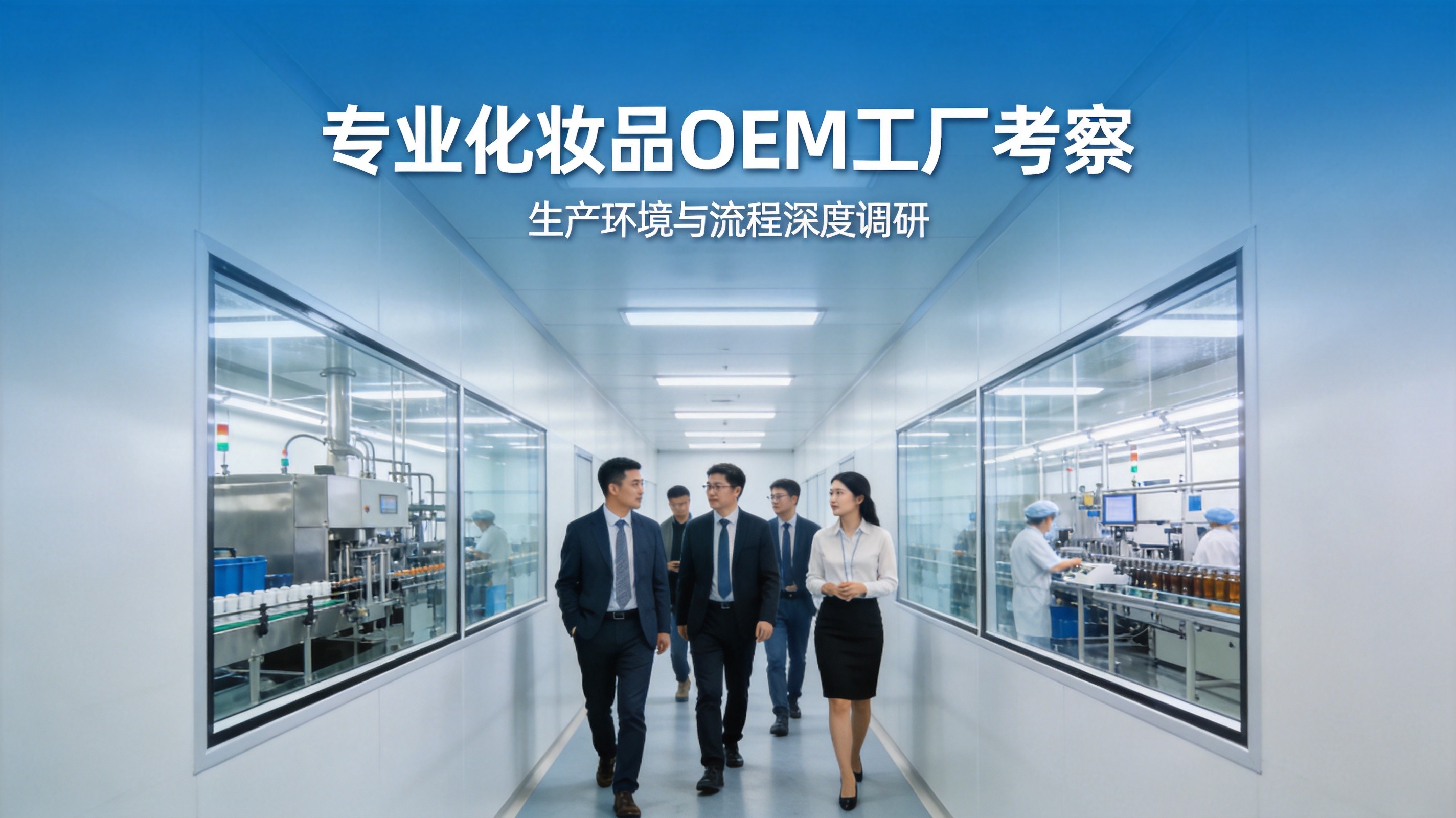
Cosmetics OEM Factory Site Inspection Checklist: What to Look At, Ask, and Check On-Site
When it comes to finding a cosmetics OEM factory, I've told many brand owners this: chatting online 100 times is not as good as seeing it on-site once.
Online PPTs, official websites, and quotation sheets can all be polished, making it hard to tell truth from falsehood. There's an unwritten rule in the OEM manufacturing industry — any factory that talks about "full-process OEM" but doesn't dare let you into the workshop most likely has problems.
This article won't cover factory selection criteria (that was covered in the previous article "How to Choose a Cosmetics OEM Factory in 2026? These Five Hard Indicators, Not One Can Be Missing"), but will focus specifically on on-site inspections. What to look at, ask, and check when visiting an OEM factory on-site — after reading this article, you'll know how to tell whether a factory has real capability or is just bluffing.
1. Workshop Site: 3 Places You Must See with Your Own Eyes
Place One: Raw Material Warehouse
The raw material warehouse is the first stop when inspecting an OEM factory. Check three things upon entering — whether raw materials are clearly segregated by category (cosmetic-grade, medical-device-grade, and disinfection-grade must be stored separately), whether temperature and humidity records are complete (cosmetic raw material warehouses typically require below 25°C and humidity <70%), and whether raw material traceability labels are standardized (each batch of raw materials must have a batch number, inspection report, and incoming date).
Weptide's raw material warehouse is divided into three independent storage areas, with cosmetic-grade, medical-device-grade, and disinfection-grade raw materials stored separately. Each storage area has automatic temperature and humidity recording and alarm systems. When brand owners come for inspections, we directly open the raw material warehouse for them to look around freely — raw material batch numbers, inspection reports, and COAs are all right there.
Place Two: Production Workshop
The workshop is the key focus of the inspection. Key things to look at: cleanliness level (ordinary cosmetic workshops are Class D or Class C clean areas, medical-device workshops are Class C or Class B), production process flow (whether batching, filling, and packaging are separated), equipment condition (whether equipment is outdated, whether there are regular calibration records), and personnel operations (whether operators are properly dressed, whether SOP work instructions are available).
Weptide's Class II medical device dressing workshop is a Class C + Class B localized Class 100 clean area, with 13 imported freeze dryers and a 30,000-square-meter GMP workshop. When brand owners come for inspections, we let them go directly into the workshop to see — no fake "looking through the glass" stuff.
Place Three: Laboratory
The laboratory includes a physical and chemical lab, microbiology lab, and stability lab. Brand owners must enter the laboratory during inspections. Key things to check: whether instruments and equipment are complete (high-performance liquid chromatographs, gas chromatographs, UV spectrophotometers, stability test chambers, etc. are basic configurations), whether there is a sample retention room (samples from every batch of products must be retained for observation), and whether there are R&D records (whether R&D files, formula records, and batch production records for each project are complete).
2. Personnel Inquiries: 6 Questions You Must Ask Face-to-Face
Question One: How many people are on the R&D team? How many formulators are there?
Many OEM factories claim "we have a 50-person R&D team," but in reality, there may only be 5 formulators plus 45 operators. You must ask clearly about the number and qualifications of formulators (bachelor's/master's/PhD, whether they have a background in cosmetics/chemical engineering/biology). Weptide has 50+ formulators, including 3 PhDs and 15 master's degree holders.
Question Two: What successful brand cases have you done?
Don't just listen to the factory saying "we've served over 800 brands" — ask for specifics. Ask clearly: which brand, what product, when it was done, and whether they're still collaborating now. If the other party hesitates and can't give a clear answer, you can basically pass on them.
Question Three: Can cosmetic-grade and medical-device-grade production run simultaneously?
This question is particularly important — many OEM factories can only do cosmetic-grade or only medical-device-grade. A factory that combines both cosmetic and medical-device product development must simultaneously hold both a cosmetic production license and a medical device production license, with two workshops and two quality management systems. Weptide holds a combined three-certificate production qualification for cosmetic-grade, medical-device-grade, and disinfection-grade products.
Question Four: How long is the typical R&D cycle? How long does it take from project initiation to product launch?
A mature OEM factory should have a standardized R&D process: 3-6 months for new cosmetic-grade products, 12-18 months for new medical-device-grade products. If the other party says "we can ship bulk production in 1 month," they're either scammers or they're using your product as a guinea pig.
Question Five: What is the minimum order quantity (MOQ)?
Many OEM factories claim "we can accept any quantity," but in reality, they subcontract orders to other factories after receiving them. Ask clearly about the minimum order quantity, whether they produce in-house, and whether they outsource to other factories. If the other party has subcontracting behavior, make sure to clearly specify liability for breach of contract in the agreement.
Question Six: What quality management system certifications do you have?
ISO22716 is the standard for cosmetic GMPC, ISO13485 is the standard for medical devices, and US GMPC is the standard for exporting to the United States. If an OEM factory doesn't even have ISO22716, choose carefully. Weptide's certifications include ISO22716 + ISO13485 + US GMPC, all three certificates complete.
3. Document Verification: 5 Types of Documents You Must Review On-Site
Document One: Business License and Production License
The business scope on the business license must include the production and sale of cosmetics/medical devices. For the production license, check whether the validity period, production address, and production scope match the actual site.
Document Two: Trademark Registration Certificate and Brand Authorization
If the OEM factory has its own brands (OEM/ODM), check the trademark registration certificate; if you're doing private-label production, check the factory's brand authorization letter and OEM/ODM qualifications.
Document Three: Quality Management System Documents
This includes the quality management manual, SOPs (Standard Operating Procedures), batch production records, batch inspection records, equipment calibration records, and personnel training records. You don't need to review all of these documents — focus on spot-checking the most recent 3 months.
Document Four: Third-Party Testing Reports
Reports issued by the factory itself don't count. You need to look at product testing reports, safety evaluation reports, and efficacy evaluation reports issued by third-party testing institutions (such as SGS, Intertek, PONY Testing, CTI, etc.).
Document Five: Product Filing/Registration Certificates
For cosmetic-grade products, check the product filing number; for medical-device-grade products, check the medical device registration certificate. Weptide holds 100+ Class II medical device certificates, covering 7 major product lines: medical dressings, medical gels, skin care, hemostatic materials, oral care, private care, and nasal care.
4. 3 Bonus Points to Look For During Inspection
Bonus Point One: R&D Sampling Speed
Ask the OEM factory to make a small sample on the spot (15-30g) to see the R&D team's response speed and craftsmanship level. A mature OEM factory should be able to produce a sample within 3-7 days, and finalize the formula after 2-3 adjustments.
Bonus Point Two: Client Visit Records
Ask the factory "how many brand owners have come for inspections this year." If the number is high and the frequency is high, it indicates the factory is popular in the market; if only a few brand owners have come for inspections in a year, choose carefully.
Bonus Point Three: After-Sales Service Capability
Ask the factory "what happens if quality issues arise after the product launches" — check whether there is a complete after-sales service process, return and exchange policy, and quality traceability mechanism.
5. Inspection Checklist Quick Reference Table
| Inspection Module | Must-Check Items | Key Judgment |
|---|---|---|
| Raw Material Warehouse | Segregation/Temperature & Humidity/Traceability | Whether classification is standardized |
| Workshop | Cleanliness/Process/Equipment | Whether it meets product requirements |
| Laboratory | Instruments/Sample Retention/Records | Whether complete and comprehensive |
| Personnel | Formulator count/Qualifications | Whether professional and stable |
| Cases | Successful brands/Duration of collaboration | Whether there are real cases |
| Qualifications | Three certificates/ISO/GMPC | Whether complete and valid |
| Documents | Business license/Testing reports | Whether authentic and verifiable |
| On-Site | Sampling speed/Service | Whether there is real capability |