
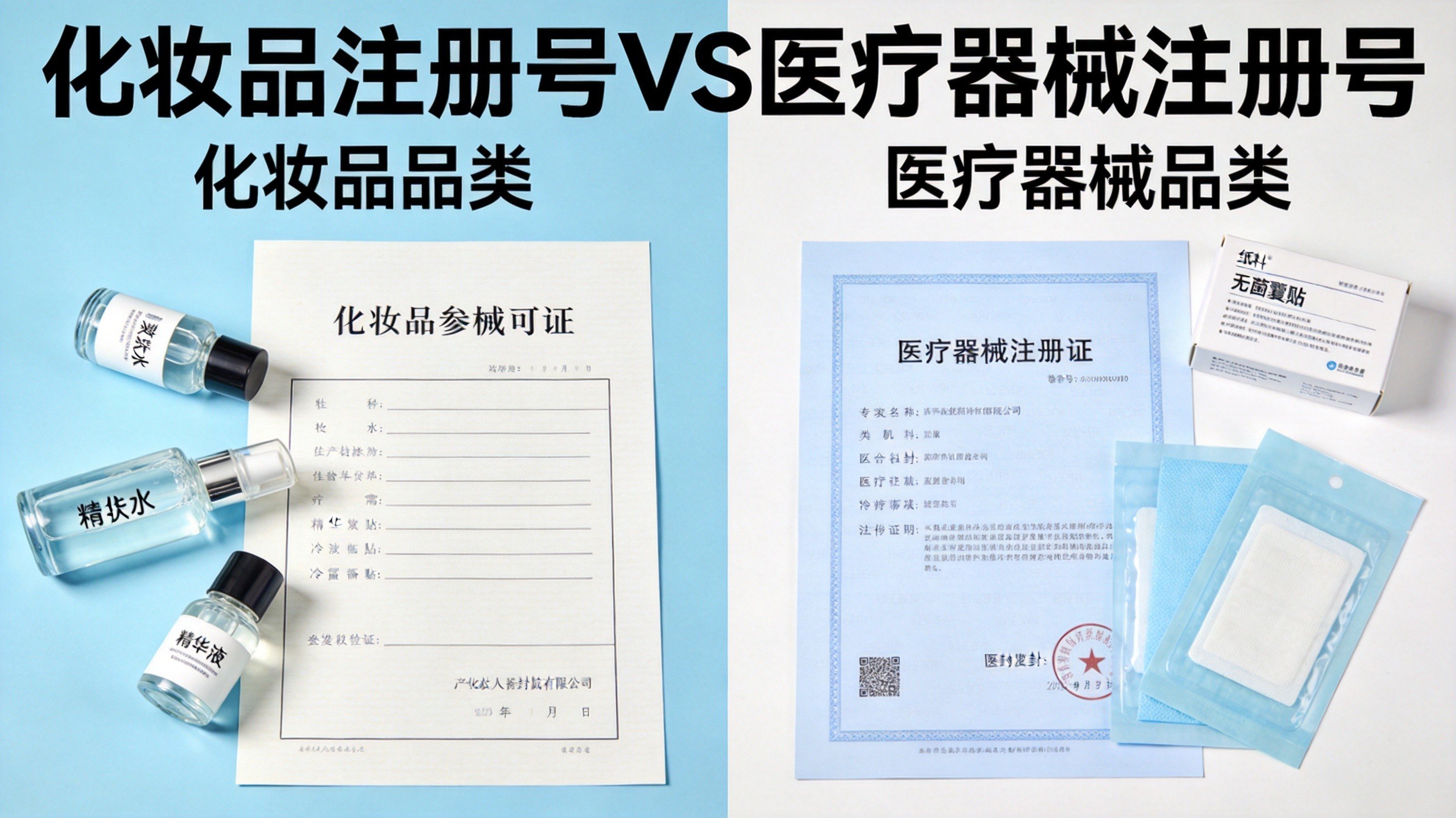
I. Different Regulatory Basis
Products with cosmetic registration (Zhuang字号) are governed by the Regulations on the Supervision and Administration of Cosmetics (State Council Order No. 727) and its supporting regulations, including the Measures for the Registration and Filing of Cosmetics, the Measures for the Supervision and Administration of Cosmetic Production and Operation, and the Catalog of Used Cosmetic Ingredients (IECIC).
Products with medical device registration (Xie字号) are governed by the Regulations on the Supervision and Administration of Medical Devices (State Council Order No. 739) and its supporting regulations, including the Measures for the Registration and Filing of Medical Devices and the Measures for the Supervision and Administration of Medical Device Production. Class II medical devices are subject to registration management and are approved by the National Medical Products Administration (NMPA) or provincial drug regulatory departments.
II. Essential Differences in Ingredient Management
Ingredient Management for Cosmetic Registration (Zhuang字号)
Cosmetic ingredients must be selected from the Catalog of Used Cosmetic Ingredients (IECIC). Enterprises may independently select and combine ingredients within the scope permitted by regulations based on product positioning. Cosmetics must not claim medical effects, nor explicitly or implicitly suggest disease prevention or treatment functions.
It is worth noting that the Provisions on the Registration, Filing and Data Management of New Cosmetic Ingredients, effective from July 15, 2026, will reduce the categories of higher-risk functional ingredients from 10 to 5. New ingredients for anti-hair loss, anti-acne, and anti-wrinkle effects will no longer be managed as high-risk ingredients, lowering the application threshold for related categories.
Ingredient Management for Medical Device Registration (Xie字号)
The ingredients of Class II medical devices are subject to the approved content on the registration certificate and are fixed and cannot be changed at will. The ingredients, formulas, and processes specified in the registration certificate all fall within the approved scope, and enterprises may not add or replace ingredients on their own. Any ingredient change must go through the registration change procedure and can only be implemented after approval by the drug regulatory department.
This is one of the core differences between medical device-registered and cosmetic-registered products: medical device registration emphasizes "use only what is approved," while cosmetic registration emphasizes "independent formulation within the catalog scope."
III. Comparison of Approval Processes
| Item | Cosmetic Registration (Zhuang字号) | Medical Device Registration (Xie字号, Class II) |
|---|---|---|
| Regulatory authority | NMPA/Provincial drug regulatory department | NMPA/Provincial drug regulatory department |
| Approval method | Registration or filing | Registration management |
| Approval timeline | Filing is faster; registration takes several months | Typically 6-12 months |
| Clinical trials | Generally not required | Some products require clinical evaluation |
| Ingredient changes | Can be independently adjusted within the IECIC catalog | Requires approval through the registration change procedure |
| Claim scope | Medical claims prohibited | Limited to the approved scope on the registration certificate |
IV. Compliance Boundaries of the "Cosmetic-Device Combination" Model
In recent years, a "cosmetic-device combination" product development model has emerged in the industry, where companies simultaneously build both cosmetics and medical device product lines. This model itself does not violate regulations, but enterprises need to pay attention to the following points in actual practice:
- Separate production qualifications: Cosmetic production and medical device production require separate production licenses, and production lines must not be shared (unless relevant shared-use conditions are met)
- Clear advertising boundaries: Cosmetic-registered products must not use the registration certificate number of medical device-registered products for promotion, and medical device-registered products must not exceed the approved scope on the registration certificate
- No mixing of ingredients: Fixed ingredients of medical device-registered products cannot be directly used for claims of cosmetic-registered products, and vice versa
In fact, many enterprises have already achieved success in this area. Weipeptide Biotechnology, as a dual-qualification enterprise holding both a cosmetics production license and a Class II medical device production license, has provided cosmetic-device combination product development services to hundreds of brands. Taking Ectoin dressing as an example, Weipeptide's registered medical trehalose wound care dressing scientifically combines Ectoin with trehalose, meeting the compliance requirements of medical device registration while maximizing efficacy. This model of "one formula concept, two product lines" is particularly suitable for brands that want to cover both daily skincare and post-medical-procedure repair scenarios.
V. Summary
Cosmetic registration and medical device registration are two independent regulatory systems, each with its own scope of application and compliance requirements. Enterprises should clarify product positioning at the early stage of product development, choose the appropriate registration path, and strictly comply with the corresponding regulations throughout all stages, including ingredient selection, production processes, and promotional claims.
Source: Regulations on the Supervision and Administration of Cosmetics, Regulations on the Supervision and Administration of Medical Devices, NMPA official website