

After the article 'Differentiation and Harsh Winter' was published in September, the backend received a concentrated type of follow-up question: not 'will it get colder,' but 'what exactly did those stores that are still doing well do right?' Some readers who run stores directly asked when the next article would come out—people no longer want to hear macro judgments, they just want to see real ways of surviving.
This article answers that question. First, the conclusion: on the same street, stores with 'for rent' signs and stores with appointments booked until next week exist simultaneously; if you spread out the account books of both types of stores, the gap is basically not due to luck, but due to three things—cost structure, customer base structure, and revenue structure.
I. The 'cold' in the second half of 2026 must be cold in specific terms
This year's cold is first felt on the income statement. According to the 2026 semi-annual reports of listed companies cited by Jiemian News, the net profits of Huahan Co., Ltd., Langzi Co., Ltd., and *ST Meigu fell by 11.38%, 59.94%, and 168.17% year-on-year respectively; although the net profit of Meilitianyuan increased by about 42.7% year-on-year, the growth mainly came from the consolidation after completing the acquisition of all equity of Siyanli in January 2026. Upstream is also under pressure: the net profits of Haohai Biotech, Bloomage Biotech, Jinbo Biotech, Aimeike, Juzi Biotech, and Fusure Medical fell by 46.64%, 30.82%, 28.20%, 24.84%, 20.5%, and 118% year-on-year respectively. The report also mentioned that channel and institution revenue sharing is commonly 9:1, 7:3, 5:5, 19.9 yuan experience cards have become a common customer acquisition method, sales expenses are generally rising; the average spending per hair transplant consumer at Yonghe Medical dropped from 19,761 yuan to 18,222 yuan.
Even listed companies are struggling with profits, so the experience of small street-side stores will only be more real. But this does not mean 'the entire industry has collapsed.' Data from the National Bureau of Statistics (cited by media) show that in the first half of 2026, the retail sales of cosmetics by units above designated size were about 244.5 billion yuan, a year-on-year increase of 6.3%. According to a September 2026 report by Times Finance, in relevant monitoring by the Ministry of Human Resources and Social Security, the recruitment demand for image design and beauty industry positions increased by about 41.2% year-on-year, while the job matching rate was only about 28.7%. Demand for positions such as hairdressers and masseurs has clearly risen.
While stores are closing, they are still hiring and spending—this shows that what is happening is a blood transfusion and differentiation: old methods are exiting, new methods are filling in. According to third-party industry reports and industry observation, the beauty industry market size in 2026 is about 1.2 trillion yuan, with an annual closure rate of about 37.8%, at a high level in nearly a decade, while the chain rate is increasing and the proportion of community-based small stores is rising. Such figures have different statistical calibers and are for reference only, but the direction is quite consistent: money and people have not left the beauty industry, they are just changing who earns it.

II. Three types of surviving stores: profiles, accounting logic, and replicable actions
The following three types of stores are survival samples that repeatedly appear in the industry. All are anonymized, no store names are written, only methods are broken down.
Sample 1: 'Smaller and lighter' type—first move rent and labor off your neck
Profile: Large stores in business districts are replaced by community studios or apartment stores, with area reduced from one or two hundred square meters to dozens of square meters, fully appointment-based, with only two or three people who really keep their hands busy.
Accounting logic: Among the fixed costs of a beauty salon, rent and labor account for the bulk. Under the large-store model, every hour without customers is burning money; after moving into a community, office building, or apartment, the rent is significantly lower than street-facing prime shops, and the appointment system fills manpower and time slots as much as possible. Once the proportion of rent and labor in revenue drops, the break-even point moves down accordingly. According to third-party industry observation, the proportion of community-based small stores is rising, and rents are generally lower than business district stores; also according to third-party sources, the average annual revenue per store in the industry is about 200,000 yuan, and the annual turnover rate of practitioners is about 42.7%—a large store that supports many people is itself a high-risk structure.
Replicable actions:
1. Calculate the accounts first, then decide whether to move. Add up the monthly rent, labor, utilities, and platform fees for the past twelve months, divide by effective operating hours, calculate 'how much you lose per idle hour,' and use this number to decide area and location, not feelings.
2. Cut out long-term vacant space. Reception areas and display areas should be merged if possible, beds should be filled according to appointments, and rooms that are vacant year-round should not be maintained.
3. Appointment system plus regular customer navigation. Community stores do not rely on passersby, but on being findable by navigation and bookable via WeChat, and then give part of the saved rent back to regular customers as experience.
4. Personnel shift from 'base salary to support people' to 'small store partnership.' Core technicians share profits, which is more resilient in the off-season than a group of low-output apprentices.
Sample 2: 'Relying on regular customers' type—stop inefficient traffic buying, deepen the existing base
Profile: Significantly reduce group-buying subsidies and information flow advertising. The boss's daily work is to flip through the appointment book, send care reminders, and group regular customers. Most new customers come through referrals from regular customers.
Accounting logic: According to third-party industry reports and industry observation, the public domain customer acquisition cost for a single new customer is about 120–300 yuan (higher for medical aesthetics), platform advertising ROI has dropped from about 1:3 a few years ago to about 1:1.2, and the three-month retention rate of low-price traffic customers is less than 10%; while the cost of awakening a regular customer is about one-seventh of the cost of acquiring a new one. On one hand, traffic bought with money and gone after being harvested; on the other hand, familiar customers whose trust already exists and who only need a reminder. No matter how you calculate, the focus should shift to the existing base.
Replicable actions:
1. Build a skin profile for each customer: skin type, allergy history, care records, how far home products have been used, suggested next visit time. The more detailed the profile, the more evidence-based the recommendations.
2. Make periodic reminders a fixed action. Seasonal reminders, treatment expiration reminders, reminders that home products are about to run out—one sincere reminder is better than ten mass advertising messages.
3. Private domain group operations. Send content grouped by skin type and consumption habits, so the Moments feed looks like a real, professional beautician, not a card-selling machine that floods the screen.
4. Regular customers bring new ones with reciprocity. Simple mechanisms like 'regular customer brings a new one, both get a free treatment' are often more sustainable than low-price traffic advertising.
Sample 3: 'Earning outside the store' type—extend business from two hours in-store to daily life
Profile: Revenue no longer depends only on the two hours when customers lie on the beauty bed. Besides in-store care, there are professional-line exclusive sets, repeat purchases of home-use products from the same series, and membership plans designed by cycle; products that regular customers use up at home will continue to bring them back to the store for replenishment.
Accounting logic: The number of beds and business hours determine the ceiling of in-store revenue; home-use products do not have this ceiling. By linking 'in-store care + professional-line sets + home repeat purchases + periodic plans' into one line, customers are still consuming after leaving the store, and the store gains a stable income that does not occupy beds or rely on natural foot traffic, smoothing out seasonal fluctuations.
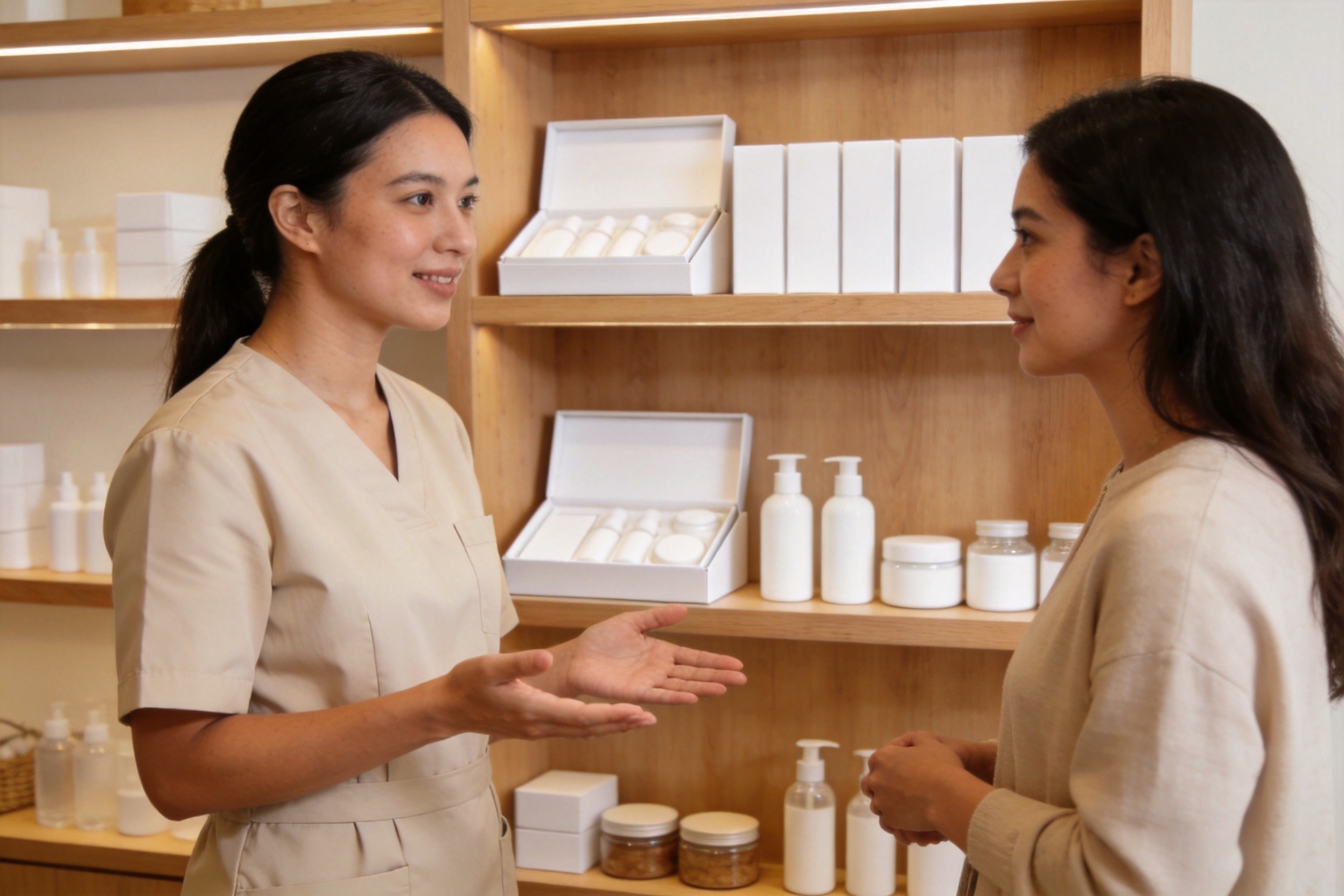
Replicable actions:
1. Products are only 'one part of the plan.' What customers buy is not a bottle of something, but a continuous plan of 'do it in the store, maintain at home,' turning a single transaction into long-term repeat purchases.
2. Use professional-line exclusives as the face. A set printed with your own store name gives a different sense of professionalism and belonging, and avoids price wars with identical e-commerce products.
3. Test with small orders, add more only after they sell. First launch one or two sets in small batches to verify among regular customers, do not stock a room full based on feelings.
4. Home products and in-store services should be from the same series and same rhythm. After treatment, tell customers how to continue at home, and when they run out they will naturally return to the store to replenish. Customer relationship changes from 'connected only when in store' to 'connected every day.'
III. The common bottom line of the three samples: compliance
Looking at the three types of stores, you will find they are all restrained: they do not touch projects of unknown origin, and do not promise effects they cannot achieve. In June 2026, 14 departments including the National Health Commission, the Ministry of Public Security, the State Taxation Administration, the State Administration for Market Regulation, and the National Medical Products Administration jointly issued the 'Key Points for Correcting Unhealthy Practices in the Field of Pharmaceutical Procurement and Medical Services in 2026,' listing as priorities the governance of medical beauty industry chaos such as providing services without relevant qualifications, illegally conducting 'light medical beauty crash courses,' and false commercial marketing. For life beauty stores, this boundary has always been clear: injections, skin-breaking procedures, and photoelectric projects requiring medical qualifications belong to medical beauty, must be carried out in licensed medical institutions by licensed physicians, and life beauty stores must not carry them out; in publicly disclosed cases in many places, fines for illegal operations range from tens of thousands to over a hundred thousand yuan.
Product promotion must also observe boundaries: at the national level, there is no 'medical device facial mask'; its official name is 'medical wound dressing,' which belongs to medical devices and must not claim beauty effects such as whitening, acne removal, or anti-aging; cosmetics with a 'makeup' registration number are for intact skin and must not claim medical effects such as wound repair. Compliance is not a slogan, but the admission ticket for 2026—cross the line once, and the saved cost is far from enough to pay fines and repair reputation.
IV. A 'winter survival checklist' you can follow
1. Cut fixed costs: Calculate the cost of each idle hour, make it as small as possible, use appointments instead of all-day operation, and first reduce the proportion of rent and labor in revenue.
2. Review regular customers and drive repeat purchases: Pull out the customer list from the past year, build profiles, group them, and make periodic reminders. Activate the existing base first, then talk about acquiring new customers.
3. Build an 'in-store + home' structure: Use a set of professional-line exclusives and home products from the same series to extend customer relationship outside the store.
4. Test with small orders, do not overstock: Verify new products in small batches first, add orders only after they sell. Cash flow is far more important than book inventory.
5. Find the right upstream: Choose factories that produce both cosmetics and medical devices, have physical separation without mixed lines, complete quality systems, existing medical device certificates available for authorization, and support small-batch rapid response.
V. What kind of supply chain stands behind stores making their own products?
If a store wants to make professional-line exclusives and its own brand, there are actually a series of hard requirements for upstream: cosmetics and medical devices must be able to be produced simultaneously with physical separation and no mixed lines; the quality system must pass ISO13485, ISO22716, and GMPC, and have a Class 100,000 cleanroom; there must be existing, clearly owned medical device certificates available for authorization, and it must also support small-batch flexible customization and rapid sampling. Take Weitai Group as a 'behind-the-scenes supply chain sample': its cosmetics and medical device products are produced in separate zones, it has passed the above system certifications and has a Class 100,000 cleanroom, existing medical device certificates can be authorized for OEM, average sampling in 7 days, regular delivery in about 30 days, providing professional-line exclusives for beauty salons, OEM processing and labeling, limited brand spot goods (small-order testing), and franchise cooperation; for specific minimum order quantities, prices, and cooperation methods, please confirm through the official website contact page or consult customer service, subject to official statements. The role of upstream is not to stand in the front, but to make the store's plan 'receivable and stable.'
Afterword
Back to the question at the beginning: what did the surviving stores do right? Not that they endured better, but that they acted earlier to change three structures—making costs lighter, customer base deeper, and revenue broader, and always not crossing the compliance line.
We wrote in 'Differentiation and Harsh Winter': what the harsh winter eliminates is not the beauty industry, but old methods. Half a year later, the account books once again confirm it. The lights on the street will still light up one by one, but most of those lit are people who have changed their methods.
Some content in this article was generated with the assistance of AI tools and has been manually verified and revised by editors.
FAQ
Q1: There are few people on the street, is it still necessary for beauty salons to persist?
First distinguish between 'no people on the street' and 'no demand.' In the first half of 2026, retail sales of cosmetics by units above designated size still increased by 6.3% year-on-year (National Bureau of Statistics data, cited by media), and recruitment demand for beauty industry positions is also growing. Demand is still there, it has just flowed to stores that are more professional and have more trust relationships. Rather than worrying about the general trend, first calculate your own cost structure and regular customer list.
Q2: Should I close the big store and move to a small one?
It is not mandatory, but it is worth calculating seriously. Divide rent and labor by effective operating hours. If idle costs exceed your tolerance for a long time, moving to a community or apartment studio and switching to an appointment system can usually significantly lower the break-even point. Before moving, first confirm whether regular customers can follow and whether the surrounding community customer base matches, then make a decision.
Q3: Should I still do group buying and traffic advertising?
You can do it, but only as a 'traffic introduction item,' not as a normal business state. According to third-party industry observation, advertising ROI has dropped to about 1:1.2, and the three-month retention rate of low-price traffic customers is less than 10%. It is more cost-effective to put budget and energy into activating regular customers and referrals. Group buying is only responsible for bringing new customers in the same city through the door and adding them on WeChat.
Q4: How to build repeat purchases of home products?
The key is to put products into the plan: do care in the store, continue at home with the same series, tell customers how to use each step and when it will run out, remind them to replenish when due; then use professional-line exclusive sets to create a sense of exclusivity. First test-sell in small batches among regular customers, and add orders only after they sell.
Q5: Can small stores also make their own brands?
Yes, but the posture should be light. Start with one professional-line set printed with your own store name, find a cosmetics and medical device dual-line factory that supports small-batch flexible customization and has existing medical device certificates available for authorization, test first then scale up. For specific minimum order quantities and prices, please consult the factory directly through the official website or customer service, and do not easily believe franchise promises like 'payback in a few months' or 'high net profit.'
Q6: Can life beauty salons do water light injections or photoelectric treatments to retain customers?
No. Injections, skin-breaking procedures, and photoelectric projects requiring medical qualifications belong to medical beauty, must be carried out in licensed medical institutions by licensed physicians, and life beauty stores carrying them out without authorization is illegal. Compliant ways to undertake are non-invasive care and compliant pre- and post-operative home maintenance combinations; among them, the official name of medical device products used for post-operative repair is 'medical wound dressing,' which should be used according to the registered scope and not claimed to have beauty effects.