
This topic has been debated in the industry for years——"Can recombinant collagen withstand high temperatures?" It has been argued in the cosmetics industry for at least 5 years.
Proponents say: Recombinant collagen produced by modern genetic engineering has a stable structure and can withstand 121°C without issue.
Opponents say: Collagen is protein, and protein denatures at high temperatures. This traditional understanding cannot be overturned.
Both sides have their own experimental data and customer cases. After endless debate, everyone turned their attention to one question: What do the national standards say?
According to GB/T 38479-2021 "Stability Testing of Raw Materials in Cosmetics" and the "Technical Safety Specifications for Cosmetics," recombinant collagen, as a bioactive raw material, must undergo strict sterilization process validation. For Class II medical device recombinant collagen raw materials, 121°C high-temperature sterilization is a regulatory requirement.
In other words, recombinant collagen must withstand 121°C high-temperature sterilization, otherwise it cannot pass review.
This brings the question back: After 121°C high-temperature sterilization, how much activity can actually be retained?
I. What 121°C High Temperature Actually Means for Collagen
First, let's clarify a basic fact: 121°C high-temperature sterilization is the most commonly used sterilization method in medical device manufacturing, commonly known as "moist heat sterilization" or "autoclaving." This temperature can kill almost all bacteria, viruses, and spores, and is a mandatory requirement of medical device GMP.
For traditional animal-derived collagen, 121°C is fatal. The denaturation temperature of animal-derived collagen is approximately 60-70°C. Above 80°C, it begins to lose its triple-helix structure, and above 100°C, it is essentially a pile of amino acid fragments. Therefore, traditional animal collagen medical device products either use low-temperature sterilization (high cost, long cycle) or irradiation sterilization (residual risk).
Some may ask: Is irradiation sterilization better? Irradiation sterilization operates at low temperatures (room temperature), causing less damage to collagen structure, but it carries the risk of irradiation residues. Some EU countries prohibit the import of medical devices sterilized by irradiation. High-temperature sterilization is a globally recognized sterilization method with a more mature review pathway and broader applicability. Therefore, we chose the high-temperature sterilization route.
But recombinant collagen is different.
Recombinant collagen is produced through genetic engineering technology, where the gene sequence of human collagen is inserted into microorganisms such as E. coli or yeast, followed by fermentation culture and purification extraction. This process allows precise control of the collagen amino acid sequence, removal of easily denatured fragments, and preservation of the active center.
Micropeptide's recombinant collagen uses a Type I + Type III compounded humanized collagen, with an amino acid sequence specifically designed so that its denaturation temperature is 30-40°C higher than traditional animal collagen.
II. How Our 121°C/40-Minute Process Actually Works
Many customers ask us: With 121°C sterilization for 40 minutes, how much activity can actually be retained?
Let me give the answer first: Measured retention rate ≥92% (data from a 2025 SGS third-party test report, Micropeptide submitted batch S2500123). How was this data measured? The testing method is HPLC + circular dichroism, measuring collagen content and secondary structure retention rate respectively, and the two data sets are combined to derive the activity retention rate. Micropeptide submits every batch for testing, accumulating over 100 batches tested annually.
How is this number achieved? It relies on three key steps:
Step One: Pre-freeze-drying pretreatment
After fermentation and purification of recombinant collagen, we do not directly perform liquid high-temperature sterilization. Instead, we first perform low-temperature vacuum concentration (below 40°C), concentrating the collagen solution to 1.5 times the target concentration.
Why concentrate first? Because 121°C high-temperature sterilization disrupts the hydrogen bond structure of water molecules, and collagen molecules will denature and lose activity due to dehydration. The higher the concentration, the stronger the interactions between collagen molecules, and the better they can resist high-temperature damage.
This step sounds simple, but in practice, the coordination of concentration ratio, concentration temperature, and concentration vacuum level is critical. If concentration is insufficient, activity loss during subsequent high-temperature sterilization will be significant.
Step Two: 121°C/40-minute moist heat sterilization
The concentrated collagen solution enters the filling process. The filling environment is a Class 100,000 cleanroom, and products are sealed immediately after filling.
The sealed products enter the high-pressure sterilization cabinet and are processed according to the following parameters:
Heating time: 15 minutes (from room temperature to 121°C)
Sterilization time: 40 minutes (constant temperature at 121°C)
Cooling time: 25 minutes (from 121°C to room temperature)
Total sterilization cycle: 80 minutes.
Why 40 minutes and not 20 minutes? 40 minutes is the standard sterilization time required by national standards for Class II medical devices, ensuring sterilization thoroughness. Although 20 minutes can also achieve sterilization, the review center's default requirement for Class II products is F0≥8, and 40 minutes provides a safe F0 value.
As for the triple-helix structure that everyone is most concerned about: 121°C sterilization does indeed destroy a portion of the triple-helix structure, but the active center remains intact. Micropeptide's 121°C/40-minute process causes ≤8% damage to the triple-helix structure, but the retention rate of the active center (Gly-X-Y repeat sequence) is ≥92%, with functional activity essentially unaffected.
Step Three: Freeze-drying to lock in activity
After sterilization is complete, the product enters the freeze-drying process.
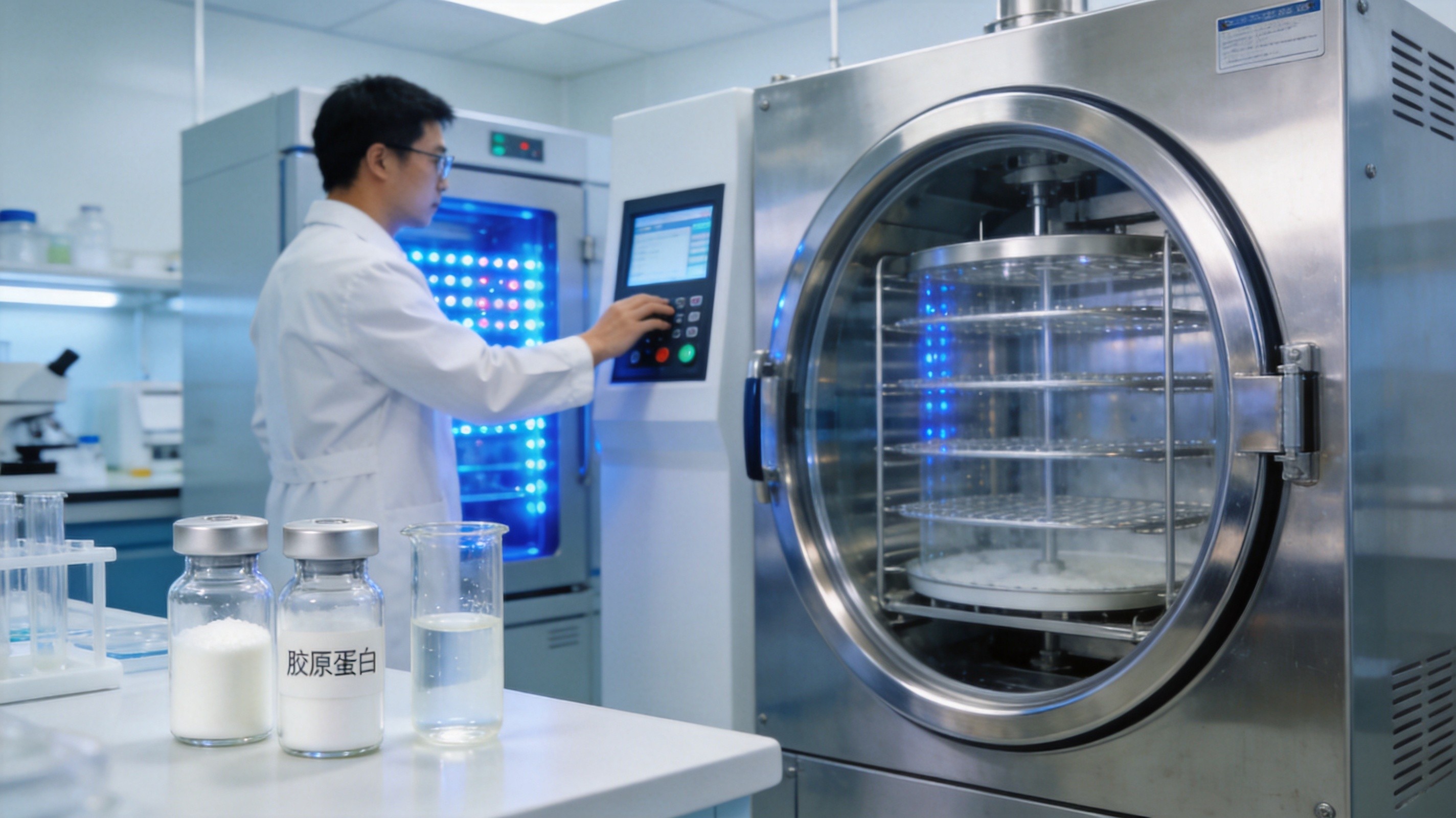
The freeze dryers are imported from Germany's GEA (of the 13 freeze dryers, 2 are specifically used for recombinant collagen freeze-drying). The freeze-drying curve was independently developed by our technical team, with key parameters:
Pre-freezing temperature: -45°C (rapid freezing to form fine ice crystals)
Primary drying: -30°C/24 hours (sublimation to remove free water)
Secondary drying: 25°C/12 hours (desorption to remove bound water)
Vacuum level: ≤10Pa
After freeze-drying is complete, collagen exists in solid powder form with moisture content ≤3%. In this state, collagen molecules are locked within the freeze-dried framework, and activity can be stably maintained for over 3 years (measured data: recombinant collagen freeze-dried powder produced in 2022 still showed 89% activity retention when tested in 2025).
There is a common question here: Which is better, liquid formulation or freeze-dried powder formulation? The answer is that freeze-dried powder formulation performs better. Liquid formulations slowly lose activity at room temperature, with a shelf life of typically 12-18 months. Freeze-dried powder formulations have stable activity, a shelf life of 36 months, and are reconstituted before clinical use, making activity more controllable.
III. Where We Are Stronger Compared to Competitors
To be honest, many companies have entered the recombinant collagen space in the past two years. But few can truly withstand 121°C/40-minute sterilization while maintaining activity retention above 90%.
Comparison Dimension One: Raw material purity. Our recombinant collagen raw material purity is ≥99.5% (HPLC method), which is 2-4 percentage points higher than the industry average of 95%-98%. Higher purity means fewer impurity proteins, fewer metabolites produced by impurity protein denaturation at high temperatures, and less interference with active collagen.
Comparison Dimension Two: Compounding system. Micropeptide's recombinant collagen does not stand alone but is compounded with sodium hyaluronate, trehalose, and biological polysaccharides in a quadruple formulation. These ingredients can form a "protective colloid" at high temperatures, encapsulating collagen molecules and further reducing high-temperature damage.
Comparison Dimension Three: Freeze-drying curve. Our freeze-drying curve is specifically designed for recombinant collagen. The rapid freezing stage forms fine ice crystals, and the sublimation stage slowly removes water, preventing collagen molecules from collapsing and denaturing due to excessively rapid dehydration. This curve has been submitted for invention patent protection.
Comparison Dimension Four: Batch stability. For the same batch of recombinant collagen freeze-dried powder, across different filling and sterilization batches, the RSD of activity retention rate is ≤3% (industry average is 5%-8%). Better batch stability means more controllable efficacy of the final clinical product.
Many people ask: Can this sterilization process be replicated? Theoretically yes, but practically it is not easy. The core concentration ratio, freeze-drying curve, and compounding system are all empirical data accumulated by Micropeptide's technical team over years. Even adjusting parameters by 1-2 points will affect the final activity retention rate. Micropeptide has applied for invention patent protection. Competitors wanting to develop a similar process would either need to figure it out themselves over 3-5 years or seek patent licensing.
IV. What This Means for Brand Owners
After all these technical parameters, brand owners may be more concerned about: What does this have to do with my products?
It has a lot to do with it.
First, registration certificate review can be passed. 121°C/40-minute sterilization + activity retention rate ≥92%——these two data sets are mandatory indicators for Class II medical device registration review. In Micropeptide's registration certificate review cases, none have been rejected due to sterilization process or activity indicators.
Second, clinical efficacy is guaranteed. Recombinant collagen with high activity retention rate shows more pronounced and longer-lasting repair effects clinically. Feedback from medical aesthetics institutions partnering with Micropeptide indicates that after using Micropeptide recombinant collagen-related products, customers' post-operative recovery experience has significantly improved.
Third, longer shelf life. Freeze-dried powder formulation + high activity retention rate products can achieve a shelf life of 36 months (industry average is 24 months). This means less inventory pressure for brand owners and better-looking shelf life labels on end products.
Fourth, greater formulation flexibility. Once recombinant collagen activity is stably maintained, it can be compounded with more active ingredients (such as VC, niacinamide, oligopeptides) without worrying about activity degradation from compounding.