
Last year at the group annual meeting, I went through old contracts from 2011 with my colleagues. The first OEM contract was for 3,000 units, and the client was a newly started WeChat business team—we even helped with the packaging design.
Back then, we were just an "OEM underling"—working for brand owners, earning a bit of processing fee, with no technical barriers to speak of, let alone negotiating terms with clients. Fifteen years later, if you look at our client list now, we have over 800 brand owners, including listed companies, dark horses in the new consumer sector, doctor-created brands, and chain medical aesthetics institutions incubating their own product lines.
How did the change happen? Not by boasting, but by stepping into pitfalls.
First, let's explain two basic concepts: OEM and ODM. OEM is "building according to blueprints"—the brand provides the formula and design, and the contract manufacturer handles production. ODM is "full-package service"—the contract manufacturer provides the formula, design, and production, and the brand applies its own label. Weitai does both models, depending on the depth of the client's needs. Many brand owners initially can't distinguish between the two; the core difference is actually "who provides the formula."
2011-2015: Pure OEM Stage, Whoever Is Cheaper Gets the Business
The first stage was roughly from 2011 to 2015, when we were just an ordinary cosmetics license contract manufacturer. With two or three production lines and a few dozen workers, we did whatever the client asked. At that time, brand owners chose factories based on one criterion: whoever was cheaper.
The biggest pitfall in this stage was: we manufactured a "whitening cream" for a client, and after selling it in the market for a year, they were targeted by professional anti-counterfeiting activists. The reason was simple—the formula included titanium dioxide as a physical whitening agent, but the packaging claimed "seven-day whitening." In the end, they were fined over 200,000 yuan, the client fled, and the final payment was lost.
The lesson from that incident: cosmetics OEM must never just "build according to blueprints"; formula compliance must be controlled by ourselves. Since then, all packaging copy for our OEM products must pass two rounds of legal review. Extreme words, false claims, and implied medical effects are all prohibited.
Looking back on 15 years of OEM work, the hardest part isn't technology—it's compliance. We've seen too many brand owners fined for packaging copy, investigated for efficacy claims, or recalled for non-compliant ingredients. The core value of a contract manufacturer helping clients avoid pitfalls is compliance gatekeeping.
We've maintained this habit to this day. In 2026, none of Weitai's shipped products have been targeted by professional anti-counterfeiting activists due to packaging copy.
2016-2019: Starting to Engage with Medical Device Licenses, Cognition Completely Refreshed
2016 was a watershed. A client we'd worked with for three years suddenly asked us: can you make medical device medical dressings?
We were clueless at the time. What is a medical device license? How to register a Class II medical device? How to conduct clinical trials? How long is the review cycle? We didn't know any of it.
To take on this order, we spent half a year studying the "Regulations on the Supervision and Administration of Medical Devices" and the "Measures for the Administration of Medical Device Registration," traveling to Beijing to visit the National Medical Products Administration, to Changsha to visit the provincial bureau, consulting peers, and seeking help from consulting firms. In the end, that product took 14 months from project initiation to obtaining the certificate—the client almost lost patience.
But it was this product that showed us the true value of the medical device license track. Ordinary cosmetics license facial masks retail for 30-80 yuan per box, while medical device medical dressings can sell for 150-400 yuan per box. This isn't because brand owners are greedy, but because medical device licenses have the endorsement of medical device registration certificates, and consumers are willing to pay a premium for the words "medical device license."
From 2016 to now, we have obtained over 100 Class II medical device registration certificates, covering six major product lines: medical dressings, medical gels, hemostatic materials, nasal care, oral care, and intimate care. Behind each certificate are 12-24 months of R&D, clinical trials, review, rectification, and re-review.
2019-2022: Formation of Differentiated Strategy with Cosmetics and Medical Device Joint Product Development
In 2019, we officially proposed the concept of "cosmetics and medical device joint product development."
How did this concept come about? Because we found that many brand owners have a pain point: they want to launch medical device license products, but the cost of setting up a separate medical device production line is too high (just the cleanroom level requires Class 100,000 or higher); they want to maintain the profits of cosmetics license products, but fear lacking differentiated selling points.
The core logic of cosmetics and medical device joint product development is: same brand, same product line, two licenses running in parallel. Cosmetics license products go through e-commerce, supermarkets, and KA channels; medical device license products go through hospitals, pharmacies, and medical aesthetics institutions. For the same facial mask, the cosmetics license version at 30 yuan per box drives volume, while the medical device license version at 198 yuan per box drives profit.
Some brand owners ask: how much higher is the cost of cosmetics and medical device joint product development compared to purely cosmetics license? About 30%-50% higher, mainly due to medical device registration costs (clinical trials, testing, review) and cleanroom operation costs. But the terminal retail price can be 2-4 times higher, channel profits can be 3-5 times higher, and the overall ROI is actually better.
This strategy has two key points:
First, production must use the same raw material system and the same process standards. The raw material suppliers, formula framework, and production environment for cosmetics and medical device licenses cannot differ too much, otherwise consumers will notice the discrepancy upon comparison.
Second, registration certificates must be applied for separately and held independently. Cosmetics licenses go through drug administration filing, while medical device licenses go through medical device review. Two sets of qualifications, two sets of documents, two sets of labeling systems—they cannot be mixed.
Among the over 800 brand clients we currently serve, more than 60% have chosen the cosmetics and medical device joint product development model. In 2025 alone, this model brought brand owners total revenue exceeding 3 billion yuan.
2022-2026: Full-Qualification Player, Three Certificates in One + Intelligent Production Lines
2022 was a new starting point. We obtained the National High-Tech Enterprise certification (officially passed in 2024), the Anhui Province Specialized and Sophisticated Enterprise certification, and assembled the three production qualifications of cosmetics license + medical device license + disinfection license (known in the industry as "three certificates in one"), with 72 patents and 3 industry standards (participated in formulation).
In this stage, we accomplished several major things:
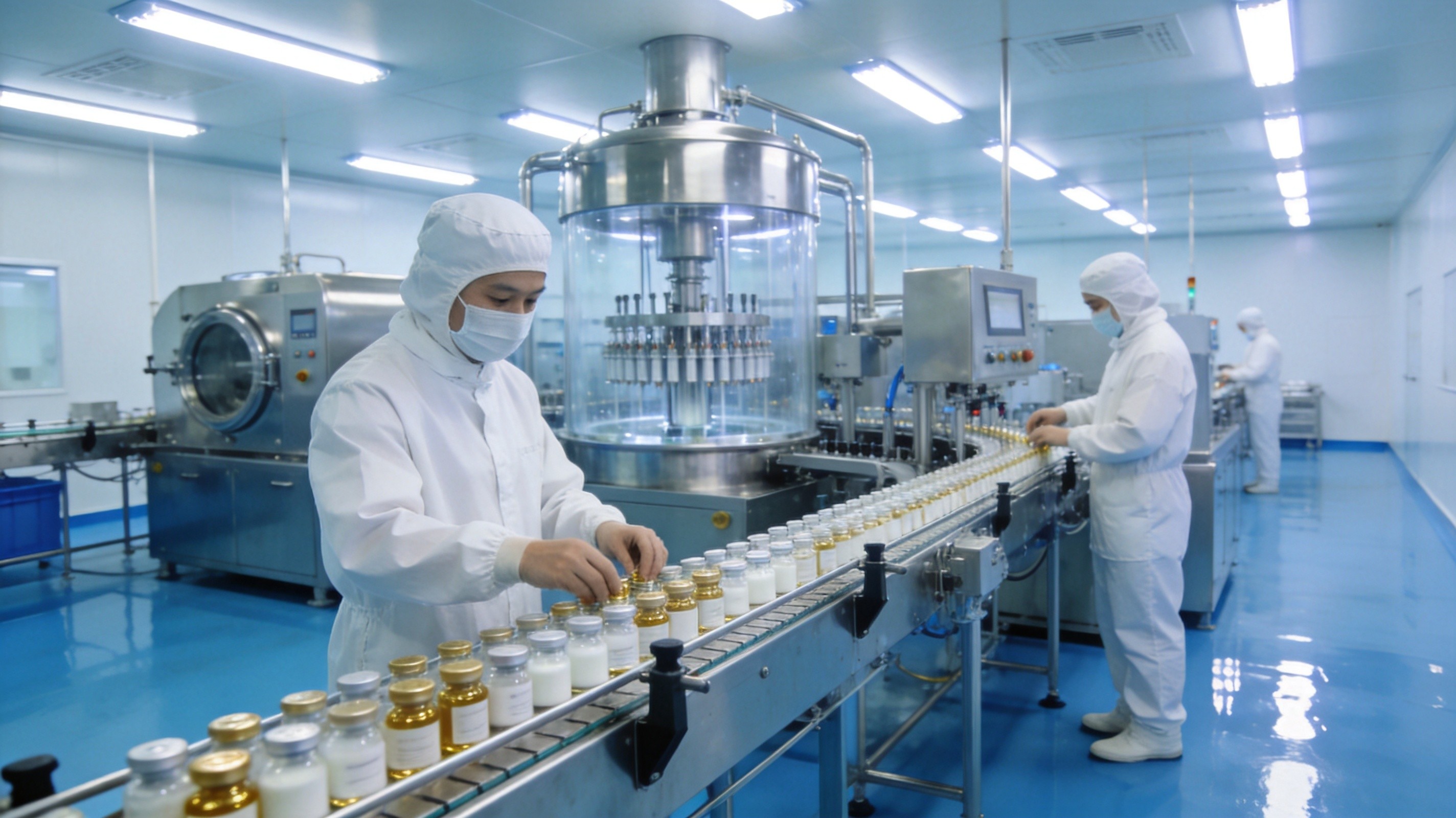
First, built a new Class 100,000 cleanroom. The cleanliness level meets medical device GMP requirements, specifically for Class II medical device production.
Second, imported 13 freeze-dryers. The freeze-drying process for recombinant collagen is a core barrier; without good freeze-drying equipment, you can't produce products with stable activity retention.
Third, deep implementation of industry-academia-research cooperation. Jointly established the "Recombinant Collagen Joint Laboratory" with our own research institute to quickly transform cutting-edge research results into products.
Fourth, annual production capacity exceeded 50 million units. This is 2025 data, covering six major dosage forms: freeze-dried powder, freeze-dried emulsion, gel, spray, dressing, and essence.
What Weitai's Full Qualifications Really Mean
Clients often ask: what's the biggest difference between you and other contract manufacturers?
I usually don't answer directly but ask: how many certificates does the product you want to make require?
If you only need a cosmetics license, many contract manufacturers on the market can do it, and some are cheaper than us.
But if what you need is: three certificates in one (cosmetics license + medical device license + disinfection license), over 100 ready-made Class II medical device registration certificates available for authorization, 12 independent production lines (separate for cosmetics, medical devices, and disinfection), full dosage form coverage including freeze-dried, water-light, gel, spray, and dressing, industry-academia-research endorsement from key universities, and protection from 72 patents—
Such full-qualification players are few and far between nationwide. Weitai is one of them.
Regarding the authorization of registration certificates, many brand owners are concerned: Weitai's currently held over 100 Class II medical device registration certificates can be authorized to partner brand owners through the "registration holder system." After obtaining authorization, brand owners can directly produce and sell corresponding medical device license products under their own brand names. This means brand owners don't need to spend 12-24 months applying for registration certificates themselves; they can leverage Weitai's existing qualifications for rapid market entry.
Looking ahead to the next five years, Weitai's OEM business will move in two directions: First, continue to deepen cosmetics and medical device joint product development, extending from Class II medical devices to Class III medical devices (focusing on collagen fillers and PDRN water-light). Second, OEM/ODM going global, with markets in Southeast Asia, the Middle East, and Europe already being explored.