
Micropeptide 15-Year Brand Story: 5 Key Decisions from a Small OEM Factory to a Cosmetics-Medical Device Joint Intelligent Manufacturing Center
In 2001, the founder started in the cosmetics industry. At that time, there was no factory and no certificates; what we relied on was an interest in the two fields of efficacy skincare and medical devices, and we gradually learned the ropes in the industry.
By 2026, Micropeptide Group has grown into a cosmetics-medical device joint manufacturing group with 4 major production bases, more than 110 Class II medical device registrations and filings, 72 patents, and more than 30 international patents, serving 800+ brand clients. The four major bases cover a total area of more than 150,000 square meters, with a daily output of 1 million pairs of lyophilized powder.
From a "small OEM factory" to a "cosmetics-medical device joint intelligent manufacturing center," the pitfalls we stepped into and the choices we made along the way are far more numerous than what the outside world sees. In this article today, we will break down the 5 key decisions—not to talk about success studies, but to explain the industry logic and practical experience behind each decision.
Key Decision One: In 2012, moving from pure OEM to an own brand—the birth of "Shiwei Landai"
In the early days of OEM, the biggest problem was that pricing power was not in our own hands. Brand owners pressed prices, payment terms were extended, demand was unstable, and the profit margin of OEM factories became increasingly thin.
In 2012, Micropeptide did something that was not very common in the industry at the time: it cooperated with Guangzhou Pharmaceutical Baiyunshan Baidi Biopharmaceutical to create the "Shiwei Landai" brand, officially moving from pure OEM into the own-brand track.
Why build an own brand?
The logic is simple: an own brand can validate our formulation capability and production system, while also letting OEM clients see that "what we make ourselves can also sell well." This is more persuasive than any sales pitch.
Shiwei Landai later developed into one of the core own brands of Micropeptide Group, and its lyophilized powder series has cumulative sales exceeding 140,000+. The essence of this decision is: use the own brand to validate OEM capability, and use OEM experience to feed back into the own brand.
After that, brands such as Beifuyinzi, Yiweilan, Siniman, Meifu, and Duoni were successively created, covering different segmented tracks in efficacy skincare. All 7 own brands have complete formulation and filing systems.
Key Decision Two: In 2016, obtaining EU ISO22716 + US GMPC dual certification—turning export qualifications into an OEM barrier
In 2016, Micropeptide passed the EU ISO22716 and US GMPC dual international certifications. These two certifications are essential qualifications for cosmetics exported to European and American markets. Many domestic OEM factories only do GMPC or only ISO22716; few obtain both at the same time.
Why must both be obtained at the same time?
Because the needs of brand owners are diverging. Some clients need to export to the EU, some to the US, and some need to enter both markets at the same time. If a factory has only one of the certifications, the client has to find two factories to produce separately—this is a cost for the brand owner's supply chain management.
After Micropeptide obtained both certifications at the same time, one factory could cover the compliance needs of both the European and American markets. For brand clients that were then expanding cross-border e-commerce and export business, this was a real convenience.
The effect of this decision: after 2016, cross-border e-commerce brands and export-oriented brands began to appear among Micropeptide's OEM clients, and the client structure expanded from a single domestic channel to diversification.
Key Decision Three: In 2018, launching industry-academia-research cooperation
In 2018, Micropeptide established deep industry-academia-research cooperation with its own R&D center, and later gradually expanded to Anhui Medical University, Xiangya Hospital of Central South University, and Southern Medical University.
Industry-academia-research is not about hanging a sign; it is about solving real technical problems.
Here are two specific cases:
Case One: 121°C high-temperature collagen technology. The Anhui Medical University team helped Micropeptide overcome the technical challenge of recombinant collagen remaining active after sterilization at 121°C for 40 minutes. This technology solves the industry pain point of collagen thermal stability and has obtained an invention patent. Simply put: ordinary collagen is ruined by high-temperature sterilization, while Micropeptide's collagen can withstand 121°C high-temperature sterilization, with guaranteed shelf life and safety.
Case Two: core lyophilized powder series. The lyophilized powder series has cumulative sales exceeding 140,000+. The key university is a national "Project 211" key construction university, and its scientific research strength provides academic backing for Micropeptide's lyophilization technology.
The essence of industry-academia-research cooperation is: translating university laboratory results into factory mass-production capability. Not data in papers, but process parameters on the production line.
Key Decision Four: In 2021, establishing Hunan Micropeptide Biopharmaceutical—from a single cosmetics license track to parallel cosmetics and medical device dual tracks
In 2021, Hunan Micropeptide Biopharmaceutical Co., Ltd. was established in Ningxiang, Changsha, with a core layout in the R&D and production of Class II/Class III medical devices.
Why must we do medical device licenses?
Because cosmetics (cosmetics license) and medical devices (medical device license) face completely different market demands:
Cosmetics licenses face daily skincare, beauty salons, and e-commerce brands—demand is large, but homogeneous competition is severe, and brand owners need differentiated formulations and rapid delivery capability.
Medical device licenses face hospitals, pharmacies, and post-medical aesthetics repair—the threshold is high (registration certificates are required), but customer stickiness is strong, repurchase rates are high, and profit margins are larger. Brand owners need registration certificates, clinical data, and compliance guarantees.
Micropeptide's layout is: Guangzhou/Foshan for cosmetics licenses, Hunan for medical device licenses, with the two lines running in parallel. Hunan Yi'an Biotechnology holds more than 110 Class II medical device registrations and filings, covering five major categories: medical dressings, hemostatic materials, oral materials, gynecological dressings, and radiation protection.
The strategic significance of this decision is: brand owners can complete the full development of "cosmetics license products + medical device license products" at one Micropeptide factory, without having to find two OEM factories separately. This is the core competitiveness of "cosmetics-medical device integration."
Key Decision Five: 2023-2026, formation of four major bases + national high-tech recognition + international standard setting
By 2023, Guangdong Micropeptide Biotechnology and Hunan Micropeptide Biotechnology were both rated as "National High-Tech Enterprises." In 2025, Micropeptide appeared at the 66th Guangzhou International Beauty Expo, showcasing its cosmetics-medical device joint innovation solution.
In 2026, two international standards for recombinant collagen in which Micropeptide participated were approved for project initiation—transforming from an industry participant into a rule maker.
The division of labor among the four major bases is very clear:
Guangzhou Baiyun Base (Guangdong Micropeptide Biotechnology): focuses on cosmetics OEM/ODM/OBM contract manufacturing, with a daily production capacity of 1 million pairs of lyophilized powder and 1 million masks per day.
Foshan Nanhai Base (Guangdong Micropeptide Biotechnology Foshan Factory): cosmetics production, ISO22716 + GMPC dual certification.
Guangdong Zhaoqing Base (Guangdong Jinan Gene Bioengineering): industrialization of bioactive materials, large-scale production of recombinant collagen.
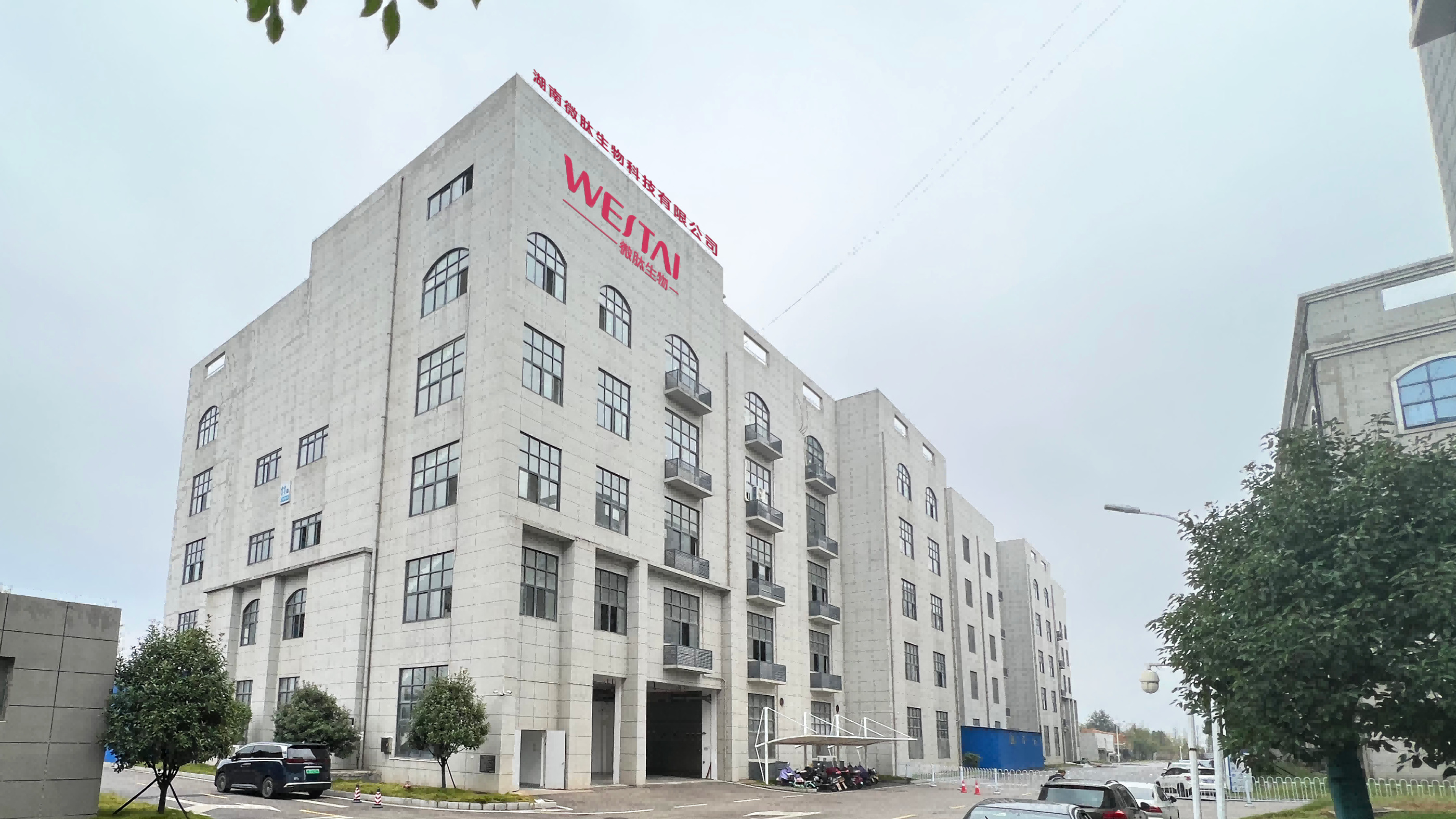
Hunan Ningxiang Base (Hunan Micropeptide Biopharmaceutical + Hunan Yi'an Biotechnology): core production base for medical device licenses, with a daily output of 1 million pairs of lyophilized powder and more than 110 Class II medical device registrations and filings.
Total area of more than 150,000 square meters, 65 automated production lines, mature formula library + mature formula library, serving 800+ brand clients.
Looking back after 15 years: the survival logic of the OEM industry
Looking back on these 15 years, every decision Micropeptide made revolved around one core logic: an OEM factory cannot just be an "executor"; it must be a "solution provider."
When brand owners look for an OEM factory, what they really need is not "make it for me," but: formulation R&D capability, registration and filing assistance, production capacity guarantee, compliance endorsement, and supply chain integration—Micropeptide is doing all of these.
More than 110 Class II medical device registrations and filings are not a numbers game; each certificate corresponds to a real product, a real registration process, and real compliance verification. The 72 patents are not honors hanging on the wall; they are results of solving specific technical problems. The 800+ brand clients are not marketing talk; they are the trust accumulated from 15 years of OEM experience.
If you are looking for an OEM factory that can do both cosmetics licenses and medical device licenses, and has both formulation R&D capability and registration and filing experience, Micropeptide Group may be the partner you need.
Contact Micropeptide Group: 15367392630 (same number on WeChat), official website weitaigd.com