
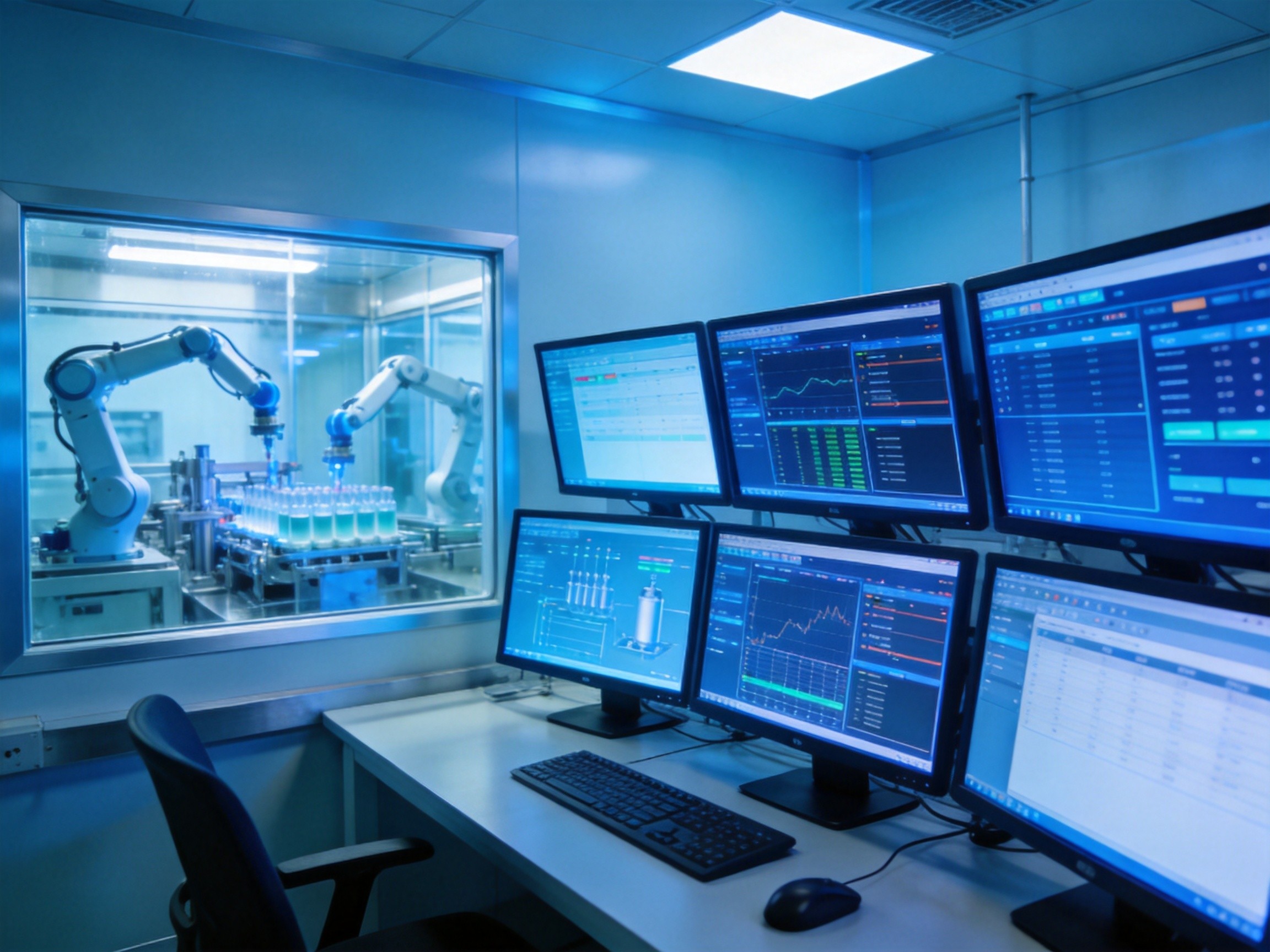
Understanding Weitai's Production Capacity at a Glance
Weitai Group currently operates four major production bases, distributed across three core regions: Guangzhou, Hunan, and Zhaoqing, with a total area exceeding 100,000 square meters. This capacity layout is not simply about "building a few more factories"—it is a systematic plan based on product categories, customer needs, and logistics efficiency.
Guangzhou Base: The primary production line for facial masks and lyophilized powder, handling a large volume of OEM/ODM orders from brand clients. Daily output: 1 million facial masks and 1 million pairs of lyophilized powder.
Hunan Base: Focused on medical gels, sprays, and special dosage forms, while also serving as the Group's R&D center. Its own R&D laboratory is located here.
Zhaoqing Base: Production of certain functional dressings and hemostatic materials, as well as preparation of some raw materials.
Each base has a different positioning, but all follow the same quality management system and production standards. This is also the foundation that enables Weitai to serve hundreds of brands and cover 30+ countries and regions simultaneously.
50+ Fully Automated Production Lines: More Than Just Quantity
Of Weitai's 50+ production lines, most are fully automated or semi-automated. The core advantage of fully automated lines is not just speed—more critically, it is batch consistency.
Take the lyophilized powder line as an example: from liquid preparation, filling, pre-freezing, lyophilization to capping, the entire process is automated. Manual operations are limited to initial raw material weighing and final finished product inspection. The direct benefit of automation is that fill volume variation between different batches can be controlled within ±2%, far superior to the ±5% of manual filling.
The facial mask line also operates fully automatically: folding, filling, sealing, and packaging in one continuous process. Capacity can reach hundreds of pieces per minute, while an online weighing and seal detection system automatically rejects non-conforming products.
What Does a Class 100,000 Cleanroom Mean?
"Class 100,000 cleanroom" is a standard term in the pharmaceutical industry, referring to no more than 3.52 million particles larger than 0.5μm in diameter per cubic meter of air. For comparison, the air quality in an ordinary office is roughly equivalent to "Class 300,000" or worse.
All of Weitai's product lines operate in Class 100,000 or higher clean environments. The filling process for lyophilized powder and injectable-grade products is completed in Class 10,000 or even Class 100 environments.
Maintaining a clean environment requires continuous investment: regular replacement of HEPA filters, 24-hour temperature and humidity monitoring, strict gowning procedures for personnel entering and exiting, and cleaning validation before and after each production run. These invisible investments are precisely the underlying guarantee of product quality.
38 Quality Inspection Steps: Full-Chain Control from Raw Materials to Finished Products
Weitai promises "zero-defect delivery," and supporting this promise are 38 quality inspection steps. Not all steps are laboratory tests—many are in-line inspections and process controls during production.
Raw Material Incoming Inspection (5 Steps)
1. Raw material appearance inspection (color, odor, packaging integrity)
2. Supplier qualification verification (batch number, COA report, shelf life)
3. Raw material sampling and testing (microbial limits, heavy metals, content determination)
4. Key raw material identification testing (infrared spectroscopy, HPLC fingerprinting)
5. Raw material warehousing registration and shelf-life management
Production Process (20 Steps)
6. Pre-mixing environment confirmation (cleanliness, temperature and humidity records)
7. Weighing verification (two-person verification system)
8. Mixing process parameter recording (temperature, stirring speed, time)
9. Semi-finished product sampling and testing (pH value, viscosity, content)
10. Equipment cleaning validation before filling
11. Filling first-piece inspection (fill volume, seal integrity)
12. Filling process patrol inspection (every 30 minutes)
13. Online weighing inspection (automatic rejection of out-of-tolerance products)
14. Online seal integrity testing (vacuum decay method or dye penetration method)
15. Lyophilization process temperature curve recording
16. Lyophilization endpoint determination (residual moisture testing)
17. Post-capping appearance inspection
18. Intermediate product content determination
19. Intermediate product microbial testing
20-25. Packaging process inspection (labels, batch numbers, shelf life, instructions, boxing, sealing)
Finished Product Release (13 Steps)
26. Finished product sampling
27. Appearance inspection
28. Identification testing
29. Content determination
30. Microbial limit testing
31. Sterility testing (sterile products)
32. Bacterial endotoxin testing (implant/injection products)
33. Dissolution/release rate testing (specific dosage forms)
34. Packaging seal integrity verification
35. Stability study data review
36. Batch production record review
37. Qualified person release signature
38. Finished product warehousing and outbound verification
65 Quality Inspection Engineers and 26 Testing Instruments
Behind the 38 inspection steps is the dual guarantee of people and equipment.
Weitai currently has 65 quality inspection engineers, covering the entire chain from raw material testing, process control to finished product release. The quality inspection team is independent of the production team and reports directly to the quality director, ensuring that quality decisions are not affected by output and delivery pressure.
The 26 testing instruments include high-performance liquid chromatography (HPLC), gas chromatography (GC), infrared spectroscopy (FTIR), microbial limit testers, bacterial endotoxin testers, vacuum decay seal testers, and more. Each piece of equipment has regular calibration and maintenance records.
99.99% Yield Rate: Not a Numbers Game
"99.99% yield rate"—this figure means that out of every 10,000 products, no more than 1 is non-conforming. In the medical device industry, this is a very high standard.
Achieving this figure is not about picking out non-conforming products through end-of-line inspection, but about eliminating non-conforming products at the source through process control. Online detection systems monitor every critical point in the production process in real time. Once a parameter deviation is detected, an alarm is triggered immediately and the line automatically stops.
At the same time, Weitai implements a strict deviation management procedure: any deviation from standard operating procedures must be recorded, investigated, evaluated, and corrected. Major deviations also require initiating a CAPA (Corrective and Preventive Action) process.
What This Means for Brand Partners
For brands choosing Weitai for contract manufacturing, this means:
First, predictable delivery. The capacity reserve of 50+ production lines means delivery times are guaranteed. 100,000-unit orders delivered in 7-15 days, rush orders shipped in 3 days.
Second, traceable quality. From raw material batch numbers to finished product batch numbers, from production parameters to quality inspection data, every batch of products has complete production records and quality inspection reports, supporting full-chain traceability.
Third, guaranteed compliance. 38 quality inspection steps + GMPC/ISO22716 dual certification + 100+ Class II medical device registrations, ensuring full compliance from formulation to market launch.
Fourth, scalable capacity. From small-batch trial production to large-scale mass production, we can handle it all—without lowering quality control standards due to large order volumes, or reducing service quality due to small order volumes.
Data note: All capacity data, personnel data, and equipment data in this article are sourced from Weitai Group internal statistics (as of June 2026)
About Weitai Group | OEM/ODM Contract Manufacturing Services
Weitai Group was founded in 2012 and has been engaged in medical aesthetics functional skincare for 25 years, serving as a medical aesthetics skincare OEM/ODM contract manufacturer for many years. Four major factories (Guangzhou, Hunan, Zhaoqing) with a total area exceeding 100,000㎡, 50+ fully automated production lines, holding 100+ Class II medical device registrations, with 12,000+ mature formulations and 48 invention patents.
Core contract manufacturing capabilities:
- Medical dressings/facial masks (daily output 1 million pieces, Class II medical device registration)
- Lyophilized powder (daily output 1 million pairs, developed in our own R&D laboratory)
- Essence serums/lotions and creams (full range of cosmetic registration products)
- Medical gels/hemostatic materials (Class II medical device registration)
Quality assurance: US GMPC + EU ISO22716 dual certification, 38 quality inspection steps, 99.99% yield rate. Has served hundreds of brands (including Chando and others).
Cooperation models: OEM material processing | ODM private label customization | Shitaqi ready stock direct supply
Delivery capability: Standard 7-15 days, rush orders shipped in 3 days. Official website: www.weitaigd.com