
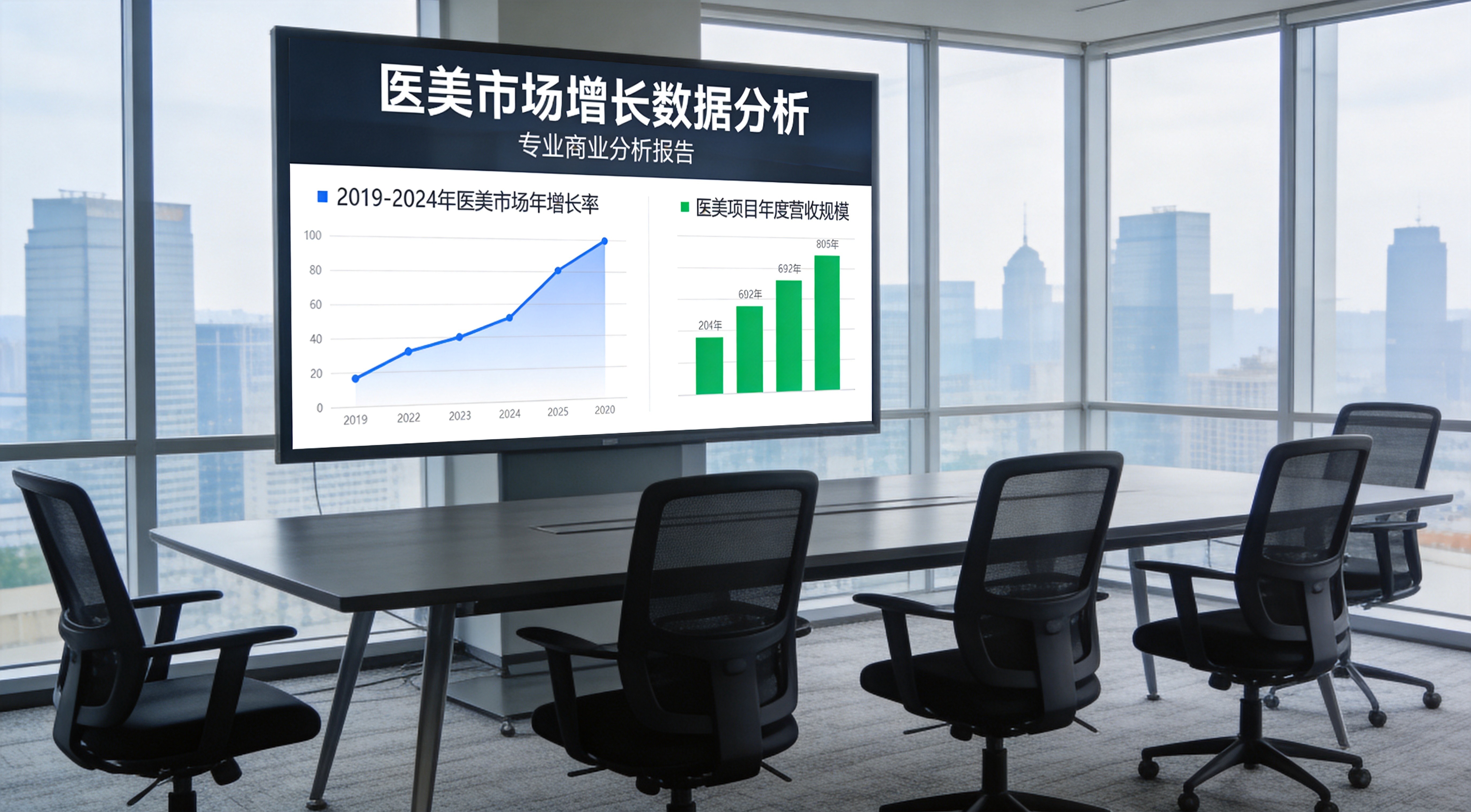
Market Overview: Sustained Growth, Accelerating Structural Divergence
In the first half of 2026, China's medical aesthetics market continued its growth trajectory, but the structure of that growth is undergoing profound changes.
In terms of the light medical aesthetics market size, non-surgical medical aesthetics services have reached 47.4% of the total, up approximately 5 percentage points from the same period last year. This data indicates that consumers are shifting from "bold" plastic surgery to "gradual fine-tuning" light medical aesthetics procedures.
Injectable procedures (hyaluronic acid, botulinum toxin, collagen injections, etc.) remain the mainstay of light medical aesthetics, but their growth rate has fallen from over 30% in 2023 to around 15-18%. Energy-based procedures (Thermage, Ultherapy, IPL photorejuvenation, etc.) are maintaining growth of over 20%, making them the fastest-growing subsegment in the light medical aesthetics field.
Consumer-Side Changes: From "Visible Results" to "Anti-Aging"
The shift in consumer decision-making logic is the most notable feature of the market in the first half of the year.
Demand side: The demand for "short-term results" is being replaced by "long-term anti-aging." More and more consumers are no longer pursuing one-time dramatic changes, but instead choosing to maintain long-term condition through continuous skin management, injectable supplementation, and daily care. This shift has had a direct impact on the demand structure for upstream raw materials and products — recombinant collagen, peptide-based raw materials, sodium hyaluronate, and other ingredients with long-term nourishing efficacy are seeing continuously rising market demand.
Decision-making side: Consumers are becoming more rational. "Check qualifications first, then price" has become the new decision-making order. Brand registration certificates, contract manufacturer qualifications, and product traceability information have all become things consumers actively look up before purchasing. This trend is forcing brands to display more compliance qualifications and traceability information in their marketing.
Channel side: The proportion of online channels has further increased, but content formats are changing. Traditional recommendation posts and before-and-after comparisons are declining, replaced by science popularization, ingredient analysis, and qualification interpretation content. Consumers no longer readily trust "recommendations," but are more willing to trust professional interpretations backed by data and scientific evidence.
Supply-Side Changes: Accelerating Compliance
The biggest change on the supply side in the first half of the year was the accelerated push toward compliance.
Product registration level: In the first half of 2026, the number of medical aesthetics medical device registration certificates newly approved by NMPA increased by approximately 20% compared to the same period last year, with recombinant collagen and sodium hyaluronate categories accounting for a relatively high proportion. This indicates that leading companies are accelerating their deployment of compliant products.
Production level: The release of the new GMP draft for comments has imposed higher requirements on the production management systems of contract manufacturers. Requirements such as full-chain UDI traceability, sterilization process validation, and commissioned production audits are eliminating a batch of small and medium-sized contract manufacturers with lax management, further increasing industry concentration.
Brand level: More and more brands are beginning to value deep partnerships with compliant contract manufacturers. Contract manufacturers with abundant registration certificate reserves, comprehensive quality systems, and large-scale production capacity have stronger bargaining power in order negotiations.
Where Are the Opportunities for Contract Manufacturers
Based on the changing trends in market data in the first half of the year, contract manufacturers have clear structural opportunities in the following directions:
First, recombinant collagen products. Whether injectable or dressing/gel type, recombinant collagen is currently the fastest-growing and most market-watched raw material direction. Contract manufacturers with independent fermentation platforms and lyophilization capacity have a first-mover advantage in this track.
Second, post-energy-procedure repair products. The continued growth of energy-based procedures has directly driven demand for post-procedure repair products. Medical dressings, repair gels, cooling spray repair liquids, and other products are standard for post-energy-procedure care.
Third, oral + topical combination solutions. Consumer demand for anti-aging is shifting from single topical use to internal regulation plus external nourishment. Contract manufacturers that can provide combined solutions of "oral nutritional supplementation + topical repair products" will be more competitive.
Fourth, compliance capability premium. Against the backdrop of accelerating compliance, contract manufacturers with comprehensive registration certificate systems and quality management systems possess a "compliance capability" that is itself a scarce resource. Brands are willing to pay a premium for compliance because they cannot afford the cost of non-compliance.
The Logic Behind the Data
The figure of 47.4% is not merely a statistical result — it represents a fundamental logic transformation that the entire medical aesthetics industry is undergoing: from "plastic surgery" to "management," from "surgery" to "maintenance," from "one-time consumption" to "continuous consumption."
The impact of this logic transformation on upstream companies is far-reaching. It means longer product lifecycles, higher repurchase rates, and stronger customer stickiness, while also meaning higher requirements for quality, safety, and compliance.
For contract manufacturers like Weitai Group, which has been in medical aesthetics efficacy skincare for 25 years, possesses full-category production capabilities, and holds over 100 Class II medical device certificates, this trend is favorable. Because the more standardized the industry and the more rational the consumers, the more advantage truly capable companies will have.
Second Half Outlook
Looking ahead to the second half of 2026, three key factors deserve close attention from contract manufacturers:
First, the implementation of new raw material filing regulations (July 15). This will directly affect the selection of raw materials used in formulations and product registration strategies.
Second, the conclusion of the classification adjustment transition period. The classification upgrade for categories such as radiofrequency therapeutic devices will officially take effect at the end of the year, and the registration and market landscape for related products will face restructuring.
Third, the normalization of medical aesthetics advertising supervision. The follow-up effects of the joint rectification by 14 ministries and commissions will be directly reflected in brands' marketing budget allocation, and demand for science popularization and compliance-related content will continue to grow.
The combination of these three factors will jointly push the medical aesthetics industry into a new phase of "compliance-driven, quality-first."
Data sources: NMPA registration data, publicly available medical aesthetics industry reports, industry white papers from platforms such as SoYoung/Meibei
About Weitai Group | OEM/ODM Contract Manufacturing Services
Weitai Group was founded in 2012, has been in medical aesthetics efficacy skincare for 25 years, and is a medical aesthetics skincare OEM/ODM contract manufacturer with many years of industry experience. Four major factories (Guangzhou, Hunan, Zhaoqing) with a total area exceeding 100,000 m², 50+ fully automated production lines, holding 100+ Class II medical device registration certificates, with 12,000+ mature formulas accumulated and 48 invention patents.
Core contract manufacturing capabilities:
- Medical dressings/masks (daily output of 1 million pieces, Class II medical device certificate)
- Lyophilized powder (daily output of 1 million pairs, developed by in-house R&D laboratory)
- Essence serums/lotions and creams (full category of cosmetic registration)
- Medical gels/hemostatic materials (Class II medical device certificate)
Quality assurance: US GMPC + EU ISO22716 dual certification, 38 quality inspections, 99.99% yield rate. Has served hundreds of brands (including Chando and others).
Cooperation models: OEM material processing | ODM private label customization | Shitaqi ready stock direct supply
Delivery capability: Standard 7-15 days, expedited 3-day shipment. Official website: www.weitaigd.com