
Introduction
2026 is a year of intensive implementation of regulations in the medical device industry. From the revised version of the "Provisions on the Administration of Registration and Filing of New Cosmetic Ingredients and Related Materials" released in June, to the release of the draft for comments on the new version of medical device GMP, and then to the conclusion of the transition period for classification adjustments, each policy change directly affects contract manufacturers' production compliance and registration application strategies.
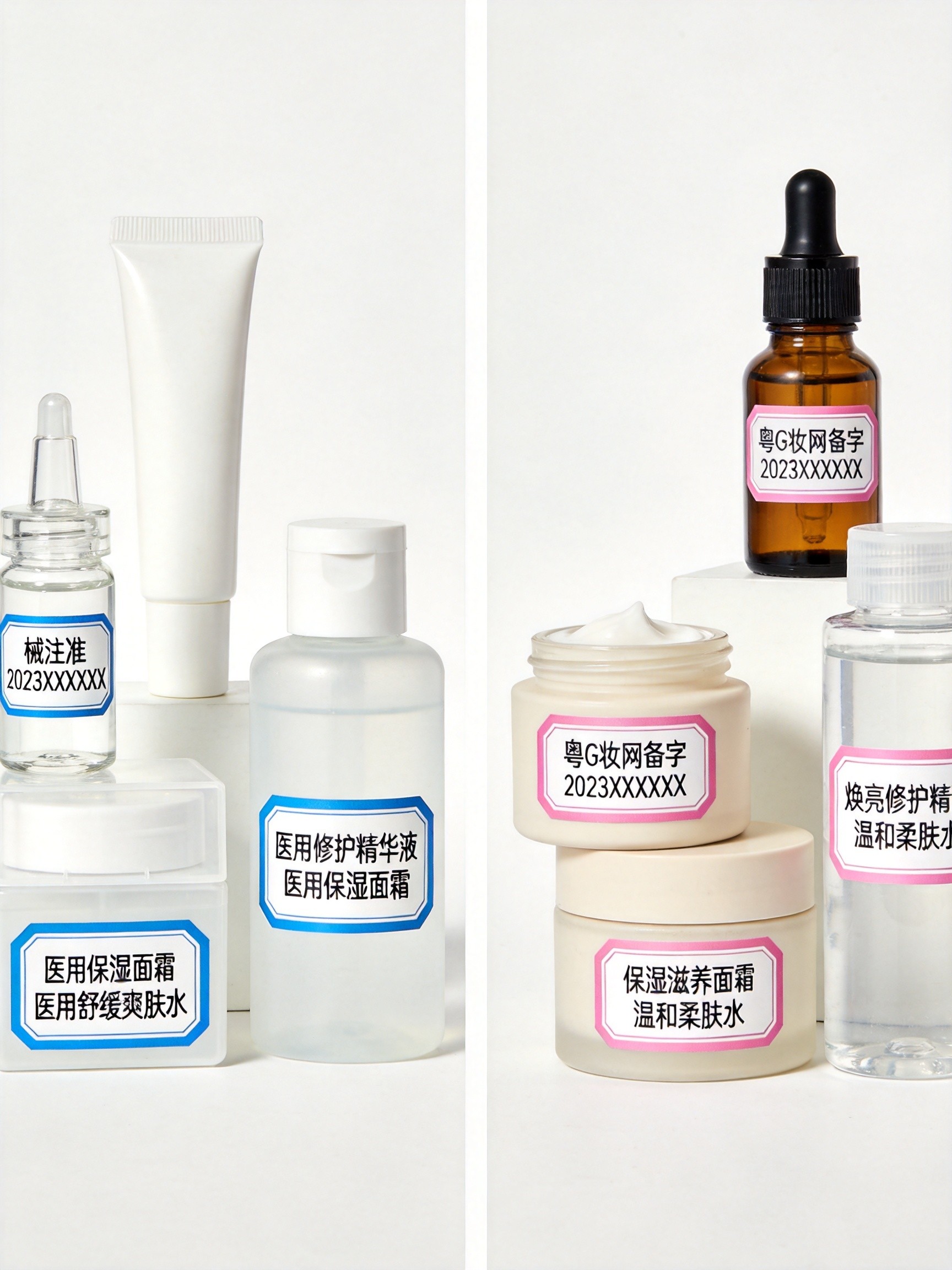
This article focuses on the core compliance differences between medical device registration number products and cosmetic registration number products under the latest 2026 regulatory framework, helping brand owners and contract manufacturers clarify their thinking and avoid pitfalls.
I. Fundamental Differences in Registration Pathways
Medical Device Registration Number (Medical Devices)
Products with a medical device registration number are divided by risk level into Class I, Class II, and Class III:
- Class I Filing System: Such as ordinary medical cold compress patches and medical fever-reducing patches, filed with the municipal drug regulatory authority, with a filing cycle of about 1-3 months and no clinical trial required.
- Class II Registration System: Such as medical recombinant collagen repair dressings and medical sodium hyaluronate gels, applied for registration with the provincial drug regulatory authority, with a registration cycle of about 12-18 months, and most products can follow the clinical exemption pathway.
- Class III Registration System: Such as injectable sodium hyaluronate and radiofrequency therapeutic devices, applied for registration with the National Medical Products Administration, with a registration cycle of about 18-30 months, and clinical trials must be completed.
Cosmetic Registration Number (Cosmetics)
Products with a cosmetic registration number are divided by use into special cosmetics and ordinary cosmetics:
- Special Cosmetics: Such as sunscreen, spot-removing, and hair dye products, applied for registration with the National Medical Products Administration, with a registration cycle of about 8-15 months.
- Ordinary Cosmetics: Such as masks, essences, and face creams, filed with the provincial drug regulatory authority, with a filing cycle of about 1-2 months.
Core Differences
| Dimension | Medical Device Registration Number | Cosmetic Registration Number |
|---|---|---|
| Registration Level | Classified by risk (Class I/II/III) | Classified by function (special/ordinary) |
| Registration Cycle | Class I 1-3 months, Class II 12-18 months, Class III 18-30 months | Ordinary 1-2 months, special 8-15 months |
| Clinical Trials | Class II may be exempt from clinical trials, Class III must undergo clinical trials | Generally no clinical trials required |
| Efficacy Claims | Strictly according to the scope of application approved in the registration certificate | May claim cleansing/moisturizing/sunscreen, etc. |
| Sales Channels | Medical institutions + pharmacies + e-commerce | E-commerce + CS channels + supermarkets |
II. Major Changes Brought by the 2026 New Regulations
1. Conclusion of the Transition Period for Classification Adjustments
The announcement on adjustments to the "Medical Device Classification Catalog" issued in 2024 set a transition period. By the end of 2026, the classification changes for the following categories will officially take effect:
- Radiofrequency therapeutic devices: Upgraded from Class II to quasi-Class III management; those without a Class III registration certificate will not be allowed to be sold
- Some facial filler products: Classification adjusted from Class II to Class III
- Recombinant collagen injection products: Clearly defined as Class III medical devices
Impact on contract manufacturers: Class II radiofrequency products currently in production will face the risk of product removal from shelves. Brand owners and contract manufacturers need to plan ahead for Class III registration or adjust product lines.
2. New Version of GMP Draft for Comments
The medical device GMP draft for comments released in the first half of 2026 has significant changes compared with the current version:
More detailed defect determination standards: The specific circumstances of critical defects and general defects are clarified. Critical defects found in unannounced inspections will directly affect product marketing authorization.
Full-chain UDI traceability becomes a mandatory requirement: From production to circulation to use, UDI information must be scanned and recorded at every stage. Contract manufacturers need to complete the upgrade and transformation of UDI coding systems.
Higher requirements for sterilization process validation: For sterile medical devices, the parameters and methods for sterilization process validation are more stringent, and revalidation according to the latest standards is required.
Tighter management of entrusted production: Where the registrant entrusts production, an on-site audit of the entrusted party's quality management system is required, and the audit report is included in the registration materials. Contract manufacturers need to be prepared to undergo audits by brand owners.
3. New Rules for Filing of New Cosmetic Ingredients
The "Provisions on the Administration of Registration and Filing of New Cosmetic Ingredients and Related Materials" revised in June 2026 came into effect on July 15. Core changes include:
- Simplified the filing process for ordinary cosmetics
- Strengthened safety assessment requirements for new ingredients
- Clarified assessment methods for efficacy claims
- More stringent qualification review of ingredient suppliers
Impact on contract manufacturers: For products using new ingredients in their formulas, it is necessary to ensure that the ingredient supplier has completed new ingredient filing or registration; otherwise, the product cannot be marketed.
III. Compliance Risk Points for Contract Manufacturers
Risk One: Blurred Boundary Between Cosmetics and Medical Devices
The blurred boundary between cosmetic registration numbers and medical device registration numbers for some products is a high-incidence area of compliance risk. Typical cases:
- Masks containing sodium hyaluronate: Filed as ordinary cosmetics under a cosmetic registration number, but claiming "medical-grade moisturizing" — this is a typical violation
- Essences containing collagen: Filed under a cosmetic registration number, but claiming "barrier repair" and "promotes wound healing" — this involves medical efficacy claims
Compliance recommendation: If a product formula contains ingredients commonly used in medical devices (such as recombinant collagen, sodium hyaluronate, chitosan, etc.) and needs to claim efficacy beyond the scope permitted for cosmetics, the medical device registration pathway should be followed.
Risk Two: Same Formula Sold Through Multiple Channels
Some contract manufacturers register products with the same formula separately under cosmetic registration numbers and medical device registration numbers and sell them through two channels. This practice is extremely risky under the 2026 regulatory environment:
- The efficacy claims of cosmetic registration number products are restricted and cannot claim the efficacy of medical devices
- The labels and instructions of medical device registration number products must strictly comply with the content approved in the registration certificate
- The quality control standards of the two channels are different, and sharing production lines poses cross-contamination risks
Compliance recommendation: Medical device registration number and cosmetic registration number products should have independent formulas, independent production lines, and independent quality control systems.
Risk Three: Efficacy Claims Beyond Scope
Advertising supervision further tightened in 2026. In the joint campaign by 14 ministries and commissions to rectify chaos in medical aesthetics, product promotion is a key inspection target:
- Medical device registration number products must not claim beyond the scope of application approved in the registration certificate
- Cosmetic registration number products must not use words such as "medical," "medicinal," or "treatment"
- All efficacy claims need sufficient scientific evidence
Compliance recommendation: Establish an internal efficacy claim review mechanism, and all external promotional content must undergo compliance review before publication.
IV. How Contract Manufacturers Can Build a Compliance System
1. Registration Certificate Reserve Strategy
Contract manufacturers should reasonably plan the application pace of registration certificates according to their own product lines and customer needs. It is recommended to prioritize the following categories:
- Medical dressings (Class II): Large market demand, relatively controllable registration cycle
- Medical gels (Class II): Cover multiple application scenarios such as nasal/oral/gynecological
- Recombinant collagen products (Class II): Core technology reserve, continuous growth in the next three years
- Hemostatic materials (Class II): Stable demand in segmented markets
2. Quality System Upgrade
In accordance with the requirements of the new version of the GMP draft for comments, complete the following upgrades in advance:
- Launch of UDI coding and traceability system
- Revalidation of sterilization processes
- Optimization of shared-line clearance SOPs
- Preparation for entrusted production audits
3. Compliance Team Configuration
It is recommended that contract manufacturers allocate at least 3 full-time compliance personnel:
- 1 regulatory registration specialist: responsible for product registration applications and registration certificate maintenance
- 1 quality control specialist: responsible for incoming material inspection, process control, and finished product release
- 1 compliance review specialist: responsible for compliance review of product labels, instructions, and promotional content
4. Customer Education
Many compliance risks arise from improper requests by brand owners. Contract manufacturers need to proactively educate customers:
- Clearly inform them of the efficacy claim boundaries for cosmetic registration numbers and medical device registration numbers
- Help brand owners understand the pros and cons of choosing registration pathways
- Provide recommendations for compliant promotional plans
V. Summary
The 2026 regulatory environment imposes higher requirements on contract manufacturers in the medical aesthetics and efficacy skincare industry. Compliance is no longer optional; it is an entry threshold.
For leading contract manufacturers with more than 100 Class II medical device certificates and dual ISO13485 and GMPC certifications, the improvement of the compliance system itself is a core competitiveness. When the tide goes out and regulation becomes stricter, only those companies that achieve compliance in place can truly win market trust.
Weitai Group's choice is: compliance first, quality as the foundation. From formula design to registration application, from production quality control to label promotion, every link is evidence-based and rule-based. This is not a cost, but an investment — the foundation for winning customer trust and market opportunities.
Basis of this article: National Medical Products Administration 2026 classification adjustment announcement, new version of GMP draft for comments, new rules for registration and filing of new cosmetic ingredients (effective July 15, 2026)
About Weitai Group | OEM/ODM Contract Manufacturing Services
Weitai Group was founded in 2012 and has been engaged in medical aesthetics efficacy skincare for many years, with 25 years of experience. It is an OEM/ODM contract factory for medical aesthetics skincare products with many years in the industry. Its four major factories (Guangzhou, Hunan, Zhaoqing) cover a total area of more than 100,000 ㎡, with 50+ fully automated production lines, holding 100+ Class II medical device registration certificates, accumulating 12,000+ mature formulas, and 48 invention patents.
Core contract manufacturing capabilities:
- Medical dressings/masks (daily output of 1 million pieces, Class II medical device certificate)
- Freeze-dried powder (daily output of 1 million pairs, developed by its own R&D laboratory)
- Essence serums/lotions and creams (full category of cosmetic registration numbers)
- Medical gels/hemostatic materials (Class II medical device certificate)
Quality assurance: U.S. GMPC + EU ISO22716 dual certification, 38 quality inspections, yield rate 99.99%. Has served hundreds of brands (including Chando, etc.).
Cooperation models: OEM processing with supplied materials | ODM private label customization | Shitaqi spot supply
Delivery capability: Regular 7-15 days, expedited shipment in 3 days. Official website: www.weitaigd.com