

"The anti-aging needle injected into the face is actually made from skin donated by deceased donors." Recently, a South Korean medical aesthetics injectable was thrust into the spotlight, and netizens gave it a blunt name — the "corpse skin needle."
According to China Newsweek, this product is a dermal filler called Elravie Re2O (hereinafter referred to as Re2O; Re2O is short for "return to your 20s") launched by South Korean biotechnology company L&C BIO. It was launched in South Korea in November 2024 and is currently sold in South Korea, Japan, Singapore, and other countries, with a single shot priced at approximately 3,200 to 4,000 RMB. Its core selling point is the "extracellular matrix" (ECM) obtained by decellularizing skin tissue from deceased donors.
Behind the buzz, the controversy has not subsided despite feedback that "the skin became smoother." By sorting through information from multiple sources, it can be seen that this product has actually posed three questions that the entire medical aesthetics and functional skincare industry must answer.
1. Ethical Question: Can Donated Tissue Meant to Save Lives Be Used for Beauty Consumption?
To understand the controversy, one must first clarify what exactly Re2O injects into the face.
According to China Newsweek, its production process involves decellularizing skin tissue from deceased donors, removing cellular components and genetic material, leaving behind a "purified framework" mainly composed of collagen, elastin, etc., namely the extracellular matrix (ECM), which is then formulated into injectable microparticles to serve as a scaffold for skin cells to attach to and grow on.
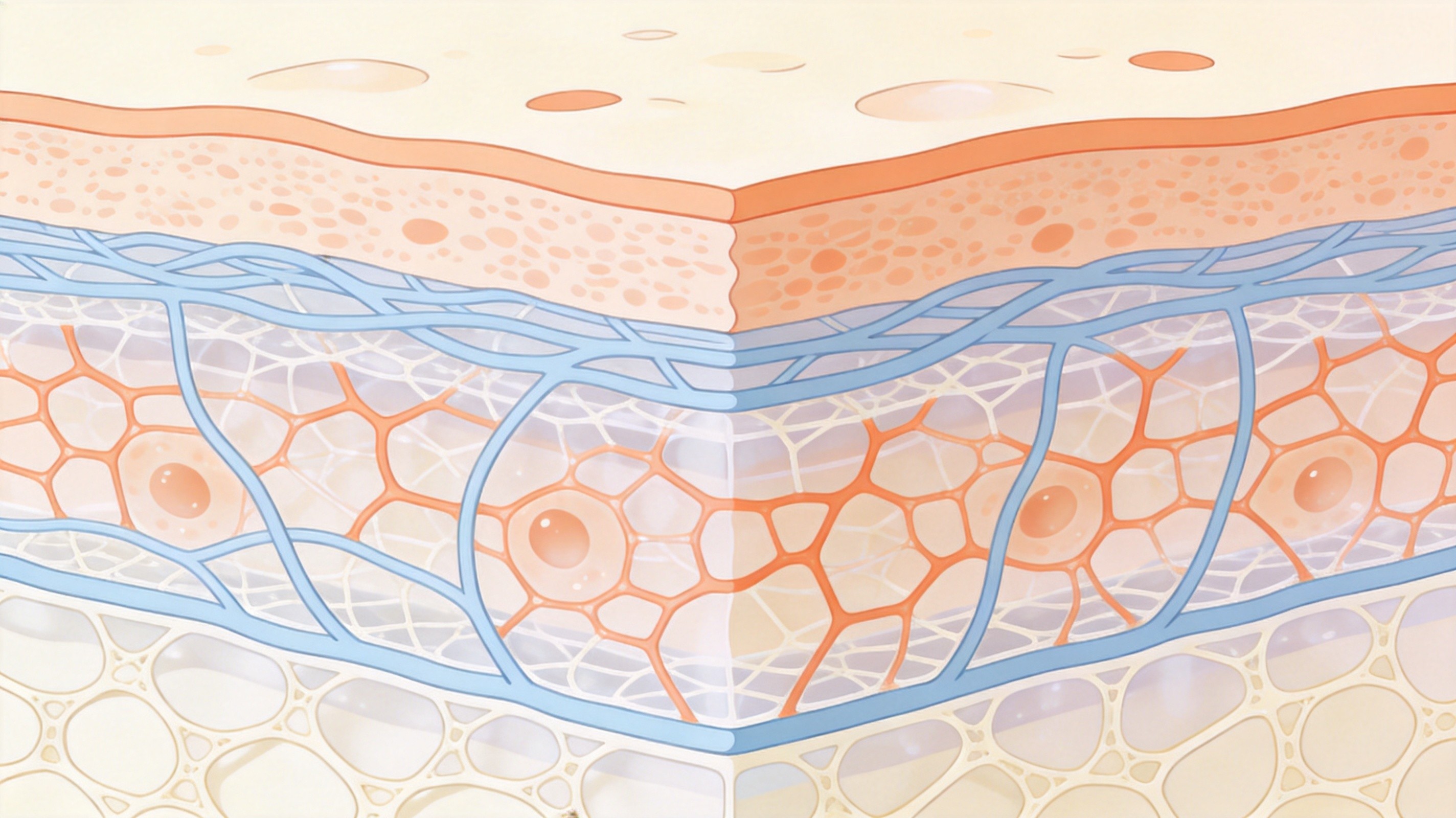
Chen Youbai, a member of the Plastic Surgery and Reconstruction Branch of the Chinese Medical Doctor Association, introduced that decellularization technology is not new in the medical aesthetics field; dermis, fat, and blood vessels can all be processed using similar methods, but 90% of clinical use involves animal materials. Xue Ke, discipline leader of plastic surgery at Shanghai Pudong New Area Gongli Hospital, mentioned that clinical "allogeneic skin" is mainly used to treat large-area burns and is a very precious medical resource.
This is the core of the ethical controversy: many people believe that the original intent of deceased donors donating skin is to save patients, and it should be prioritized for serious medical treatment, rather than being made into high-priced beauty anti-aging consumer products. According to reports relayed by Shenzhen News and other media, domestic authoritative experts have clearly stated that under Chinese regulations, commercial trading of human tissue is strictly prohibited.
Another layer of controversy is the right to know. According to a report reposted by Yangcheng Evening News, some beauty seekers only learned the source of the raw material after injection and after scrolling through social media, and said bluntly, "If I had known in advance, I would not have gotten it." Whether key information such as raw material sources that could affect consumption decisions should be fully and clearly disclosed before the procedure is itself an unavoidable question.
2. Safety Question: Short-Term Skin Feel Improves, But Is Long-Term Data Sufficient?
The logic of supporters is: after decellularization, the main components that trigger rejection are removed, and ECM is similar to human skin components. Manufacturer L&C BIO also stated that the raw material is imported from the United States, using only skin tissue that has undergone legal donation procedures and with clearly distinguished uses, and that it undergoes annual review by South Korea's Ministry of Food and Drug Safety, and claims that there have been no reports of serious adverse reactions since launch.
But in the view of professionals, "no problems so far" and "long-term safety" cannot be equated.
According to China Newsweek, Chen Youbai pointed out that current decellularization technology is difficult to achieve 100% cell removal. Once cellular components carrying the donor's genetic fragments remain, and the donor has a genetic disease, it could pose risks; in addition, ECM is a composite component, making it harder to troubleshoot and trace than single-component fillers if problems arise. Xue Ke also stated that for using "allogeneic skin" for injectable filling, relevant clinical data are relatively lacking, and at least 5 to 10 years of long-term observational follow-up are needed.
The persuasiveness of the research itself has also been questioned. The report cited foreign media information stating that an early study of Re2O lasted only 20 weeks, had a small sample size, and the participants were researchers who developed the product; a British beauty practitioner commented that this product "has more marketing than scientific validation."
In addition, issues such as differences in collagen and elastin quality due to donor age, as well as excessive dilution by some institutions and opaque effective ingredient content per milliliter, have also been repeatedly mentioned by local Korean doctors and overseas clinics.
3. Regulatory Question: Cross-Border "Internet-Famous Needles" — Who Will Protect Consumers?
The difference in regulatory approaches is the part of this controversy that deserves the most vigilance from the domestic industry.

According to multiple media reports, in South Korea, Re2O is not classified as a drug or ordinary medical device, but as "human tissue," which allows it to be marketed without the rigorous, long-term clinical trials required for drugs and devices; and according to public reports, the U.S. FDA has not approved this product for medical aesthetics injection.
In China, the threshold is much clearer. Cui Haiyan, chief physician of the Plastic and Reconstructive Surgery Department at Tongji Hospital Affiliated to Tongji University, stated that Re2O faces practical challenges at the raw material source level, including customs and social ethics, and its safety and efficacy also require more sufficient clinical evidence; according to the medical device regulatory regulations of the National Medical Products Administration, products must complete relevant standards and clinical trials before they can be approved to enter the Chinese market. In other words, at this stage, domestic consumers who travel specifically to South Korea for injections, if problems arise, mainly rely on overseas institutions for rights protection, which involves obvious uncertainty.
A larger backdrop is that cross-border light medical aesthetics is rapidly heating up. According to the "2026 China Medical Aesthetics Industry Insight Report" cited in public reports by Daily Economic News and others, in 2025, South Korea accounted for about 51% of destinations for Chinese outbound medical aesthetics travelers, and dermatology accounted for about 70% of treatments. The more severe the information asymmetry, the easier it is for the combination of "internet-famous concept + high price + opaque information" to make consumers pay for risks.
Implications for the Functional Skincare Industry: Give "Certainty" Back to Consumers
Injectable medical products and topical skincare products are inherently two different tracks. The Re2O controversy is instead a reminder for companies and contract manufacturers that honestly make cosmetics: the demand for anti-aging is real and huge, but the way to meet this demand should be built on compliance and transparency.
- Boundaries must be clear: Ordinary cosmetics ("cosmetics registration number") are managed by filing under cosmetics regulations; special functions such as whitening require special cosmetics registration (special certificate); injectable filler products are regulated at a higher level as medical devices, drugs, etc. No topical product may claim injectable or filler-type medical efficacy.
- Ingredients must be clear: The full ingredients of compliant products are labeled according to law, and filing information is officially searchable. Consumers can verify with the "Cosmetics Regulation" App, which builds long-term trust better than sensational stories.
- Choices must be stable: Whether for own brands or OEM/ODM contract manufacturing, priority should be given to factories with formal production qualifications, mature and fileable formulas, and the ability to provide complete testing and accompanying documents, rather than following trends and hyping "new concept ingredients" of questionable origin.
Anti-aging is a long-term endeavor. When a product needs a name like "return to your 20s" and a sensational raw material story to move consumers, rational consumers and a mature industry should return to the most basic question: can its safety, efficacy, and compliance withstand the test of time and regulations?
(The factual parts of this article are synthesized from public reports by China Newsweek, Yangcheng Evening News, Daily Economic News, Shenzhen News, Poster News, etc. Expert views are quoted from the above reports and are only for industry information interpretation, not constituting any medical or consumer advice. This article is industry information and science popularization content. The companies and product information mentioned are subject to official and authoritative media public reports, and no injectable medical products are recommended or sold.)
Frequently Asked Questions FAQ
Q1: What exactly is Re2O (corpse skin needle)?
It is an injectable dermal filler from South Korean company L&C BIO, whose main component is extracellular matrix (ECM) from decellularized skin donated by deceased donors. It was launched in South Korea in November 2024.
Q2: Is it the same as anti-aging creams and masks?
No. It is a medical product injected into the dermis. Topical cosmetics have completely different regulatory paths and usage methods, and cosmetics cannot claim injectable filler efficacy.
Q3: Can it be legally injected in China?
According to public reports, this product has not been approved by Chinese drug regulatory authorities for entry. Most of what appears in China is gray-market goods of unknown origin and is not protected by domestic regulations.
Q4: For anti-aging, how should ordinary consumers choose more reliably?
For injectable procedures, go to regular medical institutions and use products approved in China; for daily skincare, choose compliant cosmetics that have completed filing or registration and have transparent, verifiable ingredients.
Q5: When brands look for contract manufacturers for anti-aging skincare products, what should they focus on?
Look at production qualifications, whether the formula is mature and fileable, whether the ingredients are in the "Inventory of Used Cosmetic Ingredients," and whether testing reports and filing support can be provided — rather than chasing concept ingredients of unknown origin.