

On August 27, the third directors' meeting of 2026 of the NMPA's Cosmetics Standardization Technical Committee was held in Beijing. Deputy Commissioner Wang Weidong attended and delivered remarks. The meeting reviewed nine standard development and revision projects, including mandatory national standards for cosmetics, with the stated goal of "systematically upgrading the cosmetics standards framework, with emphasis on accelerating the building of foundational safety standards."
The official release was brief and did not list the nine standards one by one. But viewed against the full pace of 2026's regulatory calendar, the signal is clear: the standards system is shifting from scattered patches to a systematic framework, and the preparation window left for contract manufacturers is shorter than many assume.
Both brands and factories engaged in OEM manufacturing should take a close look at the context behind this meeting.

Where This Meeting Sits in the Broader Standards System
Some background first.
The Cosmetics Standardization Technical Committee is not a new body. It is the NMPA's centralized authority for cosmetics standards, with its secretariat hosted at the National Institutes for Food and Drug Control. Directors' meetings review major standards projects, and items reaching the table are generally in their final stages, close to publication. Reviewing nine items at once, explicitly including mandatory national standards, is a density rarely seen in recent years.
Looking at the full 2026 timeline, regulators have already made several major moves in succession:
On August 6, GB 7916-2026 "General Safety Requirements for Cosmetics," a mandatory national standard, was published, taking effect on January 1, 2028, and repealing the 39-year-old "Hygienic Standard for Cosmetics." This is China's first mandatory national standard for cosmetics, elevating the standard's positioning from a "hygienic standard" to a "safety standard."
On August 24, YY/T 10006-2026 "Guidelines for Cosmetics Product Standards," an industry standard, was published, effective January 1, 2027, unifying how product standards are written, how elements are structured, and how category boundaries are defined.
On June 30, the draft "Administrative Measures for Cosmetics Standards" was released for public comment, clearly structuring cosmetics standards into three tiers: mandatory national standards, safety technical specifications, and industry standards, while encouraging enterprise standards to be stricter than mandatory ones.
In April, the 2026 cosmetics standards project plan was announced, moving 27 standards into the development pipeline, covering emerging categories such as lyophilized sheet masks and no-rinse cleansers, as well as hair dyes, preservatives, and test methods.
The nine items reviewed at the August 27 directors' meeting most likely advanced to the review stage from this project pool and subsequent additions. Given the phrase "including mandatory national standards," the batch probably includes foundational safety standards supporting GB 7916, along with product standards, method standards, and ingredient standards.
In plain terms, regulators are not setting a single exam question. They are building the entire rulebook for the exam hall.
Three Threads Behind This Standards Upgrade
Stack up the published standards, the drafts under comment, and the projects in the pipeline, and the thread of this system upgrade becomes clear, unfolding along three lines.
The first line: safety baselines are tightening.
GB 7916-2026 sets microbial limits for children's cosmetics and for products used around the eyes and on the lips 10 times stricter than for regular products. For cosmetics intended for children aged 12 and under, the total aerobic plate count must not exceed 100 colony-forming units per gram or milliliter. Heavy metals such as lead, arsenic, mercury, and cadmium each get specific limit values, some more detailed than ISO international standards. Thermotolerant coliforms, Staphylococcus aureus, and Pseudomonas aeruginosa must all be absent.
For factories, the question is not whether to adapt, but when the adaptation must be complete. January 1, 2028 is the hard deadline: products already manufactured before implementation may sell through their shelf life, but every batch produced afterward must fully comply. Cleanroom controls, raw material acceptance, finished-product testing, and retention-sample monitoring: a slack in any one of these links can surface in market surveillance sampling.
The second line: product standards are being filled in.
YY/T 10006-2026 addresses how product standards should be drafted. Previously, many categories lacked unified product standards; companies wrote their own, with inconsistent indicator selection, element structure, and drafting rules, leading to repeated rejections during filing review. Once the guidelines take effect, elements such as raw material requirements, technical indicators, testing rules, net content, labeling, shelf life, and packaging, transport, and storage will all follow a unified framework.
More notable is the accelerated standardization of emerging categories. Lyophilized sheet masks are a prime example: the market has exploded in recent years, but the product format differs from traditional wet masks. The serum and the mask substrate are integrated through vacuum freeze-drying, requiring dedicated indicators for active retention, rehydration rate, and microbial control. The 2026 project plan already includes a lyophilized sheet mask product standard. This is a direct positive for factories doing lyophilized powder and lyophilized mask contract manufacturing: once the standard lands, the gap between factories with technical reserves and those with only filling capability will widen further.
The third line: test methods and ingredient standards are multiplying.
From January to August 2026, the NMPA incorporated more than thirty test methods and ingredient standards into the "Safety and Technical Standards for Cosmetics (2015 Edition)" in five batches, from testing for banned ingredients such as cannabidiol, to trivalent and hexavalent chromium determination, to supplementary test methods for illegal additives such as sodium diclofenac and methenamine, with detection limits down to the nanogram level. In August, the National Institutes for Food and Drug Control also sought public comment on nine standards including trisodium nitrilotriacetate.
The finer the method standards, the stronger factories' in-house testing capabilities and third-party lab networks need to be. Factories still running quality control on a "pass the submitted sample" mindset will find themselves increasingly on the back foot.
How OEM Factories and Brands Should Do the Math
Many brand owners we work with react to standards news with "here come more costs." That reaction is understandable, but focusing only on cost misses what really matters.
For brands, the criteria for choosing a factory have changed.
Choosing an OEM partner used to be about quotations, production line counts, and factory photos. After this standards upgrade, that is no longer enough. You need to ask factories more practical questions: Is there a remediation plan in place ahead of GB 7916 implementation? Can product execution standards be drafted, alone or with your support, per the new guidelines? For emerging categories like lyophilized masks, has the factory joined standards discussions or built technical reserves early? As test methods update, can in-house testing items and third-party testing cycles keep up?
Factories that can answer these questions have a genuinely functioning compliance system. Those that cannot deserve caution regardless of how low their quotes are. Under the new standards, if any batch goes wrong, the brand, as registrant or filer, is the responsible party, and the factory's pitfalls ultimately get filled by the brand.
For contract manufacturers, compliance capability is becoming an order qualification gate.
This is not empty talk. Look at a leading player like Nox Bellow: its 2026 half-year report showed revenue of RMB 1.107 billion with profits doubled, including 30% growth in the mask category. Behind that is not just capacity, but systematic capability built from regulatory teams, formulation libraries, efficacy evaluation, and filing experience. When brands themselves are being pushed forward by new regulations, they naturally consolidate toward factories that can handle compliance along with production.
What factories can prepare is actually quite concrete:
Compare the limit requirements of GB 7916-2026 item by item against current internal control standards, list the gaps, and close out remediation before the end of 2027.
Under the framework of YY/T 10006-2026, review existing product execution standards, adding missing elements and redefining unclear boundaries.
For categories with expected standards projects such as lyophilized masks and lyophilized powders, invest early in indicator research and validation data so you can align the moment standards are formally published.
Establish a regulatory tracking mechanism: each time the safety technical specifications update test methods, internally assess the impact on testing capability and formulations in sync.
None of this needs to be done overnight, but it needs owners and timelines. Starting only a month or two before implementation means top testing labs are fully booked and remediation costs climb.
Where Weitai Stands in This Upgrade
The industry is reshuffling, and the opportunity belongs to prepared factories.
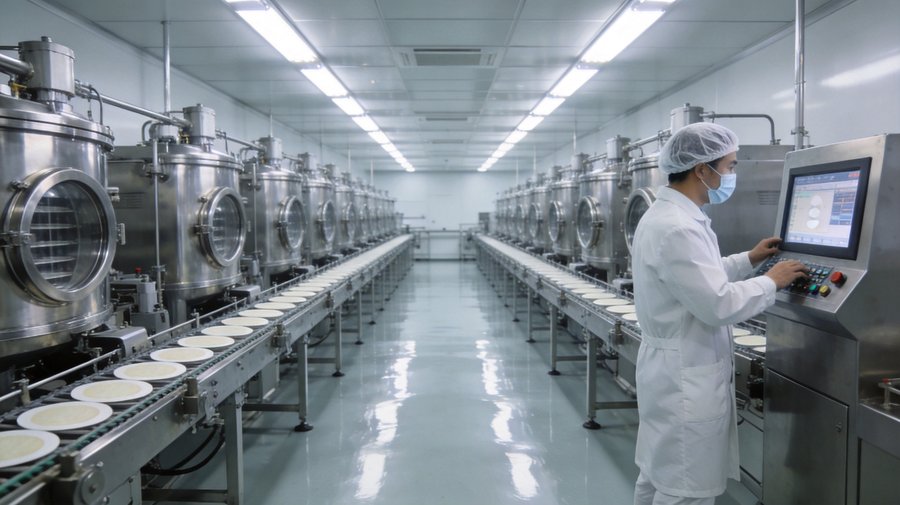
Weitai has spent over a decade building depth in active collagen and lyophilized powders: 13 freeze-dryers, daily capacity of 1 million pairs of lyophilized powder vials and 1 million sheet masks, three cosmetics production bases plus one ingredient and freeze-drying base, with both ISO 22716 and US GMPC systems fully operational. These hard foundations carry real value in a standards upgrade cycle. The tightened cleanroom controls, microbial limits, and testing capability requirements are reinforcement for factories already running within such systems, and a barrier for small factories outside them.
For clients doing franchise programs, exclusive salon-line customization, and limited-brand spot goods, a factory's compliance depth converts directly into peace of mind after products hit the market. Brands do not need to memorize regulatory clauses, but they can feel it: whether products delivered by this factory file smoothly, hold up in sampling, and stay trouble-free after launch.
The standards system is upgrading, and so is the competitive logic of the contract manufacturing industry. Capacity and pricing are the entry ticket; R&D responsiveness and compliance capability decide who stays.
FAQ
Q: Which standards were reviewed at the third 2026 directors' meeting of the NMPA Cosmetics Standardization Technical Committee?
A: The meeting was held in Beijing on August 27, 2026, reviewing nine standard development and revision projects including mandatory national standards for cosmetics. The official release did not list the specific names and numbers of all nine standards; the NMPA's formal announcements will prevail. The meeting also heard progress reports on 2026 key work from the committee secretariat and its sub-committees, confirming the direction of systematically upgrading the cosmetics standards framework and accelerating foundational safety standards during the 15th Five-Year period. Source: NMPA official website, August 27, 2026.
Q: When does GB 7916-2026 "General Safety Requirements for Cosmetics" take effect, and what are the main changes?
A: The mandatory national standard was published on August 6, 2026 and takes effect on January 1, 2028, repealing the 1987 "Hygienic Standard for Cosmetics." Main changes include: repositioning from a "hygienic standard" to a "safety standard"; microbial limits for children's cosmetics and eye-area and lip products 10 times stricter than for regular products; itemized limits for heavy metals including lead, arsenic, mercury, and cadmium; categorized limit management for aerobic plate counts; and new requirements on storage, transport, and standard implementation. Cosmetics already produced or imported before implementation may be sold through their shelf life.
Q: What does YY/T 10006-2026 "Guidelines for Cosmetics Product Standards" mean for contract manufacturers?
A: The industry standard was published on August 24, 2026 and takes effect on January 1, 2027. It unifies the drafting framework for cosmetics product standards, requiring elements such as raw material requirements, technical indicators, testing rules, net content, labeling, shelf life, and packaging, transport, and storage, with clearly defined category boundaries. Contract manufacturers should review and refine their product execution standards accordingly, especially for emerging categories like lyophilized sheet masks and no-rinse cleansers, to avoid filing or sampling issues caused by ambiguous category definitions.
Q: Which categories are in the 2026 cosmetics standards project plan?
A: The project plan announced by the NMPA in April 2026 includes 27 standards covering ingredient standards, product standards, and test method standards. Product standards include two emerging categories: lyophilized sheet masks and no-rinse cleansers. Ingredient standards cover hair dyes, preservatives, N-acetylneuraminic acid, and others; test method standards cover determination of multiple components in cosmetics and toothpaste. In addition, six hair dye ingredient standards are planned for introduction through standard conversion, and the list of approved hair dyes is expected to expand beyond the current 72.
Q: What exactly is the three-tier structure of the cosmetics standards system?
A: According to the draft "Administrative Measures for Cosmetics Standards" released in June 2026, cosmetics standards are structured in three tiers: first, mandatory national standards, defining general technical requirements that protect personal health and safety; second, the cosmetics safety technical specifications, serving a dynamic updating function and covering mandatory technical requirements not yet covered by mandatory standards; third, cosmetics industry standards, which are voluntary and supplement technical details on ingredients, packaging, and efficacy evaluation. Once cited by regulations or mandatory standards, the cited content becomes enforceable. Enterprises are encouraged to adopt enterprise standards stricter than mandatory national standards.