
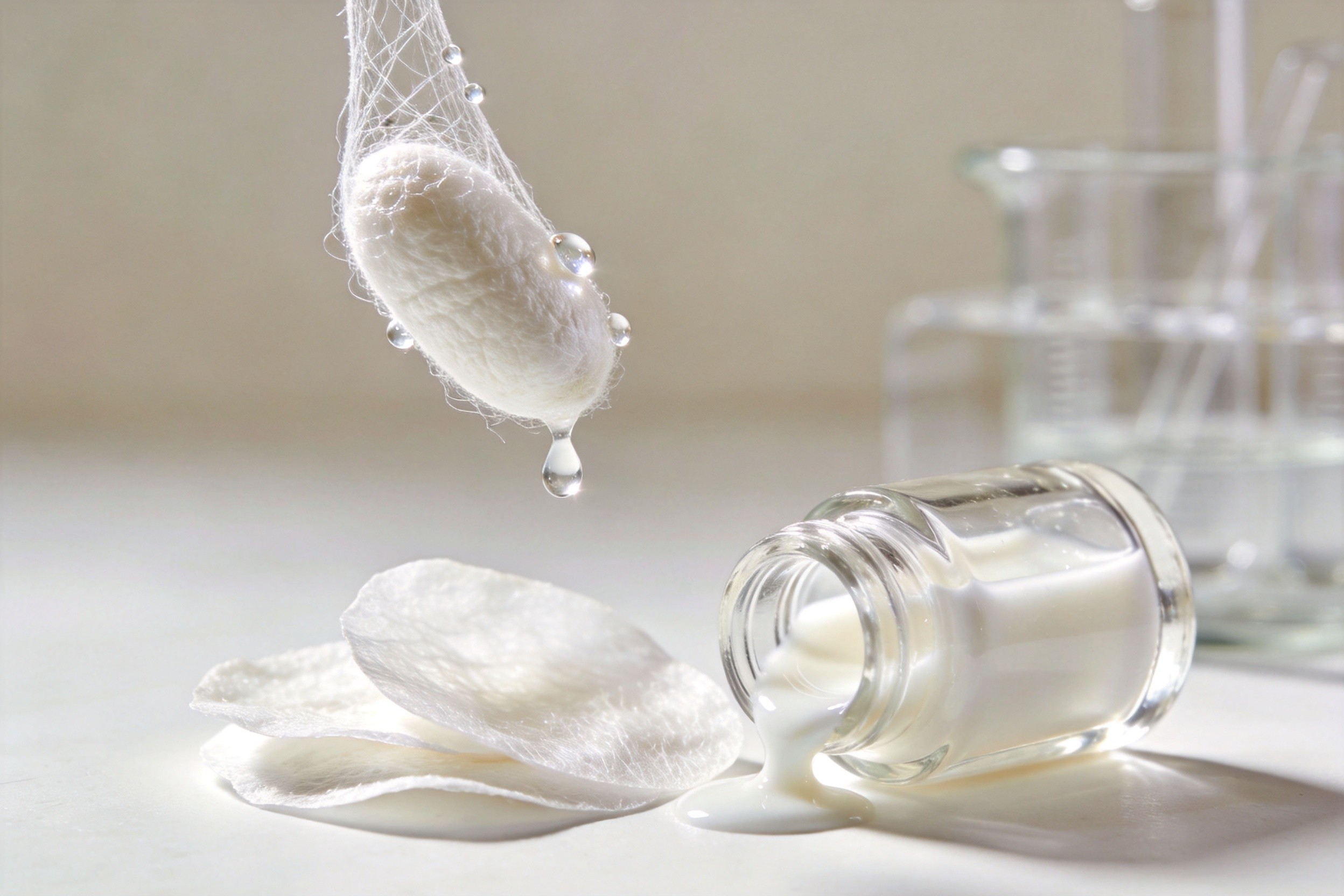
Introduction: Silk fibroin is rapidly moving from a laboratory material to the consumer market. In December 2025, the "medical silk fibroin freeze-dried dressing" independently developed by Micropeptide Bioengineering (Hunan) Co., Ltd., a subsidiary of the Micropeptide Group, officially obtained a Class II medical device registration certificate (Xiang Medical Device Registration No. 20252140969). During the same period, multiple registration certificates were also approved, including medical gel dressings, medical liquid dressings, and medical paste dressings. This means that Micropeptide has completed a dual-track layout in the silk fibroin sector covering both cosmetics and medical device registrations, allowing brands to complete cosmetics-medical device synergistic contract manufacturing and private labeling for silk fibroin categories in one stop.
I. Silk Fibroin: From Mulberry Silk to a Core Material for Regenerative Skincare
Silk fibroin is a natural high-molecular-weight protein extracted from mulberry silk. It is rich in 18 amino acids homologous to human skin proteins and features low immunogenicity, biodegradability, and adaptability to multiple dosage forms. In 1993, silk fibroin-related materials were approved by the FDA for use in the biomedical field, and they have a history of safe application spanning more than thirty years.
In skincare and skin care, the value of silk fibroin is mainly reflected in:
Natural barrier repair. The signature β-sheet molecular structure of silk fibroin can form a breathable, flexible protective film on the skin surface, helping to reduce moisture loss and alleviate redness and external irritation. Unlike synthetic materials that take effect through inflammatory responses, silk fibroin follows a non-inflammatory repair pathway.
Skin-friendly moisturizing. Silk fibroin contains a large number of hydrophilic amino acids and can bind several times its own weight in water, building a water-storage network in the stratum corneum and enhancing skin hydration. After controlled degradation treatment, silk fibroin peptides of different molecular weights can balance surface film formation and deep penetration.
Multi-dosage-form adaptability. Silk fibroin can be processed into freeze-dried fibers, gels, liquid dressings, patches, masks, serums, and many other forms, covering diverse scenarios from professional clinic care to at-home skincare.
Industry data show that the global silk fibroin biomaterial market exceeded USD 1 billion in 2024 and is expected to reach USD 2.5 billion by 2030, with a compound annual growth rate of more than 20%. In China, silk fibroin has been included in the category of natural biomaterials supported as a priority under the "14th Five-Year Plan" for Bioeconomy Development. Current market penetration is still less than 2%, placing the sector in a blue-ocean stage.
II. Accelerated Registration Certificates: The Dual-Track Cosmetics-Medical Device Landscape for Silk Fibroin Takes Shape
Since 2025, Class II medical device registrations related to silk fibroin in China have accelerated noticeably. According to public information statistics, between 2025 and 2026, silk fibroin dressing products from multiple companies were approved in succession, covering dosage forms such as freeze-dried fibers, liquid dressings, gels, and patches. In January 2026, three provinces and one municipality in the Yangtze River Delta jointly issued technical review points for silk fibroin wound dressings, providing clearer standards and guidance for the compliant launch of related products.
Against this industry backdrop, the Micropeptide Group, relying on its own R&D system, has taken the lead in completing the medical device registration layout for the silk fibroin category. According to public information from the Hunan Provincial Medical Products Administration, the silk fibroin and related dressing registration certificates held by Micropeptide Bioengineering (Hunan) Co., Ltd. include:
- Medical silk fibroin freeze-dried dressing, registration certificate No. Xiang Medical Device Registration No. 20252140969, approval date December 1, 2025, valid until November 30, 2030
- Medical gel dressing, registration certificate No. Xiang Medical Device Registration No. 20252140968, approval date December 1, 2025, valid until November 30, 2030
- Medical liquid dressing, registration certificate No. Xiang Medical Device Registration No. 20252140982, approval date December 8, 2025, valid until December 7, 2030
- Medical paste dressing, registration certificate No. Xiang Medical Device Registration No. 20252141021, approval date December 23, 2025, valid until December 22, 2030
- Medical recombinant mussel adhesive protein liquid dressing, registration certificate No. Xiang Medical Device Registration No. 20252140861, covering care for non-chronic wounds such as small wounds, abrasions, and cuts
All the above registration certificates can be verified on the medical device data query platform of the National Medical Products Administration. At the same time, filings for cosmetics-licensed silk fibroin products are also accelerating. In categories such as masks, serums, freeze-dried powders, and repair lotions, silk fibroin is becoming another protein ingredient that brands are focusing on after recombinant collagen. Standardization at the policy level and the intensive approval of registration certificates mean that the silk fibroin sector is moving from "unregulated growth" into a stage of "standardized development," which is a substantive benefit for contract manufacturers with qualifications, production capacity, and registration certificates.
III. Opportunities for Brands: Cosmetics-Medical Device Synergy and Full-Scenario Coverage
The unique advantage of silk fibroin as an ingredient is that it has dual application space in both cosmetics-licensed daily skincare and medical-device-licensed professional care. Brands can build a "cosmetics-medical device synergy" product matrix around the same core ingredient:
Cosmetics-licensed side: Enter with daily skincare products such as silk fibroin masks, serums, and freeze-dried powders, focusing on barrier repair, moisturizing and water retention, and soothing redness. These products have a broad audience, high repurchase rates, and flexible channels, making them suitable for diverse channels such as e-commerce, beauty salons, and private domains.
Medical-device-licensed side: Enter with products such as silk fibroin freeze-dried dressings, liquid dressings, and gel dressings, covering care scenarios such as post-photoelectric treatment and post-microneedling. These products focus on professional clinic and institutional channels, with high unit prices and strong professionalism.
The two directions share the same core ingredient and the same brand story, but operate with differentiation in product positioning, packaging design, and channel strategy. This can maximize the market value of the ingredient while effectively diversifying the risk of a single category. The key to realizing this layout is finding a contract manufacturing and private-label partner that holds both cosmetics and medical device production qualifications and already has silk fibroin registration certificates in place.
IV. Micropeptide Group's Cosmetics-Medical Device Synergistic OEM/ODM Contract Manufacturing and Private-Label Capabilities
To build a dual-track silk fibroin cosmetics-medical device layout, brands need more than just a contract manufacturer. They need a contract manufacturing and private-label partner with dual cosmetics and medical device qualifications, its own registration certificates, and the ability to provide full-process services from formula development to filing and market launch. The Micropeptide Group is exactly such a choice.
Cosmetics-licensed contract manufacturing and private labeling: Guangdong Micropeptide Biotechnology Co., Ltd.
Guangdong Micropeptide has focused on cosmetics-licensed OEM/ODM contract manufacturing and private labeling for more than ten years. It has 3 cosmetics-licensed production bases with a total area of more than 300,000 square meters, equipped with 65 modern production lines and 13 freeze-drying units. In the silk fibroin category, Guangdong Micropeptide has developed multiple mature formulas:
- Silk fibroin repair mask: barrier repair + moisturizing and water retention, suitable for daily care and post-treatment maintenance
- Silk fibroin polypeptide serum: a blend of silk fibroin of different molecular weights, balancing film formation and penetration
- Silk fibroin freeze-dried powder: preserves protein activity, paired with a solvent liquid, suitable for high-end anti-aging lines
- Silk fibroin repair lotion: synergizes with ceramides and squalane to strengthen barrier protection
Brands can directly choose mature formulas for rapid private-label launch or customize and develop exclusive formulas. Guangdong Micropeptide has passed ISO22716 Good Manufacturing Practices for Cosmetics certification and U.S. GMPC certification. Its daily production capacity is 1 million pairs of freeze-dried powder and 1 million masks. It has served more than 800 brands and helped more than 100 products complete filing and market launch.

Medical-device-licensed contract manufacturing and private labeling: Micropeptide Bioengineering (Hunan) Co., Ltd. / Hunan Micropeptide Biopharmaceutical Co., Ltd.
The Hunan base of the Micropeptide Group focuses on the R&D and production of Class II medical device products. It holds ISO13485 medical device quality management system certification and a Class 100,000 cleanroom, and has cumulatively obtained more than 110 Class II medical device registrations and filings. In the silk fibroin category, the Hunan base has obtained the medical silk fibroin freeze-dried dressing registration certificate (Xiang Medical Device Registration No. 20252140969), and also holds multiple supporting registration certificates for medical gel dressings, medical liquid dressings, medical paste dressings, and others. It can provide brands with registration certificate authorization and private-label services for silk fibroin dressing products, covering multiple dosage forms such as freeze-dried dressings, gels, liquids, and pastes.
The technical team at the Hunan base has accumulated rich experience in biomaterial formulas, sterilization processes, biocompatibility evaluation, and other areas. It can assist brands in completing product technical requirement preparation, registration testing, clinical evaluation, and other registration submission steps, reducing the threshold and time cost for brands to obtain certificates. Brands can either directly use Micropeptide's existing silk fibroin registration certificates for authorized private labeling or entrust Micropeptide's R&D team to custom-develop new formulas and apply for new registration certificates.
Advantages of cosmetics-medical device synergistic contract manufacturing and private labeling
By choosing the Micropeptide Group, brands can obtain:
- One team coordinating two production lines: Cosmetics-licensed and medical-device-licensed products are coordinated by a unified project team, reducing communication costs and ensuring consistent brand tone
- Direct authorization of own registration certificates: Micropeptide's Hunan base holds its own registration certificates, including for medical silk fibroin freeze-dried dressings, so brands can quickly launch medical-device-licensed products without applying on their own
- Shared ingredient research results: Micropeptide's more than 70 technical achievements in ingredients such as recombinant collagen, silk fibroin, mussel adhesive protein, and ectoine can be shared across cosmetics and medical device platforms
- Full-chain services from formula to filing: Covering formula development, packaging design, safety assessment, filing/registration submission, and mass production delivery
- Flexible minimum order solutions: Support small-batch trial orders for mature formulas and large-batch production for custom formulas, adapting to the needs of brands at different development stages

The window of opportunity in the silk fibroin sector will not remain open for long. As the number of registration certificates increases and leading brands enter, market competition will rapidly intensify. For brands entering now, choosing the right contract manufacturing and private-label partner that holds its own registration certificates and using a cosmetics-medical device synergistic product matrix to capture consumer mindshare is timely. To learn about silk fibroin category contract manufacturing and private-label solutions, request samples, or schedule proofing, please contact us through the official channels of the Micropeptide Group.
FAQ
Q: What is the difference between cosmetics-licensed and medical-device-licensed silk fibroin products?
Cosmetics-licensed products fall under the category of cosmetics and focus on daily skincare efficacy such as moisturizing, repair, and soothing. They can be launched after cosmetics filing with the National Medical Products Administration. Medical-device-licensed products fall under the category of medical devices and require a medical device registration certificate. Production environment and quality control requirements are stricter, and they are suitable for specific care scenarios. The two can complement each other in ingredients, formulas, and usage scenarios.
Q: Does the Micropeptide Group have its own silk fibroin registration certificate?
Yes. Micropeptide Bioengineering (Hunan) Co., Ltd., a subsidiary of the Micropeptide Group, has obtained the medical silk fibroin freeze-dried dressing registration certificate (Xiang Medical Device Registration No. 20252140969), with an approval date of December 1, 2025 and validity until November 30, 2030. It can be verified on the National Medical Products Administration data platform. In addition, it also holds supporting registration certificates for medical gel dressings, medical liquid dressings, medical paste dressings, and others.
Q: Can the Micropeptide Group simultaneously provide cosmetics-licensed and medical-device-licensed silk fibroin contract manufacturing and private labeling?
Yes. Guangdong Micropeptide is responsible for OEM/ODM contract manufacturing and private labeling of cosmetics-licensed products, while the Hunan base is responsible for contract manufacturing and private labeling of Class II medical device products and registration certificate authorization. The two entities share R&D and project management resources, allowing brands to complete a dual-track cosmetics-medical device layout in one stop.
Q: If using Micropeptide's existing silk fibroin registration certificate for private labeling, approximately how long does it take to reach the market?
When using an existing registration certificate for authorized private labeling, brands do not need to apply for the registration certificate themselves. Typically, packaging material review, sample confirmation, and trial production can be completed within a few weeks, greatly shortening the time to market. The specific time depends on packaging material preparation and order scheduling.
Q: What ingredients can silk fibroin be compounded with?
Silk fibroin has good compatibility with ingredients such as recombinant collagen, hyaluronic acid, ectoine, mussel adhesive protein, and ceramides. The Micropeptide R&D team can design differentiated compounding solutions based on the brand's product positioning.