

Efficacy Skincare Industry Faces Repeated Quality Control Tests: From Packaging Migration to Ingredient Labeling, Contract Manufacturing Quality Systems Face a New Round of Reshuffling
Since 2026, the cosmetics industry has seen a series of quality disputes—from third-party testing agencies detecting migration of prohibited substances from packaging materials, to significant discrepancies between measured and labeled concentrations of active ingredients, to customs in some regions reporting products containing prohibited raw materials. These incidents appear to be individual cases, but they collectively point to a deeper issue: the efficacy skincare industry is undergoing a painful transition from "ingredient marketing" to "full-chain compliance."
For OEM/ODM contract manufacturers positioned in the middle of the industry chain, these incidents are not only industry warnings but also a comprehensive review of their own quality control systems.
Incident Review: Common Issues Behind Two Testing Controversies
Incident 1: Prohibited Substance Detected in Packaging Materials
In July 2026, a well-known domestic third-party testing agency submitted 16 products from an international efficacy skincare brand for testing, and 5 bottles were found to contain the industrial rubber vulcanization accelerator 1,3-diphenylguanidine (DPG), with the highest content reaching 2.8 mg/kg. Traceability analysis pointed to the rubber dropper packaging used in the products. After comparative testing of another 24 skincare products containing rubber droppers, only this brand's products were found to contain the substance. Notably, the brand's parent company is a top-tier international cosmetics group, which completed the acquisition of the brand for approximately US$1.7 billion in 2024.
According to media reports such as Sohu News, based on toxicological formulas, the detected amount is not expected to cause direct harm to the human body for now, but 1,3-diphenylguanidine, as a rubber industry vulcanization accelerator, is not in the permitted raw materials list of the Cosmetic Safety Technical Specifications (2015 edition) and should not appear in cosmetic packaging materials that come into direct contact with skin.
Incident 2: Controversy Over Ingredient Concentration Labeling
In the same evaluation, a serum product from the brand named "10% Hexapeptide" was tested and found to have an actual concentration of acetyl hexapeptide-8 (Argireline) far below the level implied by the label. The brand later responded that "10%" was a product nickname referring to the concentration of the hexapeptide raw material solution, not the concentration of the active peptide itself.
This incident sparked widespread discussion in the industry. Some industry insiders pointed out that labeling based on raw material group concentration rather than active ingredient concentration is not uncommon in the industry, similar to the labeling convention for pro-xylane products. However, when a brand uses "high concentration of a single ingredient" as its core selling point, a cognitive gap arises between consumers' understanding of "10%" and the actual meaning of the label, which involves the requirement in the Cosmetic Labeling Management Measures that consumers must not be misled.
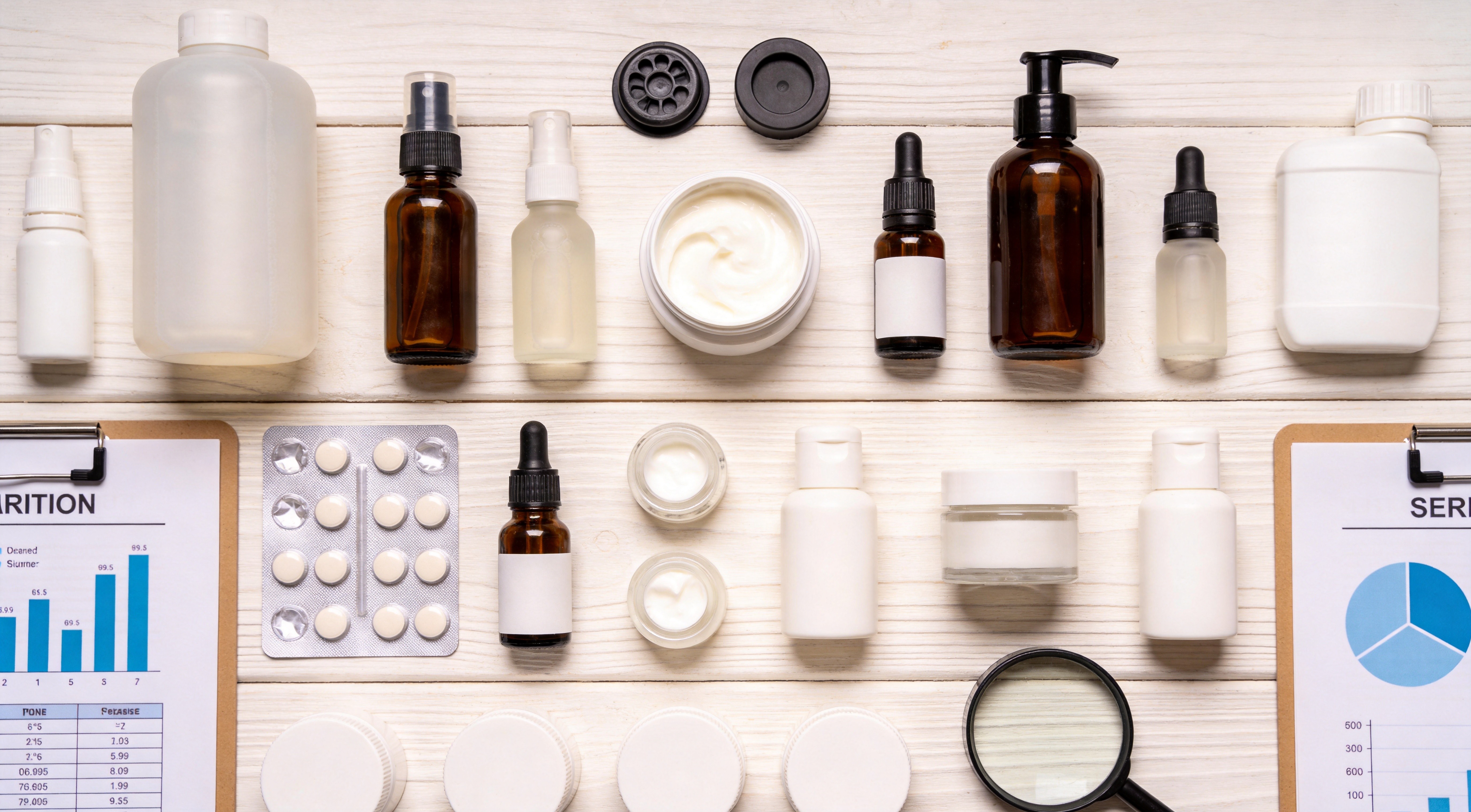
Regulatory Trends: From Terminal Sampling to Full-Chain Traceability
In 2026, regulatory enforcement in the cosmetics industry continues to intensify. The National Medical Products Administration has repeatedly issued announcements on cosmetics quality and safety, increasing investigation and punishment for illegal additions, non-compliant labeling, and false efficacy claims. Since the implementation of the Cosmetics Supervision and Administration Regulation in 2021, the regulatory system has been gradually improved, and industry entry barriers have continued to rise.
A notable trend is that regulatory focus is extending from "finished product sampling" to "full-chain traceability":
• Packaging safety brought into regulatory scope: The Cosmetics Production Quality Management Specifications explicitly require manufacturers to inspect packaging materials that come into direct contact with cosmetics and establish a purchase inspection record system. Packaging is no longer just an "appearance issue" but part of quality and safety.
• Increased transparency requirements for composite raw materials: Some plant extracts and composite raw material groups only list ingredient names during filing, without disclosing the actual formula composition, creating difficulties for brand owners and contract manufacturers in raw material verification. The industry is calling for a more complete raw material information disclosure mechanism.
• Efficacy claim evaluation continues to tighten: The Cosmetics Efficacy Claim Evaluation Specifications require efficacy claims to have sufficient scientific basis. When products use "high concentration" as an efficacy endorsement, the authenticity and verifiability of the concentration will become a regulatory focus.
Four Defense Lines for Contract Manufacturers
The above incidents expose not management oversights of a single company but common shortcomings across the industry in refined supply chain control. For OEM/ODM contract manufacturers bearing production entity responsibility, establishing the following four defense lines has become mandatory:
First: Special Screening of Incoming Packaging Materials
Rubber-based (droppers, sealing rings), silicone-based, and plastic-based packaging containing pigments or dyes are high-risk categories. In addition to routine microbiological and heavy metal testing, contract manufacturers should establish special screening mechanisms for vulcanization accelerators (such as 1,3-diphenylguanidine), plasticizers (such as phthalates), azo dyes, etc. Testing should not rely solely on reports provided by packaging suppliers but should involve independent sampling.
Second: Dual-Track Verification of Incoming Raw Materials
For active ingredient raw materials (such as peptides, collagen, hyaluronic acid, etc.), establish "targeted + non-targeted" dual-track testing. Targeted testing verifies whether the active ingredient content is consistent with supplier specifications; non-targeted screening checks for unconventional prohibited substances and abnormal ingredients. Especially for composite raw material groups, suppliers should be required to provide a complete component list and concentration information, rather than filing based solely on ingredient names.
Third: Concentration Verification Before Finished Product Release
When a product uses a specific ingredient concentration as a selling point, the contract manufacturer should add active ingredient content testing in the pre-release inspection process to ensure that the label claim is consistent with the actual content. This is not only a compliance requirement but also a necessary measure to protect the brand owner and the contract manufacturer from complaints and penalties.
Fourth: Full-Chain Traceability System
Establish a complete traceability chain from raw material batches to finished product distribution. The source, test reports, and storage time of each batch of raw materials, as well as the formula records, production parameters, inspection reports, and outbound distribution of each batch of products, should all be traceable and verifiable. In the event of a quality incident, the problem link can be identified in the shortest time, affected batches locked down, and precise recall initiated.

Industry Implications: Compliance Capability Is Becoming Core Competitiveness
Looking back at industry incidents in recent years, a pattern is easy to see: after every quality controversy, regulatory requirements further tighten, and consumer trust further concentrates on companies with strong compliance capabilities.
For brand owners, the criteria for choosing contract manufacturers are changing—beyond price, capacity, and delivery time, compliance capability is becoming a key consideration. Contract manufacturers with packaging special screening, raw material dual-track verification, finished product concentration verification, and full-chain traceability capabilities will gain favor with more brand owners.
For contract manufacturers, compliance investment is not a cost but competitiveness. The loss from a quality incident—brand recall, administrative penalties, collapse of trust—far exceeds the investment in routine quality control. Establishing a systematic quality defense line is both responsible to consumers and responsible for one's own long-term development.
Take Guangdong Weitai Biotech as an example. As a cosmetics contract manufacturer focused on OEM/ODM processing and private labeling for fifteen years, it has 3 cosmetics license factories and 1 Class II medical device factory, holds 72 patents and more than 100 registration certificates, and has passed the triple system certification of ISO13485 + ISO22716 + US GMPC. From formula development to finished product shipment, it covers categories such as freeze-dried powder, serum, and masks, while also providing limited brand stock exclusively for beauty salon channels and supporting franchise cooperation.
In the second half of the efficacy skincare industry, competition is no longer just about formulas and marketing, but about hard strength across the entire chain from raw materials to packaging, from production to traceability. Whoever turns compliance into competitiveness first will be able to stand firm in the next round of reshuffling.
Frequently Asked Questions (FAQ)
Q1: What is 1,3-diphenylguanidine? Why would it appear in cosmetics?
A: 1,3-diphenylguanidine (DPG) is an industrial rubber vulcanization accelerator mainly used in the production of rubber products such as tires, rubber sheets, and rubber shoes. It is not in the permitted raw materials list of the Cosmetic Safety Technical Specifications. When this substance is detected in cosmetics, it is usually not actively added to the formula but is migration residue from rubber-based packaging (such as droppers and sealing rings).
Q2: Who is responsible for packaging safety issues? The contract manufacturer or the brand owner?
A: The Cosmetics Supervision and Administration Regulation and the Cosmetics Production Quality Management Specifications clearly state that the cosmetics registrant and filer are responsible for product quality and safety, and the entrusted production enterprise should inspect packaging materials that come into direct contact with cosmetics. That is, both the brand owner and the contract manufacturer bear corresponding responsibilities.
Q3: What is the difference between labeling "raw material group concentration" and "active ingredient concentration"?
A: Raw material group concentration refers to the concentration of the raw material solution including solvents, carriers, etc.; active ingredient concentration refers to the content of the pure active substance in the final product. Taking pro-xylane as an example, "30% pro-xylane" usually refers to a 30% raw material group solution concentration, while the actual effective ingredient hydroxypropyl tetrahydropyrantriol concentration is about 9%. Consumers should pay attention to the INCI names and content ranking in the ingredient list when purchasing.
Q4: How can contract manufacturers prevent packaging migration risks?
A: It is recommended that contract manufacturers establish special incoming inspection mechanisms for high-risk packaging such as rubber and silicone, focusing on screening industrial additives such as vulcanization accelerators and plasticizers; at the same time, establish a tiered review system for packaging suppliers, independently verify supplier qualifications and test reports, and not rely on supplier self-reported data.
Q5: How can consumers tell whether ingredient concentrations are genuine?
A: Consumers can check product filing information on the National Medical Products Administration website or the "Cosmetics Supervision" APP and verify the ingredient list. Generally, ingredients are listed in descending order of content, with higher content appearing earlier. For products sold on the claim of "high concentration," consumers can check whether the brand provides third-party test reports as support.